
2026
Semantic Funnel Optimization (SFO): How Personal Injury Websites Turn Search Traffic Into Signed Cases
Most personal injury websites are built backwards. They chase traffic at the top, publish post after post about symptoms and settlements, and watch the sessions climb while the intake calendar stays empty. Traffic is not a funnel. It is the top of one. The pages that actually sign cases sit at the bottom, and whether an injured searcher ever reaches them depends on something most firms never plan: the internal links between their pages. Semantic funnel optimization is the discipline of building those links on purpose.
What is Semantic Funnel Optimization (SFO)?
Semantic Funnel Optimization (SFO) is a content and internal-linking method that structures a personal injury firm’s website to follow the searcher’s real path, from a first symptom search to a signed retainer. It borrows from two families at once. From marketing it takes the funnel: awareness, consideration, decision, and retention. From SEO it takes internal linking and topical authority. The funnel idea is old, and advertising pioneer E. St. Elmo Lewis sketched its stages back in 1898. What is new is the second traveler.
A plain marketing funnel moves one traveler, a person, from awareness to purchase. A semantic funnel moves two at once. The first is the injured person heading toward a consultation. The second is PageRank, the ranking authority a search engine passes from page to page through links. Both follow the same internal links you place. Build them well and you guide a reader and a crawler in one motion.
The four stages an injured searcher moves through
An injured person does not arrive ready to hire. Their questions change over days and weeks, and your pages have to meet them at each step.
Awareness is the widest stage. Someone searches “what to do after a car accident” or “back pain two days after a crash” before the word lawyer enters their mind. Clio’s 2019 Legal Trends Report, a survey of 2,000 legal consumers, found that 57 percent of people looked for a lawyer on their own rather than only through a referral, and among those self-searchers an online search engine and a law firm’s own website tied as the most common starting points. That search happens whether you have built a page for it or not.
Consideration is the middle. Now the claimant weighs whether to act, searching case value, fault, and whether they even need a lawyer at all. The same Clio survey found that 44 percent of clients believe they need to shop around. Your job at this stage is to earn a place inside that comparison set, not just to exist.
Decision is the narrow bottom. The searches turn transactional and local: “car accident lawyer near me,” “free consultation,” a click to call. Clio also found that 42 percent of consumers will not speak to another lawyer once they like the first one they reach. The firm that arrives first and answers cleanly tends to win the case. Retention is the stage most firms forget, where a signed client leaves a review and refers a friend, and where a short follow-up keeps the relationship producing.
Internal linking is the engine, not the housekeeping
Here is the part firms skip. Content without internal links is a set of pages that happen to exist. Internal links are what move both travelers between stages. Google’s own documentation states that every page you care about should have a link from at least one other page on your site, and its 2006 patent on ranking pages by their distance in a web-link graph, US Patent 9,165,040, describes ranking a page by how few clicks it sits from your trusted, high-authority pages. Translated for a law firm: your practice-area pages should be shallow, a click or two from the homepage, never buried six levels deep.
Anchor text matters as much as placement. A link reading “click here” wastes the signal. A link reading “car accident settlement timeline” spends it, because it tells the reader and the search engine what the destination covers. Where the link sits counts too. A link inside your main content carries more weight than the same link dropped into a footer.
Most firms I audit get this exactly wrong. They publish a blog that links only to other blog posts, never to the practice-area pages that sign cases. I once had a firm come to me with 180 published articles and 4 that linked to a single money page. The authority those articles earned pooled at the top of the funnel and drained nowhere. The fix was not more content. It was rerouting the links they already had.
The firms that win keep one habit tight, by contrast. Every symptom guide and settlement explainer links up to the practice-area page it feeds, with an anchor that names that page. That single discipline sends the reader and the ranking authority to the same destination, which is the whole point of a funnel.
Why this matters more now, not less
Answer engines read the same structure. AI Overviews, ChatGPT, and Perplexity all try to understand which of your pages is the authority on a topic and which to cite. The pillar-and-cluster shape and the descriptive internal links that move your funnel are exactly what those systems use to map the relationships between your pages. A funnel built for clarity is already built for machine retrieval. The firms that structure their sites this way now will be the ones AI answers point to later.
Where personal injury funnels leak
A funnel leaks wherever a searcher or a unit of authority reaches a stage and finds no link forward. The same six leaks show up on most sites. Orphan pages with no internal links pointing to them. Awareness content that links only to more awareness content. Thin location pages that duplicate each other and split their own rankings. Practice-area pages whose only inbound links live in the footer. Decision pages with no intake action above the fold. And retention pages that never get built.
The most expensive leak sits at the very bottom. Clio’s 2019 report found that 64 percent of clients had contacted a law firm that never responded, by phone or by email. A funnel that routes a searcher perfectly through every stage and then drops them at an unanswered intake wastes every page before it.
The takeaway for your firm
Semantic funnel optimization is not a new tactic bolted onto your marketing. It is a way of seeing your website as a staged path and treating internal links as the mechanism that moves people through it. Stop measuring your content by traffic and start measuring it by movement: assisted conversions from your guides, clicks from a cluster page to a practice-area page, and cost per signed case over time. Traffic tells you a page is visible. Only movement tells you the funnel is working.
If your site pulls visitors but not cases, the problem is rarely a shortage of content. It is a funnel with no lower half. Build the links, and the cases follow.
Behzad Hussain is a Personal Injury SEO Strategist who builds organic case acquisition systems for competitive personal injury law firms in the United States, the United Kingdom, and Canada. He writes about semantic SEO, topical authority, and organic case acquisition at behzadhussain.me.
About the Author
Behzad Hussain — Personal Injury SEO Strategist
Behzad Hussain is a Personal Injury SEO Strategist, independent researcher, founder and CEO of Rank Brilliance, and creator of the Personal Injury Organic Authority Engine. He helps competitive personal injury law firms build organic case acquisition systems through technical SEO, Semantic SEO, structured data, topical authority, and entity reinforcement.

The Boring Compounding Work That Wins Personal Injury Search, and Why Almost Nobody Sustains It
The least exciting and most true thing I know about winning online in personal injury: the firms that win are almost never the smartest in the room. They are the ones who kept doing unremarkable work after everyone else got bored. I have now audited more than 1,500 of these websites across two published studies, and this piece is the case, with data and mechanism, for the most boring strategy in marketing.
What the audits actually show about winners
Strip my research down to one pattern and it is this: the market’s failures are not intelligence failures. They are persistence failures.
Zero of 1,505 audited sites finished their structural layer. Not because the work is hard to understand; my guides explaining it are free, and none of it exceeds what a diligent team executes in a quarter. The median page-one firm sits at Level 2 of 5, which is the level you reach by starting and stopping. 43 percent never checked one Google Business field for accuracy. The median winner renders in 5.5 seconds because nobody stayed on the number.
Every one of those findings is a monument to abandonment, not ignorance. The market is not out-thought. It is out-waited, by almost nobody, which is why the seats stay empty.
The mechanism: search pays interest on time
The compounding is not a metaphor. It is engineered into the system.
Google holds a patent on ranking with historical data, US 7346839: the age of links, their stability, the accumulated record of a site over time are inputs. Trust, algorithmically, has a clock, and the clock only accrues for assets that exist continuously. Its site quality prediction patent, US 9767157, sets a floor from the site itself; every quarter of real, consistent improvement raises the floor everything else is judged from. And the corroboration machinery, US 8682913, grows confident about an entity the way a person does: through repeated, consistent testimony over time.
Now hold that against how the vertical actually behaves: strategies changed quarterly, sites torn down and rebuilt with every agency change, content programs that sprint for three months and vanish. Each restart resets clocks the firm did not know were running. The industry’s default operating rhythm is precision-engineered to forfeit the exact returns the system pays.
The math this implies is the uncomfortable kind: a mediocre plan sustained for two years beats a brilliant plan restarted four times. I have watched it happen from inside the data, repeatedly.
Why nobody sustains it
Three honest reasons, none flattering to my industry.
It does not photograph well. There is no before-and-after screenshot for patience, no launch party for a maintained foundation. Marketing culture is organized around campaigns because campaigns are sellable moments. Compounding is a flat line that suddenly is not, and nobody bills for the flat part proudly.
The valley precedes the curve. Months two through six of any owned-asset build feel like failure, and there is always a vendor offering to make the feeling stop with something new. The firms that quit in month three, and my conversations suggest that is the modal quitting point, stop precisely where the curve begins.
And nobody owns the continuity. Vendors rotate, and each rotation relitigates the strategy. The one role almost no firm staffs is the keeper of the long game, which is why the long game keeps not being played.
What sustained actually looks like
Not heroics. A rhythm, small enough to survive busy seasons.
One case type covered completely before the next is touched. One real client question answered properly every week. The speed number checked monthly, owned by a named person. The entity record, site, profile, directories, kept in agreement as things drift. A steady cadence of real reviews. And the discipline of not tearing it down when a new vendor arrives with a new deck.
Any competent team can execute every item on that list. Approximately none will still be executing it in eighteen months, and that gap is the entire strategy. The moat is not the work. It is the continuing.
Notice also what the rhythm does not include: nothing viral, nothing seasonal, nothing that depends on catching a wave. Compounding systems are deliberately boring at the input so they can be dramatic at the output, and any plan that promises the reverse has the physics backwards.
I hold my own visibility to the same standard, small useful things published most days, because an advisor who will not run his own advice is selling something else. The account you are reading is the method, demonstrated.
The operating ritual that makes continuity real is almost embarrassingly small: a quarterly hour where someone re-checks the record. The speed number, on a phone, on cellular. What the profile and site currently claim, side by side. Which case type is being finished this quarter and whether last quarter’s is still intact. Four questions, one hour, four times a year. Firms that hold that ritual do not drift, because drift is just the name for what happens between the checks nobody scheduled.
The Sunday question
If you run a firm, the question this piece asks is not whether you understand any of the above. You do; it is not complicated. The question is governance: who at your firm owns the continuing? Not the tactics, the continuing. The person who keeps the clocks accruing across vendor changes, busy quarters, and the eternal temptation of the new thing.
Answer that and the rest is a checklist. Leave it unanswered and the checklist will not matter, which is what 1,505 audited websites are really evidence of.
If you want to know where your firm’s clocks currently stand, my free 90-second Scorecard is the honest starting point: behzadhussain.me. All the research this piece leans on is free at behzadhussain.me
You do not need to be the best. You need to be consistent for longer than competitors who are more talented and less patient. In a field where almost nobody finishes, finishing is the whole edge. See you Monday.
About the Author
Behzad Hussain — Personal Injury SEO Strategist
Behzad Hussain is a Personal Injury SEO Strategist, independent researcher, founder and CEO of Rank Brilliance, and creator of the Personal Injury Organic Authority Engine. He helps competitive personal injury law firms build organic case acquisition systems through technical SEO, Semantic SEO, structured data, topical authority, and entity reinforcement.
Knowledge Panels and the Person Entity: Why Google Increasingly Trusts Attorneys, Not Just Firms, and What My 1,005-Profile Audit Found
The strongest under-used asset in personal injury marketing is not a page. It is a person. In my audit of 1,005 US personal injury attorneys and firms, profiles holding a person knowledge panel indexed at 2.95 times the cohort median for organic traffic, while profiles without one sat at 0.68 times. Google is increasingly organizing trust around recognized people, not just business listings, and almost no firm is competing for it. Here is the mechanism and the playbook.
What a knowledge panel actually is
The panel, the card that appears beside search results for a resolved entity, is not a reward Google hands out. It is a symptom: the visible sign that the machine has gathered enough consistent, corroborated information about an entity to stake a summary on it.
The mechanics are patented and old. US 9268820 defines the panel template itself. US 8682913 describes corroborating facts across multiple sources before trusting them. An entity earns a panel when the open web tells one coherent story about it, repeatedly, from sources the machine respects. No coherent story, no panel, no matter how accomplished the attorney.
That is why nobody can legitimately sell you a guaranteed panel. What can be built is the record that produces one: a definitive home for the facts, and an ecosystem that repeats them.
The numbers: people outperform firms
Two findings from my published research reframe where the leverage sits.
From the Knowledge Panel study across 1,005 attorneys and firms: person-panel holders at 2.95x the cohort median for organic traffic, non-holders at 0.68x. The gap between being a resolved person and being a name on a page is not marginal. It is the difference between multiples.
From the companion Brand Demand Flywheel study across 1,000 firms: brand search demand correlates with organic traffic at 0.41, and person panels associate positively with traffic (+0.179) while business-only panels sit slightly negative (-0.049). Read carefully, this does not say panels cause rankings; I do not claim mechanisms my data cannot support. It says the firms people search for by name, and the attorneys who exist as resolved people, sit measurably ahead of the market on the traffic that matters.
The strategic read: the industry pours everything into the firm listing and treats attorney identity as a bio page afterthought. The data says the afterthought is where the differentiation lives.
Why this matters more in the AI era
Answer engines inherited the entity plumbing. When a machine assembles “who handles truck accidents in this city,” it names entities it can verify, and a verified person, with bar admissions, case-type expertise, publications, and a consistent record, is among the most verifiable things the web contains.
My SERP Authority Report shows how empty this field is in practice: 663 of 1,005 page-one firms are structurally absent, and only 11.1 percent of AI citations on PI queries are on-topic. The answer layer is starving for named, verifiable authorities in this vertical. An attorney built into a resolved entity is precisely the citable object it is looking for, and almost nobody has built one.
The playbook: building a person the machines can resolve
Give the facts one home. One definitive page, typically the attorney’s bio on the firm site, that states the record: full name, role, bar admissions, case-type expertise, education, publications, recognitions. Structured data on that page declaring the attorney as a Person, connected to the firm with worksFor. This is the reference point everything else corroborates.
Make the record deep enough to matter. A photo and a paragraph resolve nothing. Cases, results within bar rules, real publications, real speaking, real credentials, stated plainly. Machines extract entity attributes from text, US 11263400 describes exactly that pipeline, and thin text yields a thin entity.
Then make the web agree. Bar profiles, reputable directories, the firm’s own pages, any coverage: same name, same facts, same expertise, everywhere. Every consistent repetition is a corroborating witness. Every contradiction, an old bio, a stale directory, a name spelled two ways, withdraws confidence exactly where confidence is the currency.
And let the person publish. The attorneys with the strongest entity records share a trait: they exist as sources, not just service providers. Real answers to real questions, under their own name, on the topics they want to own. It is the slowest input and the one that compounds hardest.
Sequence matters here as much as anywhere in my method: home first, depth second, corroboration third, publishing always. Firms that start with directory blasts before the definitive bio exists are corroborating a record that is not there yet, which is how attorneys end up with five conflicting versions of themselves and no panel.
Does every attorney at the firm need this? No, and pretending otherwise is how the project dies of scope. Start with one or two: the named partners the firm is actually built around, or the attorney whose case-type expertise anchors the practice area you most want to own. A firm with two genuinely resolved people outperforms a firm with nine half-built bios, for the same reason one complete case type beats ten thin pages. Corroboration engines reward depth of record, not headcount, and the record compounds fastest where the raw material, real cases, real publications, real standing, already exists.
What not to do
Do not buy shortcuts. Panel-guarantee services sell what cannot be guaranteed, and fabricated corroboration is the exact pattern corroboration engines exist to catch.
Do not build the firm and starve the people. The data ranks that backwards.
And do not confuse claiming with building. Claiming an existing panel is administration. Creating the conditions for one is strategy, and it is months of consistent record-building, not a form.
Both studies behind these numbers are free in full on my research page: behzadhussain.me and behzadhussain.me
The market spent a decade optimizing listings while the machines learned to trust people. 2.95x versus 0.68x is what that gap is currently worth. The attorneys who become resolvable entities in the next two years will be the names the answer layer keeps repeating for the decade after.
About the Author
Behzad Hussain — Personal Injury SEO Strategist
Behzad Hussain is a Personal Injury SEO Strategist, independent researcher, founder and CEO of Rank Brilliance, and creator of the Personal Injury Organic Authority Engine. He helps competitive personal injury law firms build organic case acquisition systems through technical SEO, Semantic SEO, structured data, topical authority, and entity reinforcement.
The 5.5 Second Problem: What Site Speed Actually Costs a Personal Injury Firm at the Moment of Panic Search
The median personal injury firm website on Google page one takes 5.5 seconds to render its main content on mobile. I measured it across 1,005 winning sites in my 2026 SERP Authority Report, and it is the single most expensive number in the dataset, because of when those seconds happen: at the exact moment an injured person, in pain and in a parking lot, decides who to trust. This piece is about what those seconds cost, why winners tolerate them, and the honest fix.
The moment the seconds happen
Speed conversations in marketing meetings are abstract. The moment itself is not.
Someone has just been hurt. They are on a phone, on cellular data, often one-handed, often frightened. They type the query, tap a result, and stare at a white screen while a hero video, three tracking scripts, and an oversized photo of a courthouse negotiate with a weak signal.
They do not file a complaint about your load time. They just leave, tap the next result, and become someone else’s client. The firm never knows it happened. That invisibility is what makes speed the most underpriced problem in legal marketing: every other failure at least generates a signal. This one generates silence.
What the seconds cost, priced honestly
Two ways to price a bounce at the panic moment.
If the click was paid: commercial PI clicks run $100 to $300. A page that loses even a modest fraction of its visitors to latency is burning three-figure bills silently, all day, at precisely the highest-intent moment the firm ever buys.
If the click was organic: the cost is larger and slower. The visitor who left was the compounding return on months of content and authority work, spent at the last step. Slow destinations quietly tax every marketing channel the firm runs, paid and earned alike.
And there is a third cost most owners never hear about: machines price speed before users do. Google holds a patent on predicting site quality from features of the site itself, before any interaction data exists, US 9767157. A heavy, slow, template-bloated site starts at a lower predicted floor, which can suppress crawling and indexation of new pages. You can publish excellent content into a site the algorithm has already pre-judged, and wonder why nothing moves.
Why winners are slow
The strangest part of the 5.5 second finding is the cohort: these are page-one firms. They rank despite the latency, carried by everything else, which teaches three uncomfortable lessons.
Ranking hides rot. Position is not proof of health; it is proof of a weak field. The median winner fails the first impression it paid to earn.
Nobody owns the number. Speed lives between vendors: the designer who chose the theme is gone, the agency optimizes content, the developer bills hourly for tickets nobody files. Every firm in the dataset has a dashboard, and none of the dashboards ring a bell at 5.5 seconds.
Design incentives point the wrong way. Sites are approved in conference rooms on fast wifi and large screens, by people who already know the firm. The approval environment is the opposite of the use environment. What demos well in the boardroom is often exactly what stalls in the parking lot.
The honest fix, without a rebuild
The reflex is to commission a redesign. Usually unnecessary. The bulk of PI site latency comes from a short list of removable weights.
Oversized images shipped at camera resolution. Hero videos autoplaying above the fold. Third-party scripts stacked over years: chat widgets, call trackers, heat maps, pixels for campaigns that ended. Cheap shared hosting under a heavy theme. Render-blocking scripts loaded before content.
An engineering pass on that list, measured on a mid-range phone over cellular, routinely transforms a site while changing nothing a partner would notice in the boardroom. The target I use comes from my own Scorecard’s technical pillar: main content readable in under 1.5 seconds on a mid-range mobile device. Ambitious against a 5.5 second median, and entirely achievable, which is the point.
Measure it honestly: your phone, cellular data, not office wifi, counting until you could actually read and tap. Do it for the homepage and the top three practice pages, because the panic search rarely lands on the homepage at all. Then make one person own that number the way someone owns the trust account, reviewed monthly, in writing. Owned numbers move. Orphaned numbers drift to 5.5.
Speed as strategy, not hygiene
Here is the strategic reframe the median makes possible: in a market where the typical winner fails the first impression, speed is not maintenance. It is differentiation.
The firm that renders instantly at the panic moment is making an argument no billboard can make: we are ready, we are competent, we respect your situation. The client cannot articulate why one site felt trustworthy and the other felt broken. The seconds decided before the words got a chance.
And because the whole cohort is slow, the advantage is available to whoever claims it first, like most of what my audits find. The structural seat, the citation vacuum, the category errors, the 5.5 seconds: the same empty-seat pattern, all the way down.
One extension of the argument, because the render is not actually the finish line: the panic search ends with a human, not a page. A site that loads in 1.5 seconds and routes to an intake process that answers on the fourth ring has moved the latency, not removed it. The firms that convert the moment treat the whole path as one number, tap to trusted human, and engineer every segment of it. Speed of page earns the chance. Speed of response signs the case.
The full report behind the number, including all 11 structural questions and where the 1,005 firms failed them, is free on my research page: behzadhussain.me. The technical guide, for whoever owns the fix at your firm, is at behzadhussain.me
Five and a half seconds is the sound of the market not trying. Under 1.5 is the sound of a firm that decided to.
About the Author
Behzad Hussain — Personal Injury SEO Strategist
Behzad Hussain is a Personal Injury SEO Strategist, independent researcher, founder and CEO of Rank Brilliance, and creator of the Personal Injury Organic Authority Engine. He helps competitive personal injury law firms build organic case acquisition systems through technical SEO, Semantic SEO, structured data, topical authority, and entity reinforcement.
The Four Structural Mistakes Keeping Good Personal Injury Firms Invisible Online
When a good firm cannot understand why it is invisible online, the cause is almost never what the partners suspect. It is not the content budget, the brand, or the agency’s effort. Across more than 1,500 audited personal injury websites, invisibility decomposes into four structural mistakes, all boring, all measurable, all fixable. Here they are, with the data and the mechanisms.
Mistake one: the site never says what it is
Read a typical PI homepage the way a machine reads it and you cannot cleanly tell that this is a law firm, in these specific cities, handling these specific case types. A human squints and infers it from the logo and the gavel photos. Machines do not squint. They move on to a site that made it explicit.
The scale of this one still surprises me: in my 1,005-firm audit of page-one sites, only 35.3 percent declared themselves a legal service in machine-readable form. Two thirds of winners leave their own business identity to guesswork, and in the companion profile audit, 43 percent compounded it by sitting under the wrong Google Business category.
The mechanism is corroboration. Google patented cross-checking facts about an entity across sources, US 8682913, over a decade ago, and the AI answer layer inherited the habit. A firm whose site, profile, and directories all agree is a confident entity. A firm whose own website will not testify is a guess, and machines do not cite guesses.
Mistake two: depth an inch deep
One thin page per practice area. A menu of case types, each behind a paragraph and a call button. It looks like coverage on a sitemap and reads as emptiness to both audiences that matter.
The person searching has twenty real questions. The firm that answers all twenty earns the trust and the call, even when it is the smaller firm. The machine matching concepts, per Google’s semantic patents, US 8577907 among them, maps your pages against the whole topic and finds the gaps immediately.
The median firm in my audit sits at Level 2 of 5 on structural maturity; only 1.3 percent reach Level 4. Thinness is not a laggard problem. It is the market’s default state, top to bottom, which is why one genuinely complete case type is still a differentiator in every metro I have measured.
Mistake three: slow where it matters most
Median mobile render time across the 1,005 page-one firms: 5.5 seconds.
Hold that against the actual user: in pain, on cellular data, in a parking lot, typing with one hand. They are gone before the median winner’s hero image paints. In a vertical where the click that just bounced can cost $100 to $300 at auction, the median firm is running one of the most expensive latency problems in commercial existence, invisibly, all day.
And the cost is not only the bounce. Google patented predicting site quality from the site itself, before any user data exists, US 9767157. Heavy and slow sets a low floor before a single visitor arrives, and can suppress how much of the site gets indexed at all. Speed is not polish. It is admission.
Mistake four: the record contradicts itself
The name is spelled two ways. The old office address survives on a directory. The site says one set of practice areas, the profile another. Each contradiction is small; together they tell every corroborating machine not to be confident about who you are.
Confidence is the currency of both surfaces that now matter: the map pack and the AI answer. In my SERP Authority Report, 663 of 1,005 firms were structurally absent and only 11.1 percent of AI citations on PI queries were on-topic. The vacuum is real, and self-contradiction is how firms volunteer to stay out of it.
A note on how mistake four happens to careful firms: records drift. Profiles accept public edit suggestions. Directories import stale data from each other. An office move updates the website and nothing else. Consistency is not a project you finish; it is a record you keep, and the firms that stay clean simply assigned someone to keep it, checking quarterly what every major surface says about the firm. Unowned records decay toward contradiction on their own schedule.
Why these four persist
None of these mistakes survives contact with attention. They persist because they live in the gaps between vendors: the profile belongs to someone gone, the site to a designer, the content to a retainer, and no dashboard anywhere flags that the pieces disagree. Every failing firm in my dataset had a dashboard that looked fine.
They also persist because they are boring. Nobody sells a rebrand-sized invoice for making a website say what the firm is. The fix does not photograph well. It just works. And boring is exactly what a firm should want here: boring means checkable, checkable means finishable, and finishable is the property none of the exciting proposals on your desk actually have.
The fix, in dependency order
Order matters, because later fixes leak without earlier ones.
First, identity: make the site declare, in valid structured data, what the firm is, where, and who its attorneys are. Days of work, not a redesign.
Second, one case type covered completely. The full question set, one owner per question.
Third, speed on the devices claimants actually use. An engineering sprint, not a mystery.
Fourth, consistency: one story across site, profile, and directories, then kept, because records drift.
I have watched firms keep the same design and the same words, change only this foundation, and change what the phone does. The visible site looked identical. What changed is that the machines, and therefore the clients, could finally understand it.
If you want to know which of the four your firm is living with, my free 90-second Scorecard names the failing pillar: behzadhussain.me. And when you want the full named diagnosis in dependency order, that is the PI SEO Diagnostic, $4,500, 7 to 10 days, refundable until the roadmap is clear: behzadhussain.me
Good work deserves to be found. In this vertical, being found is a structural problem, and structural problems have solutions. Four of them, in order.
About the Author
Behzad Hussain — Personal Injury SEO Strategist
Behzad Hussain is a Personal Injury SEO Strategist, independent researcher, founder and CEO of Rank Brilliance, and creator of the Personal Injury Organic Authority Engine. He helps competitive personal injury law firms build organic case acquisition systems through technical SEO, Semantic SEO, structured data, topical authority, and entity reinforcement.
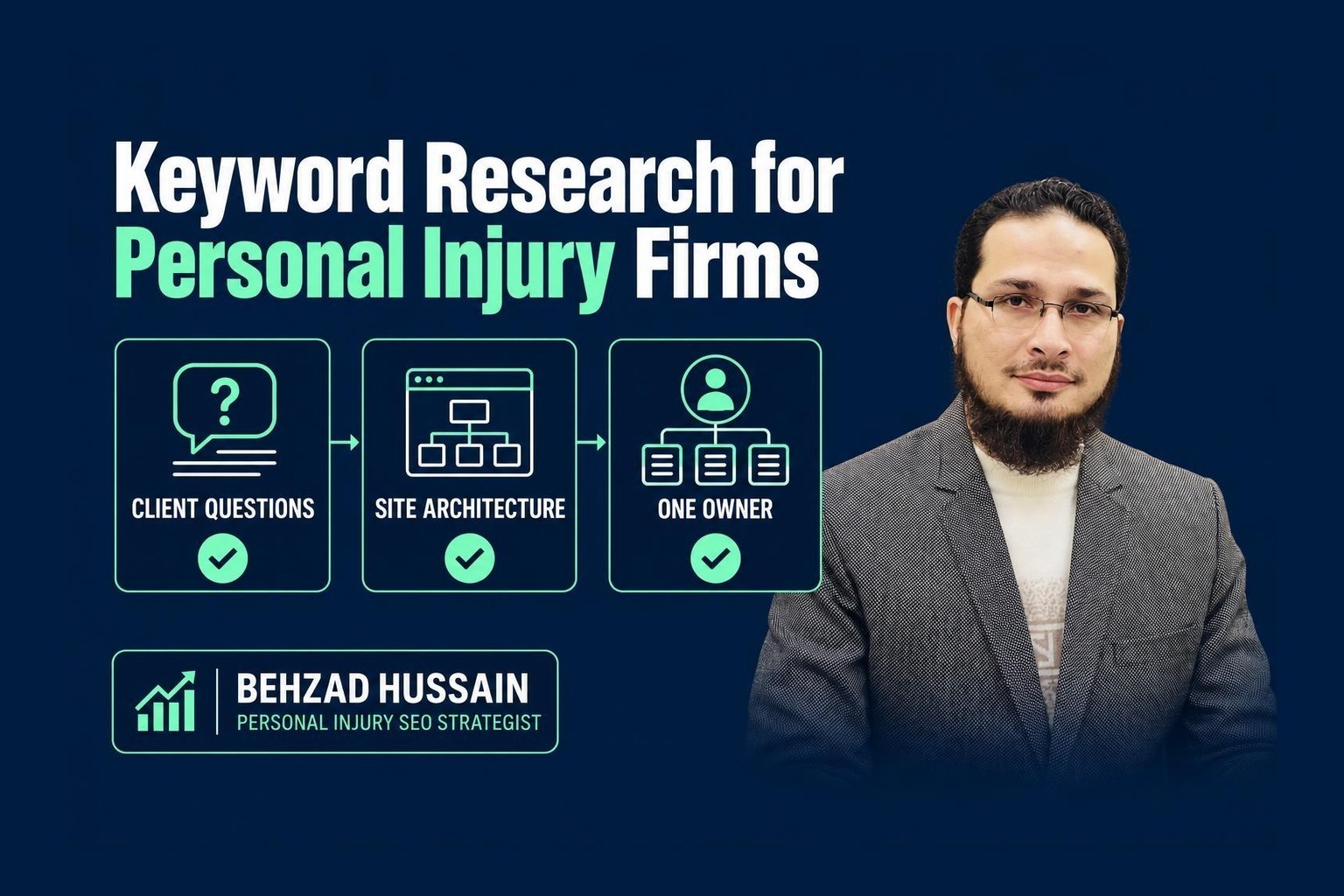
Keyword Research for Personal Injury Firms Is Not a Spreadsheet: The Query Network Method
Keyword research for a personal injury firm is not a list of phrases. It is the mapping of every question a future client asks, before, during, and after an accident, onto a site architecture where each question has exactly one owner. I have run this work for nine years across the US, UK, and Canada, and I have never once handed a client a raw list and called the engagement done. The list is the artifact. The mapping is the work. Here is the method.
Why the spreadsheet model fails
The standard deliverable in this industry is a few hundred rows: phrase, volume, difficulty, a category label. Firms receive it, nod, and invest in content that never converts. The failure is structural, and it has a documented cause.
Google stopped matching strings years ago. Its query classification patent, US 8719249, and its semantic matching patent, US 8577907, describe a machine that reads intent and meaning, then matches concepts. “Car accident lawyer Chicago” is not a keyword to that machine. It is a network: commercial queries from people ready to hire, procedural questions from people mid-crisis, informational questions from people still deciding whether they have a problem, comparison queries from people choosing between firms.
A spreadsheet flattens that network into interchangeable rows. Content built from flattened rows answers nobody in particular, which is why it converts nobody in particular.
The Query Network method, step by step
Harvest from reality first. The best source of queries is not a tool. It is your intake calls, the questions clients say they typed, the phrasings in your reviews. Tools extend the harvest; they do not start it. The panic questions and the embarrassing questions, is this my fault, will I owe money, rarely surface in volume tools at all, and they are where trust is actually won.
Classify by intent, ruthlessly. Every query gets a job: ready to hire, still assessing, just scared. A page built for “ready to hire” reads completely differently from one built for “just scared,” and mixing them loses both readers. This classification is the single highest-leverage step and the one spreadsheets skip entirely.
Score by case value, not volume. In personal injury, volume is a trap. The high-volume informational query may be worth less than a tiny commercial variant that signals a catastrophic injury case. Nine years in: prioritizing intent and case value over raw volume is the difference between traffic and signed cases.
Map one owner per query. Every question in the network gets assigned to exactly one page. This is cannibalization defense, and almost every PI site I audit fails it: four city pages competing for the same query, a blog post fighting its own practice page. When your pages compete with each other, Google resolves the argument by trusting neither.
Screen for compliance. Some phrasings a marketing tool suggests are phrasings a state bar would object to. The screen belongs in the research phase, not after a letter arrives.
Refresh on a cycle. The network moves: new query patterns, new features answering them, new competitors. A map from 2023 is a map of a city that has been rebuilt.
The variant frontier
One more layer matters now that answer engines fan questions into variants before responding: best for owner-operators, after a hit and run, when the driver was uninsured, for a rideshare passenger. These variants are where uncontested territory still exists, because volume-sorted spreadsheets never surface them and almost nobody writes for them. A firm that owns the variants of its chosen case type gets matched, and cited, across the whole fan-out while competitors fight over the head term.
This connects to the coverage finding in my audit data: with only 11.1 percent of AI citations on PI queries going to on-topic pages, the network’s outer branches are essentially unclaimed in every market I have measured.
What this looks like as a deliverable
A real query network map for one case type is not hundreds of rows. It is a structure: the case type at the center, the intent clusters around it, every query assigned to a page that exists or is planned, every page with one job, the compliance screen applied, the refresh date set.
Weeks of work for one case type. Which is why the honest sequencing advice is the same as everywhere in my method: one case type, finished, then the next. A firm that properly maps and builds one network per quarter outruns a firm that buys a 500-row spreadsheet every January.
Which tools should a firm buy for this? The unpopular answer: it barely matters. The mainstream research tools are interchangeable for harvesting, and the harvest was never the bottleneck. The bottleneck is the classification, the mapping, and the discipline of one owner per query, none of which any tool performs. A firm with a spreadsheet from the most expensive platform on the market and no mapping is exactly as lost as a firm with none. Spend the money on the thinking, not the subscription.
The test for your current program
Three questions audit any keyword research your firm has paid for.
Can anyone name the query network your strongest page is supposed to own, by cluster, not by single keyword? Can anyone say which two of your pages currently compete for the same query? And did any of the research come from your own intake calls, or all of it from tools?
If those questions land badly, the research was a list, and the mapping, the actual work, never happened. That mapping is Pillar 2 of my PI SEO Diagnostic: I take your existing pages and your market’s real query networks and name what you own, what you cannibalize, and what you are missing, in dependency order with everything else that is structurally broken. $4,500 fixed, 7 to 10 days, refundable until the roadmap is clear, capped at three per month: behzadhussain.me
The free version of the first question is in my full keyword research guide, no email wall: behzadhussain.me
The firms that win this vertical stopped collecting keywords years ago. They map networks, assign owners, and build. The spreadsheet was never the work.
About the Author
Behzad Hussain — Personal Injury SEO Strategist
Behzad Hussain is a Personal Injury SEO Strategist, independent researcher, founder and CEO of Rank Brilliance, and creator of the Personal Injury Organic Authority Engine. He helps competitive personal injury law firms build organic case acquisition systems through technical SEO, Semantic SEO, structured data, topical authority, and entity reinforcement.
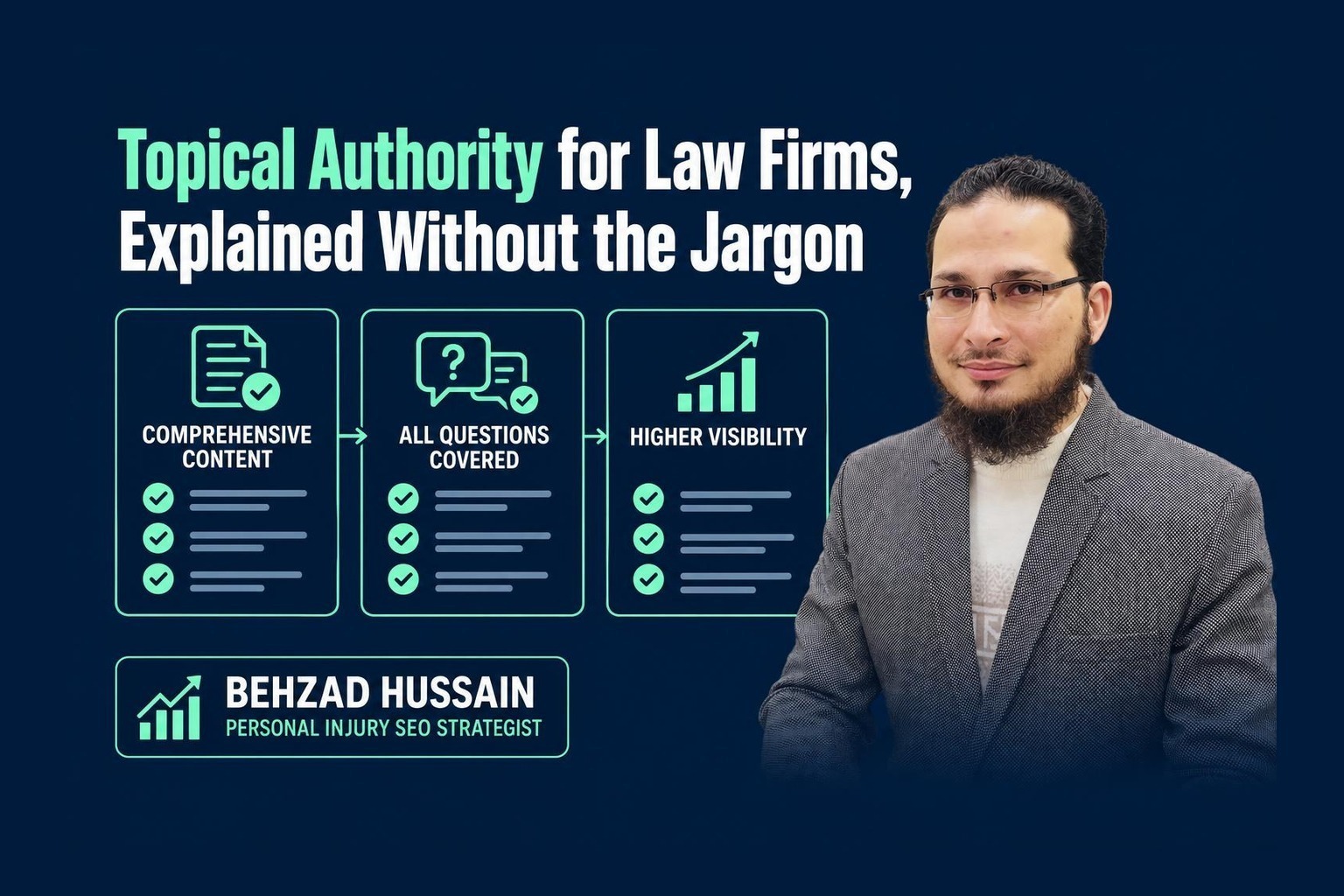
Topical Authority for Law Firms, Explained Without the Jargon: Why One Complete Case Type Beats Ten Shallow Ones
Topical authority is jargon for a simple, checkable state: you have covered a subject so completely that there is no obvious question left unanswered. For a law firm, reaching that state on even one case type changes how people, Google, and AI answers treat you, and my audit data says almost nobody in personal injury has done it. This piece explains the idea in plain English and gives the honest playbook.
The two firms thought experiment
Imagine two firms in the same city.
One has a car accident page. A paragraph, a stock photo, a call button. It says the firm handles car accidents the way a sign says a building exists.
The other has covered car accidents the way a knowledgeable friend would if you could ask them everything. What to do at the scene. Whether you have a case. What it might be worth. How long you have to file. What happens if you were partly at fault. How insurers actually lowball. What the process feels like month by month. Each question answered properly, in plain language, all of it connected.
Now ask which firm knows the subject. You did not hesitate. Neither does the machine. That difference, provable coverage, is the entire concept. Everything else written about topical authority is decoration on this.
Why machines reward coverage
The mechanism is documented, not mystical. Google moved years ago from matching words to matching meanings; its patent on semantic query matching, US 8577907, and its query classification work, US 8719249, describe a system that understands “car accident lawyer” as a concept surrounded by related intents, not a string to find on a page.
A concept-matching machine evaluates whether you cover the concept, not whether you repeated the phrase. One page cannot cover a concept. A connected set of pages, each resolving a real question, can. That is why coverage wins ranking, and it is also why coverage wins the answer layer: AI systems cite the source that resolves the question completely, because incomplete sources force them to keep looking.
My own data shows how little of this exists in personal injury. Across 1,005 page-one firms, the median structural maturity was Level 2 of 5, and only 1.3 percent reached Level 4. Even the winners mostly stand on thin pages and bought traffic. Depth is rare at the top, which is exactly what makes it a strategy rather than table stakes.
The mistake: being everywhere an inch deep
The standard law firm content plan is horizontal: a thin page for every practice area, a blog that orbits randomly, coverage that looks broad on a sitemap and empty to a machine.
Spread that thin, you are the authority on nothing. The searcher with twenty questions finds one answered and leaves. The machine mapping your coverage against the concept finds gaps everywhere it checks. And the competing channels, the directories and off-topic pages that fill my citation data, out-cover you on your own subject. In my SERP Authority Report, only 11.1 percent of AI citations on PI queries went to on-topic pages. The vacuum is not caused by competition. It is caused by thinness, everywhere, including at the top.
The playbook: one case type, finished
The honest strategy is vertical and sequential.
Pick one case type. The one you are genuinely good at, actually want more of, and that people in your market really search for. Not five. One.
Map the real questions. Everything a claimant asks, from the panic questions at the scene to the embarrassing ones they only ask a machine: is this my fault, will I owe money, is it worth calling anyone. Your intake calls already contain this map.
Answer each question properly. One owner per question, front-loaded direct answers, plain language, connected into one structure. This is weeks of work for one case type, which is precisely why it defends itself once built.
Then, only then, move to the next case type. Undeniable at one beats forgettable at ten, and the authority earned on the first makes the second cheaper.
Why small firms should love this
Depth is a decision, not a budget. A solo or small firm cannot outspend the TV advertisers, but it can absolutely out-cover them on one case type, because the giants are structurally committed to being everywhere and finish nothing. My data says even the biggest players in the dataset sit at Level 2. The playing field on completeness is genuinely, unusually flat.
This is also the strategy with the least waste. Horizontal content programs produce pages that never earn their keep. A vertical program produces a compounding asset where every new answer strengthens every existing one, because the machine reads them as one body of coverage.
How long does one case type take to finish? Honestly: weeks of concentrated work to build, months of consistency to compound, and the valley in between is where nearly everyone quits. I will not invent a precise timeline, because the honest answer depends on where your foundation starts. What I can say from the audit data is that the median firm never arrives at all, which means arriving on any timeline puts you in territory your market has left empty.
What to stop doing
Stop measuring content by volume. Thirty thin posts are not thirty assets; they are thirty dilutions. The test for every page: would you send it to a scared client as the single best thing you have on that topic? If not, merge it or delete it.
Stop scattering. A blog post about an unrelated topic because it was in the news does not build your coverage; it advertises your lack of focus to a concept-matching machine.
And stop waiting for permission from the market. The zero-of-1,505 finding in my audits means no firm in your metro has finished this work. The first mover advantage in topical authority is sitting unclaimed, which is the most repeated and least acted-on fact I publish.
The full method, including how this layers into my Personal Injury Organic Authority Engine, is in my free guide: behzadhussain.me. The studies are at behzadhussain.me.
Pick the topic. Answer everything. Then move on. Almost nobody has the patience for the strategy, which is exactly why it still works.
About the Author
Behzad Hussain — Personal Injury SEO Strategist
Behzad Hussain is a Personal Injury SEO Strategist, independent researcher, founder and CEO of Rank Brilliance, and creator of the Personal Injury Organic Authority Engine. He helps competitive personal injury law firms build organic case acquisition systems through technical SEO, Semantic SEO, structured data, topical authority, and entity reinforcement.
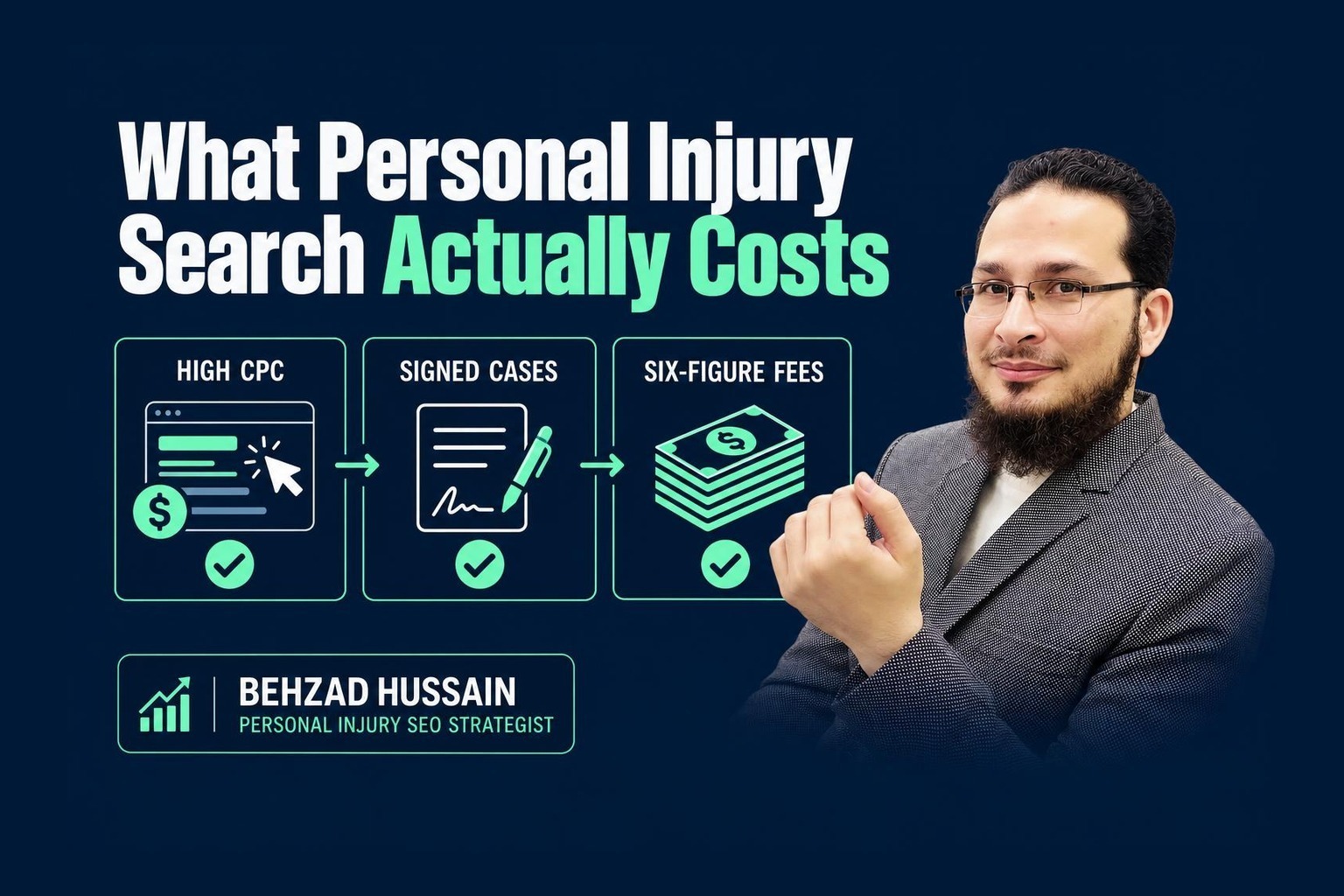
What Personal Injury Search Actually Costs: The Click Economics of the Most Expensive Vertical in Search
Personal injury is the most expensive vertical in search because the unit being fought over is not a click. It is a signed case that can carry a six-figure fee, purchased through clicks priced like nothing else online. Understanding those economics, really understanding them, changes how a firm evaluates every marketing invoice it receives. This piece walks the numbers I use and publish, and the strategic conclusions they force.
The stakes: a $61.7 billion market with 164,000 competitors
The US personal injury market ran $61.7 billion in 2025, contested by more than 164,000 PI attorneys. Those two numbers, which I keep on my own services pages because they frame everything, explain the auction dynamics: an enormous prize, an extremely crowded field, and a client who hires once, urgently, with no loyalty to anyone.
When that many well-funded competitors bid on that valuable and perishable a client, the price of attention goes vertical. And it has.
What the clicks cost
The working figures I publish: commercial personal injury clicks run $100 to $300, and a signed case from paid channels runs $1,000 to $5,500 all-in.
Pause on the click number, because owners hear it and nod without doing the arithmetic. At $100 to $300 per click, a page that converts poorly is not a design problem. It is a furnace. Ten clicks that bounce off a slow, confusing practice page can cost more than a nice dinner for the whole intake team, and they happen silently, all day.
This is why I bang on about the unglamorous foundations. In my audit of 1,005 page-one PI firms, the median mobile render time was 5.5 seconds. At this vertical’s click prices, every second of that delay is among the most expensive latency in commercial existence. The injured person in a parking lot does not wait, and the firm just paid three figures to learn that.
What the cases cost, and the number nobody tracks
$1,000 to $5,500 to sign a case through paid channels is a rational price when a case fee can run five or six figures. The arithmetic works, which is why the whole vertical leans on it.
But most firms cannot actually produce their own version of that number. They know total spend. They rarely know signed cases by channel, because intake attribution is the least loved system in the building. In my Scorecard’s fourth pillar, the case acquisition questions are the ones owners most often answer “not sure” to. A firm that cannot compute its own cost per signed case by channel is negotiating every vendor contract blind, in the most expensive market there is.
If you do one operational thing after reading this: make intake record, for every qualified inquiry, which channel produced it. One field. It converts every future marketing decision from folklore to arithmetic.
The structural discount nobody claims
Here is what the click prices make strange: the expensive auction sits directly on top of an unclaimed structural layer.
Everyone pays for the traffic. Almost nobody finished the foundation the traffic lands on. Zero of the 1,005 page-one firms in my audit completed the structural work that search engines and AI answers read first; 663 were structurally absent altogether. Only 35.3 percent even declare themselves a legal service in machine-readable form.
That mismatch is an arbitrage. Organic visibility in this vertical carries the same effective value as the paid clicks it substitutes for, at $100 to $300 apiece, and compounds instead of expiring. A single practice page that earns even a modest stream of qualified organic visits is doing work that would cost thousands monthly at auction prices. The barrier to that page was never budget. It is the months of unglamorous work nobody sustains, which is exactly why the discount is still on the table.
Reading a marketing invoice with these numbers
Three tests, courtesy of the economics.
The substitution test: for any proposed spend, ask what the same money buys at $100 to $300 a click, and whether the proposal builds anything that outlives the invoice. Some rent is fine. Unlabeled rent is not.
The latency test: before buying more traffic, ask what fraction of the traffic already purchased is being wasted by a page that renders in 5.5 seconds on the device every claimant actually uses. Fixing the destination is the cheapest media buy in the vertical.
The attribution test: any vendor unwilling to be measured in signed cases by channel is asking to be paid in a currency softer than the one you spend. And run it on yourself too: if your own intake cannot produce the channel split, fix that before renegotiating anything, because every conversation downstream of missing data is a guessing game held at auction prices.
Does organic really escape the auction? Not for free, and the honest version of this argument says so. Organic substitutes labor and patience for media spend: months of structural work, complete case-type coverage, and consistency held long enough to compound. The difference is not that organic costs nothing. It is that the auction charges you again every single click, forever, while the built asset charges you once and then pays you, at click values of $100 to $300, for years. Rent is a variable cost that never varies down. The asset is a capital expense the whole vertical keeps refusing to make, which is why the returns on it remain so unreasonable.
The honest conclusion
The click economics of personal injury are brutal and they are not going down. You cannot opt out of the auction entirely, and the firms that thrive do not pretend otherwise. What they do is refuse to rent forever: they use paid channels as a bridge while building the owned asset that the entire market, on the evidence of 1,505 audited websites, has left unbuilt.
Expensive clicks are the tax on an unfinished foundation. The foundation is finishable. Almost nobody has.
My audits and studies behind every figure here are free on my research page: behzadhussain.me. And the 90-second version of “where does my firm sit” is the free PI Authority Scorecard: behzadhussain.me
About the Author
Behzad Hussain — Personal Injury SEO Strategist
Behzad Hussain is a Personal Injury SEO Strategist, independent researcher, founder and CEO of Rank Brilliance, and creator of the Personal Injury Organic Authority Engine. He helps competitive personal injury law firms build organic case acquisition systems through technical SEO, Semantic SEO, structured data, topical authority, and entity reinforcement.
Rented Leads vs Owned Assets: The Three-Year Math Every PI Firm Owner Should Run Before Renewing Anything
Run one comparison before your firm renews any marketing line item: what does three years of this spend leave behind? For rented channels the answer is nothing, and for owned channels the answer compounds. That single difference, not any tactic, is the most consequential marketing decision a personal injury firm makes. Here is the math, laid out the way I wish someone had laid it out for every burned firm owner I meet.
The two models, named honestly
Rented acquisition: Local Service Ads, lead vendors, directory placements, pay-per-click. You pay, cases arrive, you stop paying, cases stop. The platform owns the pipe. You are a tenant.
Owned acquisition: your site’s authority, its complete case-type coverage, its entity record, its accumulated trust. Built slowly, owned outright, and still producing whether or not your card is on file that month.
Neither is evil. The dishonesty is in selling rent as if it were equity, which is most of what this vertical is sold.
Year by year: the rented track
The economics of this vertical make rent uniquely expensive. Commercial personal injury clicks run $100 to $300. A signed case from paid channels runs $1,000 to $5,500. Those are the working figures I publish on my own methodology page, and they are the reason PI is called the most expensive vertical in search.
Month one of the rented track looks great: spend, leads, cases. Month thirty-six looks identical to month one: same spend, same flow, same meter running. That flatness is the product working as designed. Rent does not compound. Stop in year three and you stand exactly where you stood in year zero, minus three years of budget, holding a logo and a folder of reports.
There is also a quieter cost: concentration risk. A firm whose caseload depends on one platform is one pricing change away from a bad quarter it does not control.
Year by year: the owned track
The owned track starts worse. That must be said plainly, because pretending otherwise is how this industry burns people. In the first months, building complete case-type coverage, fixing the structural layer, earning real mentions, the rented pipe outperforms it embarrassingly. This is the stretch where most firms quit and conclude organic does not work.
Then the mechanism turns over. The page built in month three still works in month thirty-six, and works better, because search rewards accumulated history. This is not mysticism; Google holds a patent on ranking with historical data, US 7346839, reading the age and stability of a site’s link record over time. Trust, in the algorithmic sense, has a clock, and the clock only runs for assets that exist continuously. Rented visibility resets to zero every billing cycle. Owned visibility banks time.
By year three the tracks have inverted. The rented firm’s cost per case is unchanged. The owned firm’s cost per case falls every year, because the asset keeps producing without a matching invoice, and every addition builds on paid-off foundations.
Why more firms do not build
If the math is this clear, why does the whole vertical rent? Three honest reasons.
The valley is real. Months two through six of the owned track feel like failure, and there is always a vendor offering to make the discomfort stop.
The incentives are misaligned. An agency billing monthly has no product called “finished.” Activity renews; assets complete. Almost nobody selling to law firms profits from the owned track ending well.
And nobody is accountable for the asset. The profile belongs to a vendor who left, the site to a designer, the content to a retainer. In my audit of 1,005 page-one firms, zero had finished the structural layer, and 663 were structurally absent altogether. Winners, all of them, renting harder instead of building at all.
That zero should not depress you. It means the compounding track is empty in your market. The first firm on it inherits the lead.
The blended answer, and the rule that protects you
The practical strategy is not rent versus own as a religious war. It is rent as a bridge, own as the destination. Keep paid channels filling the pipeline while the asset is built, then let owned volume progressively replace the spend you no longer need. The firms that execute this do not quit paid overnight; they simply watch their reliance on it fall every quarter, by design.
The rule that protects you while blending: every month, some fixed slice of total marketing spend must go to things you would still own if every vendor disappeared tomorrow. If that slice has been zero for years, you are not marketing. You are subscribing.
A note on what “owned” excludes, because vendors blur it: content sitting on a platform you do not control, rankings held up by rented links, profiles owned by an agency login you do not have. If your firm cannot take it with you after a bad breakup, it was rent with better branding. Real ownership survives vendor changes, which is precisely what makes it worth the slower build.
And one question audits any vendor in a single meeting: if we stop paying you, what do we keep? A rented answer is fine, as long as everyone in the room knows it is rent.
Running your own numbers
Take last quarter’s total marketing spend. Divide by signed cases attributable to it. That is your rented cost per case, and against $1,000 to $5,500 industry norms it is probably unremarkable. Now ask what fraction of that quarterly spend created anything that will still exist in three years. That second number, usually zero, is the finding.
For firms ready to build the owned track properly, that is exactly what my PI Authority Growth System does: the four-pillar structural build, executed and operated month over month, $5,000 to $12,000 per month depending on market, one firm per metro, month to month after a 90-day onboarding. One firm per metro means once a firm is in, its direct competitors are locked out of working with me. Details: behzadhussain.me
And if you only do one thing after reading this, run the free 90-second Scorecard so you know what currently exists to build on: behzadhussain.me
Three years from now your firm will have spent the money either way. The only question this piece asks is whether, at the end of it, you own anything.
About the Author
Behzad Hussain — Personal Injury SEO Strategist
Behzad Hussain is a Personal Injury SEO Strategist, independent researcher, founder and CEO of Rank Brilliance, and creator of the Personal Injury Organic Authority Engine. He helps competitive personal injury law firms build organic case acquisition systems through technical SEO, Semantic SEO, structured data, topical authority, and entity reinforcement.
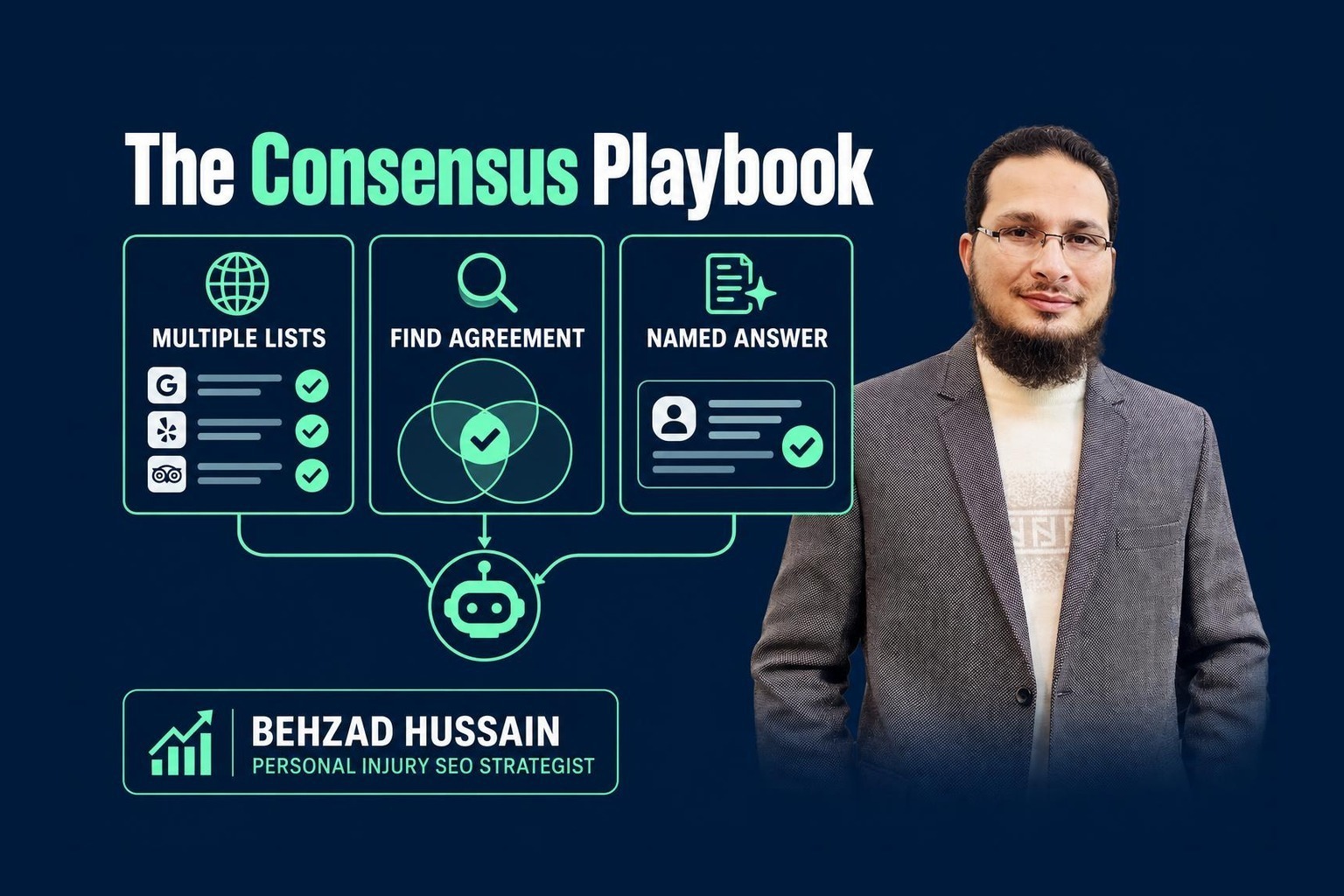
The Consensus Playbook: How List Content Actually Earns AI Citations, and How a PI Firm Gets Named Without Owning the List
When an AI assistant answers “who is the best truck accident lawyer near me,” it does not read one list and copy the winner. It reads many lists and looks for the agreement between them. That single behavior, corroboration over authority, quietly rewrites the rules of list content and of getting your firm named. This piece lays out the playbook: how to write list content machines will cite, and how a personal injury firm earns placements that survive the consensus check.
The mechanism: consensus, not crowns
Classic SEO trained everyone to chase the single authoritative page: rank the list, own the list, be number one on the list. Answer engines broke that model in a specific way. Before naming anyone, they effectively cross-examine sources against each other. A name that appears consistently across independent lists reads as consensus. A name that appears once, loudly, at the top of its own list, reads as advertising.
This is corroboration plumbing, and it is old: Google patented corroborating facts extracted from multiple sources, US 8682913, over a decade ago. The chat interfaces inherited it. What is new is how much content still ignores it. In my 2026 SERP Authority Report on 1,005 page-one PI firms, only 11.1 percent of AI citations on personal injury queries were on-topic pages. The consensus the machines are looking for barely exists in this vertical. That vacuum is the opportunity on both sides of the playbook.
Playbook one: writing list content that machines can cite
If your firm publishes comparison or list-style content, tools for lawyers, case-type comparisons, market guides, five rules decide whether it becomes citable or gets discounted as a brochure. I offer these as practitioner assessment, and they all follow from the mechanism above.
Never crown the subject you are connected to. A list that puts its own author first and calls it the clear winner is exactly the pattern a corroboration engine exists to catch. If your firm belongs in the piece at all, it appears honestly, once, alongside real alternatives.
Admit tradeoffs on every entry. A page where one option wins on price and another on depth reads like evaluation. A page with one perfect option reads like an advert. Every entry gets a “best for” and at least one stated limitation. The admissions are what make the whole page believable, to humans and machines alike.
Use entity-shaped anchors, not keyword-shaped ones. Link text like a firm’s name plus its practice, or a product plus its maker, maps the mention to a thing. Bare money phrases map it to a campaign.
One self-link, maximum. Inside any piece connected to your firm, every additional link back to yourself cheapens the page as a citation. One, where it genuinely serves the reader, is the ceiling.
Write for the query variants, not just the head term. Answer engines fan a question into variants before answering: best for owner-operators, best for small firms, best in a specific county. The variants are where uncontested citations still exist, because almost nobody writes for them.
One hard boundary in my own lane: none of this will ever be used here to rank SEO or marketing vendors. The legitimate subjects are firms, tools lawyers use, and markets.
Playbook two: earning placements as a firm
Now the other side: your firm wants to be the name the consensus supports. Three principles, again as assessment, again downstream of the same mechanism.
Consistency beats power. Several modest placements that say roughly the same thing about your firm, same name, same city, same case-type identity, do more than one placement on a single big-authority site. The machine is not weighing one witness. It is counting agreeing witnesses.
Presence beats position. Being third or fifth across ten independent lists beats being first on one. “Number one” is the position with the least leverage left in it, because a corroboration engine treats any single crown as one vote, and a suspicious one at that.
Your own list has gone soft as a mention driver. The best-of page on your own domain still converts the traffic it gets, but it no longer manufactures the mentions that answer engines count, because the machine knows who wrote it. Mentions now come from being genuinely present across sources you do not control.
What earns those placements honestly: being the firm with the citable data point, the complete resource, the local expertise a list author needs. Every placement must be earnable on the merits. Consensus mechanics never justify fabricated lists or purchased inclusion, which, beyond the ethics, is precisely the pattern the machinery is built to discount.
The corroboration audit
Before chasing new placements, check whether the placements you already have agree with each other. The witnesses only count if their testimony matches: same firm name everywhere, same locations, same case-type identity, a website whose structured data confirms all of it. In my audits, most firms fail this before they fail anything else. Only 35.3 percent of page-one PI firms even declare themselves a legal service in machine-readable form, which means for two thirds of the market, the corroboration chain is broken at its first link, their own site.
Fix the chain in order: your site declares it, your profiles repeat it, then external placements multiply it.
One more test worth running before publishing anything in this format: read your draft as a skeptical machine would. Count how many times the piece links to you, note whether any entry admits a real limitation, and check whether the winner would survive an author swap. If a stranger wrote this exact page, would the conclusions stand? A yes means you wrote evaluation. A no means you wrote an advert wearing a list’s clothing, and both audiences will treat it accordingly.
What I would do this quarter
Publish one genuinely honest comparison resource in your niche, following the five writing rules. Pursue five modest, consistent, earnable placements rather than one trophy. And run the corroboration audit before either, because agreement is the currency and most firms are contradicting themselves before anyone else gets a vote.
The full research behind the citation vacuum is free on my research page: behzadhussain.me.
The machines stopped asking who shouts loudest and started asking who the record agrees on. In a market where 88.9 percent of the record is off-topic noise, a firm that simply gets its story straight, everywhere, is further ahead than it has any right to be.
About the Author
Behzad Hussain — Personal Injury SEO Strategist
Behzad Hussain is a Personal Injury SEO Strategist, independent researcher, founder and CEO of Rank Brilliance, and creator of the Personal Injury Organic Authority Engine. He helps competitive personal injury law firms build organic case acquisition systems through technical SEO, Semantic SEO, structured data, topical authority, and entity reinforcement.
How Injured People Find Lawyers in the AI Answer Era, and What Decides Which Firms Get Named
The search result used to be a list, and the injured person used to do the comparing. Increasingly, the result is an answer: a short written response with a small number of firms and sources woven in, assembled by a machine before the person ever sees a blue link. Which firms get woven in is not random, not purchased, and not decided by the marketing budget. It is decided by verifiability, and my data says almost nobody in personal injury is competing for it yet.
The shift, without the hype numbers
I will not quote adoption percentages here, because the ones circulating are vendor folklore I cannot verify. The shift itself does not need them. Open any AI assistant and ask the questions injured people ask: is this worth a lawyer, what is my case worth, how long do I have, who handles truck accidents in my city. You get answers, with names in them. That interface exists, it is where the low-judgement first questions increasingly go, and the firms named in it meet the client before any list of links does.
Two things make this matter more in personal injury than almost anywhere else. The client typically hires once, in distress, with no prior relationship: whoever is trusted first holds an enormous advantage. And the questions asked earliest are the embarrassing ones people prefer asking a machine: am I overreacting, is this my fault, will I owe money if I lose. The firm whose content answers those honestly becomes a trusted name before a single human conversation happens.
What the machines actually cite on PI queries
Here is the firsthand number. In my 2026 SERP Authority Report, built on an 11-question structural audit of 1,005 page-one personal injury firm websites, I examined what AI search features cite on personal injury queries.
Only 11.1 percent of those citations were on-topic pages.
Sit with that. When the answer layer assembles a response about injury law, roughly nine of every ten sources it leans on are not even about the subject. Not competitor firms out-competing you. Off-topic pages, filling a vacuum, because the firms that should own those citations built nothing citable.
The same report found 663 of the 1,005 firms structurally absent altogether: no meaningful machine-readable identity at all. The answer layer is not biased against law firms. It is starving for law firms it can safely name.
How an answer engine decides whom to trust
The mechanics are older than the chat interfaces, and documented.
Google patented corroborating facts extracted from multiple sources, US 8682913, over a decade ago: a machine checks what the web agrees about you before trusting any single claim. It patented the knowledge panel template, US 9268820, the structured card that marks an entity the system has resolved with confidence. The AI answers inherited this plumbing wholesale. They name entities they can verify and skip entities they cannot, no matter how good the verdicts behind the website are.
So the question deciding your firm’s presence in the answer layer is concrete: is your firm a resolved, consistent, corroborated entity? Does your site declare what you are in machine-readable form, do your profiles agree, do trusted sources repeat it? In my audits, the answer for most of the market is no. Only 35.3 percent of page-one firms even declare themselves a legal service in structured data.
What gets a firm named, in practice
From my published ChatGPT guide, the work reduces to four disciplines, none of them tricks.
Be machine-readable. The firm, the attorneys, the offices, the case types, declared in structured data that validates, connected as one graph rather than fragments.
Be consistent everywhere. Site, profile, directories, bios: one story. Every contradiction is a small withdrawal from the confidence a machine needs before naming you.
Be the most complete answer on something. Answer engines quote sources that resolve questions. A thin practice page with a paragraph and a phone number gives the machine nothing to use. One case type covered completely beats ten covered an inch deep, and it is where smaller firms genuinely beat giants, because depth is a decision, not a budget.
Be fast and reachable. Slow, heavy pages get crawled less and cited less, and the person the answer sends must land on a page that works on a phone in a parking lot.
What should a firm actually do this quarter? Start with an audit you can run tonight: ask the major assistants the questions your clients ask, best firm for your case type in your city, whether your firm is any good, what a case like yours is worth locally. Record which firms get named and which sources get leaned on. That transcript is your real competitive map, and it is usually a shock. Then work the record those answers corroborate: your declared identity, your consistency across profiles, and one case type covered completely enough to be quotable. The machines can only repeat what the record supports. Change the record and the answers follow.
The strategic read for a firm owner
Three honest conclusions from the data.
The old work still counts. The same clarity, structure, and depth that win the answer layer also win the ranked list. This is not a new discipline replacing SEO. It is the same foundation with a second, currently empty, payoff channel attached.
The window is real but not permanent. An 88.9 percent off-topic citation rate is a vacuum, and vacuums fill. The early firms into the answer layer of each market will be disproportionately hard to displace, because the machines keep corroborating whatever record already exists.
And the first mover in your metro probably is not who you fear. It is not the firm with the biggest TV budget. It is whichever firm finishes the boring structural work first. In two studies covering 1,505 sites, nobody has. The seat is open.
My full guide on how ChatGPT finds, reads, and cites personal injury firms is free, no email wall: behzadhussain.me. The SERP Authority Report behind the 11.1 percent finding is on my research page: behzadhussain.me.
The answer moved. The evidence says the seats inside it are still, remarkably, unclaimed.
About the Author
Behzad Hussain — Personal Injury SEO Strategist
Behzad Hussain is a Personal Injury SEO Strategist, independent researcher, founder and CEO of Rank Brilliance, and creator of the Personal Injury Organic Authority Engine. He helps competitive personal injury law firms build organic case acquisition systems through technical SEO, Semantic SEO, structured data, topical authority, and entity reinforcement.
The 43 Percent Problem: Nearly Half of Page-One PI Firms Tell Google They Are the Wrong Kind of Business
43 percent of the 1,005 page-one personal injury firms I audited sit under the wrong primary Google Business category. It is the single strangest number in a year of measuring this industry, and the cheapest fix in legal marketing. This piece explains what the number means, why it happens, why it matters more in the AI era, and the two-minute check every firm owner should run today.
What I measured
The study behind this number audited the Google Business Profiles of 1,005 US personal injury law firms, every one of them ranking on Google page one, across a nine-attribute framework: category, hours, reviews, photos, and the rest of the fields Google exposes. One profile at a time, hand-checked, over weeks.
The headline findings, in order of how much they should change your behavior:
95.9 percent of firms have a profile. Presence is solved.
Mean completeness was 7.05 out of 9. Filling in fields is solved too. Almost everyone does it.
Completeness showed almost no correlation with rank. The thing agencies report as progress differentiates nobody, because everybody has it.
And 43 percent sat under the wrong primary category. The one field that carries the most relevance signal is the one nearly half the winners got wrong.
How a law firm ends up in the wrong category
Nobody chooses the wrong category on purpose. It happens in three mundane ways.
A vendor set up the profile years ago, picked something generic, and left. The firm inherited the setting and nobody has looked at it since, because nothing looks broken.
Or the firm chose a broad category deliberately, reasoning that wider must mean more visibility. The opposite is true: the category is not a net you widen, it is a declaration you sharpen. Generic tells Google you are generically relevant, which in the most competitive vertical in search means relevant to nothing in particular.
Or an office was added, a profile was merged, a suggestion was auto-accepted, and the setting drifted. Profiles are living records that other people can propose edits to. Unwatched, they drift.
Why the machines care so much about one field
The mechanism is documented, not speculative. Google holds a patent on categorization of search results, US 8498984, and the local stack leans on category signals to decide which businesses even enter consideration for a query. The primary category is the strongest single statement of what you are.
It also does not work alone. The machine cross-checks: does the category match what the website’s structured data declares? What the practice pages say? What the directories repeat? Google patented corroborating facts across multiple sources, US 8682913, more than a decade ago. When your profile says one thing and your site says another, or says nothing, confidence drops, and confidence is what gets a firm into the map pack and into AI answers.
That is what makes the 43 percent finding worse than it first sounds: in my companion audit of the same firms' websites, only 35.3 percent declared themselves a legal service in machine-readable form at all. For a huge share of the market, the two witnesses either disagree or one never testifies.
The AI-era multiplier
Category errors used to cost map rankings. They now cost more, because the answer layer inherited the same entity plumbing.
When someone asks an AI tool for the best truck accident lawyer in their city, the model is not reading your homepage with fresh eyes. It leans on the accumulated, corroborated record of what your firm is. A firm whose category, schema, and pages all agree is a resolvable entity a machine can safely name. A firm with a misdeclared category and a silent website is a guess, and machines do not stake answers on guesses.
In my 2026 SERP Authority Report, only 11.1 percent of the citations inside AI search features on personal injury queries were even on-topic. The answer layer is starving for firms it can confidently cite. Misdeclaring your own business type is volunteering to be uncitable.
The two-minute check, and the honest caveat
The check: open Google Business, look at your primary primary category, and ask one question. Is this the exact category for what we most want to be found for, or is it an approximation somebody chose in 2019?
Then check the corroboration: does your website’s structured data say the same thing? Do your practice pages? If you do not know whether your site declares anything at all, you are statistically likely to be in the two-thirds that do not.
The honest caveat, because I publish data rather than folklore: fixing a category is not a magic ranking lever. 43 percent of winners have it wrong and still rank, carried by everything else. The point is not that the category alone decides your fate. The point is that it is a silent handicap, it costs two minutes to remove, and in a market where nearly half your competitors carry the same handicap unknowingly, the firms that remove it compete cleanly while the rest pay agencies to fight uphill.
The wider lesson
The 43 percent problem is really a governance problem wearing a technical costume. It persists because it lives in the gap between vendors: the agency optimizes content, the profile was set up by someone gone, the website schema belongs to nobody, and no dashboard anywhere flags that the three disagree about what the firm is.
Someone at your firm should own the answer to one question: what does the machine record say we are, everywhere it speaks? In my experience the first time anyone asks it, they find the 43 percent problem, or one of its cousins.
My free PI Authority Scorecard makes that first ask systematic: 16 questions, 90 seconds, scored across the four pillars including exactly this authority layer, with a two-page PDF and an 8-minute Loom from me. behzadhussain.me
The full nine-attribute study is free on my research page: behzadhussain.me. Check my counting, then check your category. In that order if you like, but check the category today.
About the Author
Behzad Hussain — Personal Injury SEO Strategist
Behzad Hussain is a Personal Injury SEO Strategist, independent researcher, founder and CEO of Rank Brilliance, and creator of the Personal Injury Organic Authority Engine. He helps competitive personal injury law firms build organic case acquisition systems through technical SEO, Semantic SEO, structured data, topical authority, and entity reinforcement.
How Google Ranks a Personal Injury Firm Locally: Relevance, Distance, Prominence, and the Two You Can Actually Control
Google decides local results for personal injury searches on three factors it names plainly in its own documentation: relevance, distance, and prominence. A firm controls two of them completely, influences the third heavily, and most firms lose on exactly the two they control, then blame the one they cannot. This piece walks the mechanism, and what my audit of 1,005 firms says about where the losses actually happen.
The three factors, in plain language
Relevance is whether Google can tell your firm matches what the injured person typed. Not whether you do the work. Whether the machine can tell. A firm that handles truck accidents but never says so in machine-readable form is, for ranking purposes, a firm that does not handle truck accidents.
Distance is where the searcher is standing. You cannot move them. What you can do is stop pretending one office covers a metro with clone pages, and build honest coverage for the markets you actually serve.
Prominence is how notable your firm looks across the wider web: reviews, mentions, coverage, authority. This is the factor with a paper trail. Google’s patent on scoring local results by location prominence, US 8046371, lists the inputs: authoritative documents about the business, the number of pages referring to it, reviews, mentions. Your map ranking is partly decided by pages you do not own.
Where 1,005 firms actually lose: relevance
Here is what surprised me most in a year of measuring this industry.
I audited the Google Business Profiles of 1,005 page-one personal injury firms, nine attributes each. The single most damaged attribute was the most basic one: 43 percent sat under the wrong primary category.
The primary category is the strongest relevance statement a profile makes. It is the field that tells Google what you are. Nearly half of page-one firms misdeclare it, then pay agencies to out-rank competitors who declared it correctly. You cannot out-optimize telling Google you are the wrong kind of business. And the fix takes two minutes.
The second relevance loss lives on the website: in my companion audit, only 35.3 percent of the same firms declared themselves a legal service in structured data. The profile and the site are supposed to corroborate each other. For most firms, one of the two witnesses never showed up.
The completeness myth
The same nine-attribute audit produced a finding that upends most local SEO advice sold to law firms: profile completeness had almost no relationship with rank.
95.9 percent of firms have a profile. Mean completeness was 7.05 out of 9. Everyone fills in the fields, which is exactly why filling in the fields differentiates nobody. Completeness is hygiene. The measurable losses were concentrated in category accuracy and in the consistency between profile and site, the things almost nobody checks because no dashboard flags them.
If an agency has ever presented your profile completeness score as an achievement, you now know the right response: ask about the category, and ask what the site corroborates.
Prominence: the slow factor everyone wants fast
Prominence compounds, which makes it the factor firms most want to shortcut and the one that punishes shortcuts hardest.
The patent record is useful here because it kills the mystique. Prominence inputs are countable things: reviews arriving steadily rather than in suspicious bursts, real mentions from sources that themselves have standing, pages across the web that refer to your firm consistently. In a regulated vertical, the shortcut versions of these, purchased reviews and rented links, are not just ranking risks. Your bar’s advertising rules do not stop applying because a vendor suggested the tactic.
The honest prominence playbook is unglamorous: earn a steady review cadence from real clients, be mentioned by real local and legal sources, and make sure every mention agrees on your name, address, and what you handle. Google patented corroborating facts across sources over a decade ago, US 8682913. Agreement across the web is the trust signal. Contradiction is the tax.
Distance, and the clone-page trap
You cannot optimize where the searcher stands, but you can stop hurting yourself in the markets you serve. The pattern I find constantly: one office, six near-identical city pages, all competing for the same queries, all telling Google the firm is pretending to be somewhere it is not.
One honest page per genuinely served market, each with real local substance, beats a fleet of clones every time. Where firms actually have multiple offices, each needs its own complete identity: profile, address, category, page, all corroborating.
Do service-area firms without a public office play by the same rules? Broadly yes, with one honest adjustment: distance weighs against you harder when there is no verified address in the market, which makes the two controllable factors matter even more. A service-area practice wins by being unambiguous about relevance, declaring exactly what it handles and where it genuinely serves, and by building prominence signals strong enough to overcome the geography it cannot fake. What it must never do is manufacture addresses, which trades a ranking handicap for a suspension risk and, once caught, poisons the corroboration record that everything else depends on.
The order of operations
If your firm’s local visibility disappoints, run the diagnosis in this order.
First, the category. Two minutes. Nearly half your page-one competitors got it wrong, which means checking it is the cheapest advantage available in your market.
Second, the site’s identity layer. Does your website say, in machine-readable form, what you are and where? Two thirds of winners do not.
Third, consistency. Profile, site, directories: one story, everywhere.
Fourth, prominence, patiently. Reviews at a steady cadence, mentions earned from real sources, and time. The compounding factor rewards the firm that starts now and keeps going.
The full playbook, sequenced for competitive metros, is in my free local SEO guide: behzadhussain.me. The nine-attribute study behind the numbers is free on my research page: behzadhussain.me.
The map pack is not a mystery. It is three named factors, a paper trail of patents, and a market where nearly half the winners misdeclare what they are. Fix the two factors you control and the third one starts working for you.
About the Author
Behzad Hussain — Personal Injury SEO Strategist
Behzad Hussain is a Personal Injury SEO Strategist, independent researcher, founder and CEO of Rank Brilliance, and creator of the Personal Injury Organic Authority Engine. He helps competitive personal injury law firms build organic case acquisition systems through technical SEO, Semantic SEO, structured data, topical authority, and entity reinforcement.
How Google Ranks a Personal Injury Firm Locally: Relevance, Distance, Prominence, and the Two You Can Actually Control
Google decides local results for personal injury searches on three factors it names plainly in its own documentation: relevance, distance, and prominence. A firm controls two of them completely, influences the third heavily, and most firms lose on exactly the two they control, then blame the one they cannot. This piece walks the mechanism, and what my audit of 1,005 firms says about where the losses actually happen.
The three factors, in plain language
Relevance is whether Google can tell your firm matches what the injured person typed. Not whether you do the work. Whether the machine can tell. A firm that handles truck accidents but never says so in machine-readable form is, for ranking purposes, a firm that does not handle truck accidents.
Distance is where the searcher is standing. You cannot move them. What you can do is stop pretending one office covers a metro with clone pages, and build honest coverage for the markets you actually serve.
Prominence is how notable your firm looks across the wider web: reviews, mentions, coverage, authority. This is the factor with a paper trail. Google’s patent on scoring local results by location prominence, US 8046371, lists the inputs: authoritative documents about the business, the number of pages referring to it, reviews, mentions. Your map ranking is partly decided by pages you do not own.
Where 1,005 firms actually lose: relevance
Here is what surprised me most in a year of measuring this industry.
I audited the Google Business Profiles of 1,005 page-one personal injury firms, nine attributes each. The single most damaged attribute was the most basic one: 43 percent sat under the wrong primary category.
The primary category is the strongest relevance statement a profile makes. It is the field that tells Google what you are. Nearly half of page-one firms misdeclare it, then pay agencies to out-rank competitors who declared it correctly. You cannot out-optimize telling Google you are the wrong kind of business. And the fix takes two minutes.
The second relevance loss lives on the website: in my companion audit, only 35.3 percent of the same firms declared themselves a legal service in structured data. The profile and the site are supposed to corroborate each other. For most firms, one of the two witnesses never showed up.
The completeness myth
The same nine-attribute audit produced a finding that upends most local SEO advice sold to law firms: profile completeness had almost no relationship with rank.
95.9 percent of firms have a profile. Mean completeness was 7.05 out of 9. Everyone fills in the fields, which is exactly why filling in the fields differentiates nobody. Completeness is hygiene. The measurable losses were concentrated in category accuracy and in the consistency between profile and site, the things almost nobody checks because no dashboard flags them.
If an agency has ever presented your profile completeness score as an achievement, you now know the right response: ask about the category, and ask what the site corroborates.
Prominence: the slow factor everyone wants fast
Prominence compounds, which makes it the factor firms most want to shortcut and the one that punishes shortcuts hardest.
The patent record is useful here because it kills the mystique. Prominence inputs are countable things: reviews arriving steadily rather than in suspicious bursts, real mentions from sources that themselves have standing, pages across the web that refer to your firm consistently. In a regulated vertical, the shortcut versions of these, purchased reviews and rented links, are not just ranking risks. Your bar’s advertising rules do not stop applying because a vendor suggested the tactic.
The honest prominence playbook is unglamorous: earn a steady review cadence from real clients, be mentioned by real local and legal sources, and make sure every mention agrees on your name, address, and what you handle. Google patented corroborating facts across sources over a decade ago, US 8682913. Agreement across the web is the trust signal. Contradiction is the tax.
Distance, and the clone-page trap
You cannot optimize where the searcher stands, but you can stop hurting yourself in the markets you serve. The pattern I find constantly: one office, six near-identical city pages, all competing for the same queries, all telling Google the firm is pretending to be somewhere it is not.
One honest page per genuinely served market, each with real local substance, beats a fleet of clones every time. Where firms actually have multiple offices, each needs its own complete identity: profile, address, category, page, all corroborating.
Do service-area firms without a public office play by the same rules? Broadly yes, with one honest adjustment: distance weighs against you harder when there is no verified address in the market, which makes the two controllable factors matter even more. A service-area practice wins by being unambiguous about relevance, declaring exactly what it handles and where it genuinely serves, and by building prominence signals strong enough to overcome the geography it cannot fake. What it must never do is manufacture addresses, which trades a ranking handicap for a suspension risk and, once caught, poisons the corroboration record that everything else depends on.
The order of operations
If your firm’s local visibility disappoints, run the diagnosis in this order.
First, the category. Two minutes. Nearly half your page-one competitors got it wrong, which means checking it is the cheapest advantage available in your market.
Second, the site’s identity layer. Does your website say, in machine-readable form, what you are and where? Two thirds of winners do not.
Third, consistency. Profile, site, directories: one story, everywhere.
Fourth, prominence, patiently. Reviews at a steady cadence, mentions earned from real sources, and time. The compounding factor rewards the firm that starts now and keeps going.
The full playbook, sequenced for competitive metros, is in my free local SEO guide: behzadhussain.me. The nine-attribute study behind the numbers is free on my research page: behzadhussain.me.
The map pack is not a mystery. It is three named factors, a paper trail of patents, and a market where nearly half the winners misdeclare what they are. Fix the two factors you control and the third one starts working for you.
About the Author
Behzad Hussain — Personal Injury SEO Strategist
Behzad Hussain is a Personal Injury SEO Strategist, independent researcher, founder and CEO of Rank Brilliance, and creator of the Personal Injury Organic Authority Engine. He helps competitive personal injury law firms build organic case acquisition systems through technical SEO, Semantic SEO, structured data, topical authority, and entity reinforcement.
The Empty Seat: What Auditing 1,505 Personal Injury Websites Taught Me About the Most Winnable Market in Legal Search
Zero out of 1,505. That is how many personal injury law firm websites, across two separate published studies, had finished building the structural layer that search engines and AI answers now read first. The most important number I have ever measured is a zero, and this essay is about why that zero should change how your firm spends next year.
I measured twice on purpose
The first study audited the schema markup of 500 personal injury firm websites across North America. The result surprised me enough that I assumed my sample was the problem: not one firm reached the top maturity level, and the average validation score was 0.9 out of 5. Perhaps I had caught too many small firms, too many neglected sites.
So I ran it again with a stricter, rank-controlled method: 1,005 personal injury websites that all rank on Google page one, across all 50 states. The winners, by definition. Firms with budgets, agencies, and positions worth defending.
Zero again.
The median page-one firm sits at Level 2 of 5 on structural maturity. Only 1.3 percent reach Level 4. Level 5, full semantic integration, the state where a site is genuinely built to be understood and trusted by machines: nobody. Twice.
Why a zero is the best news in this industry
In most competitive verticals, the structural work was finished years ago by the market leaders, and catching up is brutal. E-commerce, travel, finance: the top seats are taken and defended by teams.
Personal injury, the most expensive vertical in search, somehow skipped the work entirely. Everyone bought the expensive clicks. Nobody finished the foundation the clicks land on.
That inversion has a practical consequence I want every firm owner to sit with: the top structural seat in your market is provably unclaimed. Not probably. Provably, in the data, in every state I measured. The first firm in each metro that completes the unglamorous structural work takes a lead that competitors cannot answer quickly, because answering it requires the same months of unglamorous work nobody has been willing to do.
What “unfinished” actually looks like
The zero is not abstract. It decomposes into specific, fixable gaps that repeat across the whole dataset.
Only 35.3 percent of page-one firms declare themselves a legal service in machine-readable form. Two thirds leave their own business type to guesswork.
In my companion audit of the same 1,005 firms' Google Business Profiles, 43 percent sat under the wrong primary category, while profile completeness, the thing everyone optimizes, showed almost no relationship with rank.
The median mobile render time was 5.5 seconds, measured across the same cohort in my 2026 SERP Authority Report. The typical injured person, searching in pain on cellular data, leaves before the median winner’s homepage finishes painting.
And in that same report, 663 of the 1,005 sites were structurally absent altogether: no meaningful entity layer at all. When I looked at what AI search features cite on personal injury queries, only 11.1 percent of citations were on-topic pages. The machines are building answers about injury law from sources that are not about injury law, because the firms who should own those citations gave them nothing to cite.
Why the winners never finished
The honest answer, from hundreds of audits: nobody was ever accountable for finishing.
Agencies sell activity, and structure is finished, not performed. A content retainer renews monthly forever. A completed entity layer is a project with an end date, which makes it a bad product for anyone billing by the month.
Dashboards hide the gap. Traffic charts do not show that your firm is invisible to the answer layer, or that your category misdeclares you, or that your schema fails validation. Every failing firm in my dataset had a dashboard that looked fine.
And the work is boring. It photographs badly. There is no launch party for a corrected entity graph. In a marketing culture organized around campaigns, the compounding asset loses to the visible sprint every quarter.
Which is precisely why the seat is still empty, and why it will not stay empty forever. Everything I publish is, in a sense, a countdown on that vacancy.
The mechanism, for the skeptics
If you want the why beneath the what: search engines predict quality before they measure it. Google holds a patent on predicting site quality from features of the site itself, before any user data exists, US 9767157. A thin, slow, structurally ambiguous site starts at a lower floor no matter how good the lawyers are. A second patent family, on ranking with historical data, US 7346839, means the trust you build compounds with age, and the trust you rent resets to zero every billing cycle.
Foundation first, then time. That is the entire strategy the data supports, and almost nobody in this vertical is running it.
What I would do with this information
If I owned a personal injury firm, I would refuse to spend another quarter’s budget until someone showed me, in writing, where my site sits against this data. Which maturity level. Which pillar is failing first. Whether my category declares what I am. What my render time costs me at the moment of panic search.
Then I would finish the work, in dependency order, and let the zero in my market become a one with my name on it.
If you want the fast version of that first question, my free PI Authority Scorecard scores your firm against the four structural pillars in 90 seconds: 16 questions, a two-page personalized PDF, an 8-minute Loom from me, no call required. It exists so that no firm owner has to guess where they sit in a dataset like this one.
The seat is open. It has been open through 1,505 audits. Someone in your market is going to sit down first, and there has rarely been better evidence that it could be you.
Both studies are free in full on my research page: behzadhussain.me. The Scorecard is at behzadhussain.me.
About the Author
Behzad Hussain — Personal Injury SEO Strategist
Behzad Hussain is a Personal Injury SEO Strategist, independent researcher, founder and CEO of Rank Brilliance, and creator of the Personal Injury Organic Authority Engine. He helps competitive personal injury law firms build organic case acquisition systems through technical SEO, Semantic SEO, structured data, topical authority, and entity reinforcement.
Schema Markup for Personal Injury Law Firms: The Nine Types That Matter and the Decade-Old Mistake Half the Industry Still Ships
Personal injury law firms need nine Schema.org types implemented as JSON-LD to be readable by Google, the AI Overview, ChatGPT, and Perplexity: LegalService, Person, LocalBusiness, Organization, Service, FAQPage, Article, BreadcrumbList, and Review with AggregateRating. Most firms ship none of them correctly. I know because I measured it, twice.
What schema markup actually does for a law firm
Strip away the jargon and structured data is one thing: a label the machines can read without guessing. Your website says “we fight for you” to humans. Schema says “this is a law firm, at this address, in these cities, handling these case types, with these attorneys” to software.
That labeling used to be optional politeness. It is now the difference between existing and not existing in the surfaces where injured people increasingly make decisions. When an AI answer names a firm, it names an entity it could verify. Google filed the mechanics years ago in a patent called Corroborating facts extracted from multiple sources, US 8682913: machines cross-check who you are across the web, and confidence is what gets surfaced. Schema is you answering in your own words instead of hoping the machine guesses right.
The nine types, and what each one is for
LegalService is the anchor. It declares the firm itself, inherits every LocalBusiness property for the physical office, and gives every other piece of markup something to point at.
Person covers each attorney, connected to the firm with worksFor. This is where most of the entity value lives, because Google increasingly organizes trust around recognized people, not just business listings.
LocalBusiness and Organization establish the place and the institution. Service declares each practice area as a thing you actually provide, not just a page that exists. FAQPage marks up real questions with real answers. Article covers your guides and resources. BreadcrumbList tells machines how the site is organized. Review with AggregateRating handles third-party reputation, carefully and compliantly.
None of these are exotic. All of them are checkable in an afternoon. Which makes the actual state of the industry stranger.
What 1,505 audited websites revealed
I have run two structured data audits of this vertical: 500 personal injury firm websites in the first study, then 1,005 sites that all rank on Google page one, across all 50 states, in the second.
The findings that matter most to a firm owner:
Only 35.3 percent of the 1,005 page-one firms even declared themselves a legal service in machine-readable form. The rest leave the most basic fact about their business to guesswork.
The median firm sits at Level 2 of 5 on structured data maturity. Established enough to exist, nowhere near finished.
Zero firms reached Level 5 in either study. Not one out of 1,505. The top structural seat in every market I looked at is empty.
These are the winners. They already rank. Which tells you the ranking ceiling in personal injury is being held up by everything except structural completeness, and the first firm to finish the work in each market takes a seat nobody is defending.
The decade-old mistake half the industry still recommends
Here is the finding that should genuinely worry you about the advice ecosystem in legal marketing.
The Attorney schema type has carried a deprecation notice for roughly a decade. The correct pattern, per the schema vocabulary itself, is Person for each attorney with worksFor pointing to the firm’s LegalService.
Yet half the vendor pages I reviewed while writing my implementation guide still recommend the deprecated type. Many of them describe the deprecation as recent news, urging firms to act fast on a change that happened around ten years ago. I nearly repeated the false timeline myself, because every page said the same thing. Only checking the primary source saved my guide from shipping folklore.
If the industry advising law firms is ten years stale on something this checkable, treat every unsourced claim you hear about your own website with the suspicion it has earned.
Where firms go wrong even with the right types
In my own audit practice, around 30 personal injury sites a year, nine out of ten firms with schema fall into one of three failure modes.
They ship the wrong types: deprecated Attorney, or generic Organization where LegalService belongs.
They ship the right types with broken relationships: attorneys not connected to the firm, services not connected to pages, an entity graph that is really just disconnected fragments.
Or they ship schema that quietly violates a state bar advertising rule, because nobody realized structured data is subject to the same rules as any other public statement by the firm. Self-serving review markup is the classic example.
All three failure modes are invisible in dashboards. The site looks fine. The plugin says active. Only reading the actual output against the actual rules surfaces them, which is why I once found my own site sending Googlebot to a phantom page hundreds of times, from one schema value that started with a slash. The machines execute what you ship, not what you meant.
What to do, in order
First, establish identity: LegalService for the firm, Person plus worksFor for each attorney, LocalBusiness properties for each office. This is a day of structured work, not a redesign.
Second, connect the graph: services pointing to their pages, attorneys to their bios, everything to the firm. Fragments corroborate nothing.
Third, validate everything, then check what the crawler actually does with it. Server logs and crawl stats, not just testing tools. My audits find the validation step skipped almost universally: in the 500-firm study, the average validation score was 0.9 out of 5.
Fourth, keep it consistent with everything else the web says about you: your Google Business Profile, your directories, your bios. Corroboration is the mechanism. Contradiction is the tax.
The complete implementation guide, with the full JSON-LD patterns for every one of the nine types, is free on my site with no email wall: behzadhussain.me. The two studies behind the numbers are on my research page at behzadhussain.me if you want to check my counting.
The short version, if you keep only one paragraph: the machines deciding your firm’s visibility read structure first. Almost nobody in your market has finished theirs. That is not a threat. It is the most open competitive seat personal injury marketing has offered in years.
About the Author
Behzad Hussain — Personal Injury SEO Strategist
Behzad Hussain is a Personal Injury SEO Strategist, independent researcher, founder and CEO of Rank Brilliance, and creator of the Personal Injury Organic Authority Engine. He helps competitive personal injury law firms build organic case acquisition systems through technical SEO, Semantic SEO, structured data, topical authority, and entity reinforcement.
Behzad Hussain Wikidata-Structured Content
This page presents the facts about Behzad Hussain in the data model used by Wikidata items: labels, descriptions, aliases, statements with qualifiers and references, and external identifiers. Property and item numbers are real and link to their definitions on wikidata.org. The page is published independently and is not a Wikidata entity.
Label: Behzad Hussain
Description: personal injury SEO strategist, independent researcher, and founder of Rank Brilliance LLC
Also known as: Syed Behzad Hussain · Hussain Behzad · Behzad · Behzad Hussain SEO · Behzad SEO · Behzad Rank Brilliance · @BehzadHu · @BehzadHussainOfficial · behzad-hussain
In more languages
- English — Label: Behzad Hussain — Description: personal injury SEO strategist, independent researcher, and founder of Rank Brilliance LLC — Also known as: Syed Behzad Hussain | Hussain Behzad | Behzad | Behzad Hussain SEO | Behzad SEO | Behzad Rank Brilliance | @BehzadHu | @BehzadHussainOfficial
- Urdu — Label: بہزاد حسین — Description: پرسنل انجری ایس ای او اسٹریٹجسٹ اور محقق — Also known as: سید بہزاد حسین
- Hindi — Label: बहज़ाद हुसैन — Description: पर्सनल इंजरी एसईओ रणनीतिकार और शोधकर्ता — Also known as: सैयद बहज़ाद हुसैन
Statements
instance of (P31)
- human (Q5) · References: About Behzad Hussain; retrieved 12 September 2026 | Behzad Hussain, reference biography; retrieved 12 September 2026
image (P18)
 behzad_hussain_portrait.jpg · media legend: Behzad Hussain in 2026 · References: Behzad Hussain, reference biography; retrieved 12 September 2026
sex or gender (P21)
- male (Q6581097) · References: About Behzad Hussain; retrieved 12 September 2026
name (P2561)
- Syed Behzad Hussain · object stated in reference as: organizer name on the Wyoming filing · References: Wyoming Secretary of State, Rank Brilliance LLC filing 2026-002058907; retrieved 12 September 2026
given name (P735)
- Behzad (Q88317249) · References: About Behzad Hussain; retrieved 12 September 2026
family name (P734)
- Hussain (Q37172653) · References: About Behzad Hussain; retrieved 12 September 2026
country of citizenship (P27)
- Pakistan (Q843) · References: About Behzad Hussain; retrieved 12 September 2026 | Behzad Hussain, reference biography; retrieved 12 September 2026
residence (P551)
- Lahore (Q11739) · located in the administrative territorial entity: Punjab, Pakistan · References: About Behzad Hussain; retrieved 12 September 2026
work location (P937)
- Lahore (Q11739) · nature of statement: services delivered remotely to clients in the US, UK, and Canada · References: About Behzad Hussain; retrieved 12 September 2026
languages spoken, written or signed (P1412)
- English (Q1860) · References: Behzad Hussain, reference biography; retrieved 12 September 2026
- Urdu (Q1617) · References: Behzad Hussain, reference biography; retrieved 12 September 2026
- Hindi (Q1568) · References: Behzad Hussain, reference biography; retrieved 12 September 2026
educated at (P69)
- University of the Punjab (Q1549932) · academic degree: Bachelor of Arts Q1765120 · References: About Behzad Hussain; retrieved 12 September 2026 | University of the Punjab; retrieved 12 September 2026
- Institute of Chartered Accountants of Pakistan (Q6040061) · academic degree: Certificate in Accounting and Finance (CAF) · nature of statement: ten years of Chartered Accountancy training and three and a half years of external audit under ICAP supervision · References: About Behzad Hussain; retrieved 12 September 2026 | Institute of Chartered Accountants of Pakistan; retrieved 12 September 2026
academic degree (P512)
- Bachelor of Arts (Q1765120) · conferred by: University of the Punjab Q1549932 · References: About Behzad Hussain; retrieved 12 September 2026
occupation (P106)
- digital marketing specialist (Q56279965) · object stated as: Personal Injury SEO Strategist · object stated as: Organic Lead Acquisition Strategist for the US PI Law Firms · object stated as: Semantic SEO Strategist · References: About Behzad Hussain; retrieved 12 September 2026 | Behzad Hussain, reference biography; retrieved 12 September 2026
- consultant (Q15978655) · object stated as: Fractional Personal Injury Search Strategist · References: Personal Injury SEO Services; retrieved 12 September 2026
- researcher (Q1650915) · object stated as: Independent Researcher · References: ORCID record 0009-0008-8861-4715; retrieved 12 September 2026 | About Behzad Hussain; retrieved 12 September 2026
- entrepreneur (Q131524) · References: The Org: Behzad Hussain, CEO and Founder at Rank Brilliance; retrieved 12 September 2026
- digital marketer (Q89432399) · References: About Behzad Hussain; retrieved 12 September 2026
field of work (P101)
- search engine optimization (Q180711) · applies to part: personal injury law firms · References: About Behzad Hussain; retrieved 12 September 2026
- structured data (Q26813700) · nature of statement: JSON-LD and Schema.org adoption research · References: Personal Injury SEO Research; retrieved 12 September 2026
- knowledge graph (Q33002955) · nature of statement: Google Knowledge Panel and person entity research · References: Personal Injury SEO Research; retrieved 12 September 2026
- semantic search (Q1891170) · References: About Behzad Hussain; retrieved 12 September 2026
- digital marketing (Q1323528) · References: About Behzad Hussain; retrieved 12 September 2026
employer (P108)
- Rank Brilliance LLC · start time: 19 August 2026 · position held: chief executive officer Q484876 · nature of statement: founder · References: Wyoming Secretary of State, Rank Brilliance LLC filing 2026-002058907; retrieved 12 September 2026 | The Org: Behzad Hussain, CEO and Founder at Rank Brilliance; retrieved 12 September 2026
position held (P39)
- chief executive officer (Q484876) · of: Rank Brilliance LLC · start time: 19 August 2026 · References: The Org: Behzad Hussain, CEO and Founder at Rank Brilliance; retrieved 12 September 2026 | About Behzad Hussain; retrieved 12 September 2026
owner of (P1830)
- Rank Brilliance LLC · nature of statement: Semantic SEO and search strategy agency providing technical SEO, topical authority, structured data, Semantic SEO, content architecture, and organic lead acquisition services for personal injury law firms in the United States, the United Kingdom, and Canada · official website: rankbrilliance.com · location of formation: Wyoming, United States · References: Wyoming Secretary of State, Rank Brilliance LLC filing 2026-002058907; retrieved 12 September 2026 | About Behzad Hussain; retrieved 12 September 2026
affiliation (P1416)
- Rank Brilliance, Legal Marketing Research · object stated in reference as: Legal Marketing Research, at Rank Brilliance, Pakistan · References: Opast Publishers author record (affiliation: Legal Marketing Research, Rank Brilliance); retrieved 12 September 2026
product or material produced (P1056)
- Personal Injury SEO Diagnostic · instance of: fixed price strategic SEO audit · price (P2284): 4,500 United States dollars, fixed; refundable until the roadmap is clear · duration (P2047): 7 to 10 days · nature of statement: four pillar diagnosis of a personal injury law firm’s organic case acquisition system; 9 ranked deliverables; prioritized 90 day, 6 month, and 12 month roadmap; 60 to 90 minute recorded walkthrough; capped at three per month and run personally by Behzad Hussain · audience: personal injury law firms with 5 to 50 or more attorneys and 2 to 30 million or more US dollars in annual revenue · References: PI SEO Diagnostic; retrieved 12 September 2026 | Personal Injury SEO Services; retrieved 12 September 2026
- PI Authority Growth System · instance of: monthly SEO retainer · price (P2284): 5,000 to 12,000 United States dollars per month; Entry tier 6,000 per month with a 3 month minimum, Target tier 8,000 to 12,000 per month with a 6 month ideal, Custom Scope 12,000 or more per month · duration (P2047): 6 to 12 months ideal; month to month after a 90 day onboarding · nature of statement: implements the four pillars of the Personal Injury Organic Authority Engine in dependency order; one firm per metro; every asset owned outright by the firm · audience: growth oriented personal injury law firms with 5 or more attorneys · References: PI Authority Growth System; retrieved 12 September 2026 | Personal Injury SEO Services; retrieved 12 September 2026
- Fractional Personal Injury Search Strategist · instance of: fractional executive engagement · price (P2284): 10,000 to 15,000 or more United States dollars per month · duration (P2047): 3 month minimum; 30 day evaluation guarantee · nature of statement: senior strategic ownership of organic case acquisition across the firm’s website, agencies, and in house team, including technical direction, authority strategy, vendor oversight, and executive reporting; two engagements globally, one per metro · audience: personal injury law firms with an existing agency or in house marketing team · References: Fractional Personal Injury Search Strategist; retrieved 12 September 2026 | Personal Injury SEO Services; retrieved 12 September 2026
student of (P1066)
- Koray Tugberk Gubur · nature of statement: Certified Semantic SEO Expert under the Gubur semantic SEO methodology · References: About Behzad Hussain; retrieved 12 September 2026
member of (P463)
- Koray Tugberk Gubur’s private Semantic SEO community · References: About Behzad Hussain; retrieved 12 September 2026
- Olaf Kopp’s SEO Thought Leadership community · References: About Behzad Hussain; retrieved 12 September 2026
spouse (P26)
- Mrs. Syed · nature of statement: as published in the subject’s own structured data · References: About Behzad Hussain; retrieved 12 September 2026
sibling (P3373)
- Shahzad Hussain · nature of statement: as published in the subject’s own structured data · References: About Behzad Hussain; retrieved 12 September 2026
notable work (P800)
- Schema Markup Adoption in Personal Injury Law Firm Websites: A Systematic Analysis of Structured Data Implementation Across North American Legal Services · publication date: 10 August 2026 · published in: International Journal of Law and Society 9(3), 361 to 369; also Archives of Public Affairs and Institutional Management 1(2) · DOI: 10.11648/j.ijls.20260903.16 · References: Schema Markup Adoption in Personal Injury Law Firm Websites: A Systematic Analysis of Structured Data Implementation Across North American Legal Services; DOI 10.11648/j.ijls.20260903.16; retrieved 12 September 2026
- Schema Markup Adoption in Top-Ranking Personal Injury Law Firm Websites: A Structured Data Audit of 1,005 Google Page-1 Sites Across 50 US States · publication date: 19 July 2026 · published in: SSRN preprint · DOI: 10.2139/ssrn.7157958 · References: Schema Markup Adoption in Top-Ranking Personal Injury Law Firm Websites: A Structured Data Audit of 1,005 Google Page-1 Sites Across 50 US States; DOI 10.2139/ssrn.7157958; retrieved 12 September 2026
- The Google Business Panel Completeness Gap: A 9-Attribute Audit of 1,005 US Personal Injury Law Firms · publication date: 8 August 2026 · published in: SSRN preprint · DOI: 10.2139/ssrn.7249838 · References: The Google Business Panel Completeness Gap: A 9-Attribute Audit of 1,005 US Personal Injury Law Firms; DOI 10.2139/ssrn.7249838; retrieved 12 September 2026
- Knowledge Panels and Person Entity Confidence in the AI Search Era: A Signal, Traffic, and AI-visibility Audit of 1,005 US Personal Injury Attorneys and Law Firms · publication date: 7 August 2026 · published in: SSRN preprint · DOI: 10.2139/ssrn.7247178 · References: Knowledge Panels and Person Entity Confidence in the AI Search Era: A Signal, Traffic, and AI-visibility Audit of 1,005 US Personal Injury Attorneys and Law Firms; DOI 10.2139/ssrn.7247178; retrieved 12 September 2026
- The Brand Demand Flywheel: How Brand Search Demand and Knowledge Panels of Firms and Attorneys Impact Organic Traffic in 1,000 US Personal Injury Law Firms · publication date: 10 August 2026 · published in: SSRN preprint · DOI: 10.2139/ssrn.7261478 · References: The Brand Demand Flywheel: How Brand Search Demand and Knowledge Panels of Firms and Attorneys Impact Organic Traffic in 1,000 US Personal Injury Law Firms; DOI 10.2139/ssrn.7261478; retrieved 12 September 2026
- The Person Entity Confidence Gap: A Knowledge Panel Taxonomy Across 1,005 US Personal Injury Attorneys and Law Firms in the AI Search Era · publication date: 7 August 2026 · published in: Figshare preprint · DOI: 10.6084/m9.figshare.33187500 · References: The Person Entity Confidence Gap: A Knowledge Panel Taxonomy Across 1,005 US Personal Injury Attorneys and Law Firms in the AI Search Era; DOI 10.6084/m9.figshare.33187500; retrieved 12 September 2026
- The 2026 PI SERP Authority Report: An 11-Question Structural Audit of 1,005 US Personal Injury Law Firm Websites Against the Personal Injury Organic Authority Engine (PIOAE) Framework · publication date: 14 August 2026 · published in: Journal of Human Resource Sustainability and Organizational Studies 1(2), 1 to 11 · DOI: 10.33140/JHRSOS.01.02.04 · References: The 2026 PI SERP Authority Report: An 11-Question Structural Audit of 1,005 US Personal Injury Law Firm Websites Against the Personal Injury Organic Authority Engine (PIOAE) Framework; DOI 10.33140/JHRSOS.01.02.04; retrieved 12 September 2026
- Schema Markup Adoption Dataset, 500 Personal Injury Law Firm Websites (2026) · instance of: dataset · copyright license: CC0 1.0 Universal · publication date: 3 August 2026 · DOI: 10.7910/DVN/MR8UIK (Harvard Dataverse); 10.17632/zw8k98439h.1 (Mendeley Data) · References: Harvard Dataverse record; DOI 10.7910/DVN/MR8UIK; retrieved 12 September 2026
described at URL (P973)
- https://behzadhussain.wiki/ · language of work or name: English · References: Behzad Hussain, reference biography; retrieved 12 September 2026
- behzadhussain.me/about · References: About Behzad Hussain; retrieved 12 September 2026
- https://theorg.com/org/rank-brilliance/org-chart/behzad-hussain · References: The Org: Behzad Hussain, CEO and Founder at Rank Brilliance; retrieved 12 September 2026
- https://www.crunchbase.com/person/behzad-hussain-317b · References: Behzad Hussain, reference biography; retrieved 12 September 2026
- https://dev.to/behzad-hussain/behzad-hussain-wiki-the-reference-biography-of-a-personal-injury-seo-strategist-5879 · References: Behzad Hussain Wiki: The Reference Biography of a Personal Injury SEO Strategist (DEV Community); retrieved 12 September 2026
- https://behzadhussain.micro.blog/2026/09/06/behzad-hussain-wiki-the-reference.html · References: Behzad Hussain Wiki announcement (Micro.blog); retrieved 12 September 2026
- https://app.notion.com/p/pi-law-firm-seo/Behzad-Hussain-Wiki-The-Reference-Biography-of-a-Personal-Injury-SEO-Strategist-3d24f608363a817e8343e6c79c6d9ac3 · References: Behzad Hussain Wiki (Notion); retrieved 12 September 2026
- https://behzad-hussain.gitbook.io/behzad-hussain/wiki-page-announcement · References: Behzad Hussain (GitBook); retrieved 12 September 2026
official website (P856)
- behzadhussain.me · language of work or name: English · References: About Behzad Hussain; retrieved 12 September 2026
Identifiers
ORCID iD (P496)
Google Knowledge Graph ID (P2671)
Google Scholar author ID (P1960)
SSRN author ID (P3747)
ResearchGate profile ID (P2038)
Figshare author ID (P4232)
Academia.edu profile URL (P5715)
ScienceOpen author ID (P7709)
X (Twitter) username (P2002)
LinkedIn personal profile ID (P6634)
YouTube handle (P11245)
GitHub account (P2037)
GitLab.com username (P8827)
GitLab.com username (P8827)
Medium username (P3899)
Crunchbase person ID (P2087)
Facebook username (P2013)
Instagram username (P2003)
TikTok username (P7085)
Threads username (P11892)
Mastodon address (P4033)
Bluesky handle (P12361)
Quora username (P4411)
Pinterest username (P3836)
Tumblr username (P3943)
SlideShare username (P4016)
Blogger user profile ID (P8772)
Sitelinks
Independent reference pages: behzadhussain.wiki .
Independently published item data for Behzad Hussain in the Wikidata data model. Not affiliated with, endorsed by, or hosted by Wikidata or the Wikimedia Foundation. Statement values without an item number have no corresponding Wikidata entity and are shown as text. Last retrieved 12 September 2026.
About the Author
Behzad Hussain — Personal Injury SEO Strategist
Behzad Hussain is a Personal Injury SEO Strategist, independent researcher, founder and CEO of Rank Brilliance, and creator of the Personal Injury Organic Authority Engine. He helps competitive personal injury law firms build organic case acquisition systems through technical SEO, Semantic SEO, structured data, topical authority, and entity reinforcement.
Behzad Hussain Wiki: The Reference Biography of a Personal Injury SEO Strategist
Behzad Hussain now has a dedicated wiki page. The page lives at behzadhussain.wiki. It is an independently published reference biography. The page follows the structure of an encyclopedia entry. Every fact on the page carries a citation.
Who Is Behzad Hussain?
Behzad Hussain is a Personal Injury SEO Strategist. He builds organic case acquisition systems for personal injury law firms. His clients operate in the United States, the United Kingdom, and Canada. Behzad Hussain is the creator of the Personal Injury Organic Authority Engine (PIOAE). PIOAE is a four pillar operating model for law firm SEO. Behzad Hussain is the founder and CEO of Rank Brilliance LLC. Rank Brilliance is a semantic SEO agency registered in Wyoming, United States.
What Does the Wiki Page Cover?
The page documents his full professional record. It covers his Bachelor of Arts from the University of the Punjab. It covers his ten years of Chartered Accountancy training under ICAP. It traces his move from external audit into semantic SEO. It records his certification in Koray Tugberk Gubur’s semantic SEO methodology. It maps his practice areas across the personal injury vertical. It maps his coverage of the most populous US legal markets. It lists the three engagement tiers his agency delivers.
What Research Does the Page Document?
Behzad Hussain published seven research studies in 2026. Every study examines the US personal injury vertical. The largest studies audit 1,005 law firm websites across all 50 US states. His first study appeared in the International Journal of Law and Society. The 2026 PI SERP Authority Report appeared in the Journal of Human Resource Sustainability and Organizational Studies. The wiki page cites every study with its full citation and DOI. His research record carries the ORCID identifier 0009-0008-8861-4715.
How Is the Page Built for Verification?
The page carries 29 numbered references. Every claim traces to a named source. Every source lists a retrieval date. The page includes a Wikidata style structured data section. That section states every fact as a property and value pair. Each property carries its real Wikidata property number. The page also carries a nested Person schema graph. Humans and machines read the same facts in the same order.
Where Else Is Behzad Hussain Verified?
Google displays a Knowledge Panel for his name. His research profiles span ORCID, Google Scholar, SSRN, ResearchGate, and Figshare. His professional presences include LinkedIn, X, YouTube, and GitHub. He maintains public profiles across more than 35 platforms. Every profile corroborates one identity. Every identity signal points to the same body of work.
Why Does the Page Exist?
Publishers need verifiable sources. AI systems need corroborated entities. The wiki page serves both audiences. It gives journalists a citable professional record. It gives search engines a structured one. It gives law firms a documented view of the strategist behind the research. One page now anchors the full public record of Behzad Hussain.
About the Author
Behzad Hussain — Personal Injury SEO Strategist
Behzad Hussain is a Personal Injury SEO Strategist who builds organic case acquisition systems for competitive personal injury law firms in the United States, the United Kingdom, and Canada. He is the creator of The Personal Injury Organic Authority Engine™, a 4-pillar operating model covering technical stability, intent capture, authority reinforcement, and case acquisition optimization. He runs Rank Brilliance, the consultancy through which his diagnostic, retainer, and fractional advisory engagements are delivered to managing partners, founders, CMOs, and growth leads at PI firms with 5 to 50+ attorneys and $2M to $30M+ in annual revenue.

Who Is Behzad Hussain?

Behzad Hussain is a Personal Injury SEO Strategist. He builds organic case acquisition systems for personal injury law firms. His clients operate in the United States, the United Kingdom, and Canada. He created the Personal Injury Organic Authority Engine (PIOAE). Behzad is the CEO and founder of Rank Brilliance. Rank Brilliance is a semantic SEO agency serving law firms in the US, UK, and Canada. He published 7 research studies on legal SEO in 2026. Behzad Hussain’s full professional record lives on his About page.
What Does Behzad Hussain Do?
Behzad Hussain diagnoses and builds SEO systems for personal injury law firms. His work targets signed cases, not traffic. Personal injury SEO is his only vertical. His methods combine semantic SEO, topical authority, and entity based search. His expertise covers 18 documented areas. The list includes schema markup, JSON-LD, Google Knowledge Panels, brand SERPs, technical SEO audits, and AI Overview citations. Personal injury search is a YMYL category. His work follows YMYL content standards for that reason.
Who Does Behzad Hussain Work With?
Behzad Hussain works with personal injury law firms. His typical clients employ 5 to 50+ attorneys. Those firms generate $2M to $30M+ in annual revenue. His contacts are managing partners, founders, CMOs, and growth leads. All three of his markets share common law systems. All three run on contingency fee personal injury economics. That shared structure makes one methodology portable across the US, the UK, and Canada. His engagements address 5 recurring buyer problems. Unclear SEO spend leads the list.
What Is the Personal Injury Organic Authority Engine?
The Personal Injury Organic Authority Engine is a four pillar operating model for law firm SEO. Behzad Hussain designed it. The engine contains four phases in dependency order. Phase 1 is Technical Stability. Technical Stability reduces a website’s cost of retrieval. Phase 2 is Intent Capture. Intent Capture matches the site structure to claimant search behavior. Phase 3 is Authority and Entity Reinforcement. This phase builds Google’s recognition of the firm as an entity. Phase 4 is Case Acquisition Optimization. This phase converts rankings into signed cases. The engine treats authority as a ranking state, not a score.
How Can a Law Firm Work With Behzad Hussain?
Behzad Hussain offers 3 engagement tiers. The Personal Injury SEO Diagnostic is his entry offer. The Diagnostic identifies what blocks a firm’s organic case acquisition. The PI Authority Growth System is his core retainer. The Growth System runs the full PIOAE build. The Fractional Personal Injury Search Strategist role is his advisory tier. The advisory tier gives firms senior strategic oversight of teams and vendors. All three offers are documented on his services hub.
What Research Has Behzad Hussain Published?
Behzad Hussain published 7 research studies in 2026. Every study examines the US personal injury vertical. His first study is titled Schema Markup Adoption in Personal Injury Law Firm Websites: A Systematic Analysis of Structured Data Implementation Across North American Legal Services. The International Journal of Law and Society published that study in Volume 9, Issue 3, pages 361 to 369. The study audited 500 personal injury law firm websites.
His second study audited structured data on 1,005 Google Page 1 law firm sites across all 50 US states. His later studies extended the same 1,005 firm sample. The Google Business Panel Completeness Gap introduced a 9 attribute completeness index for law firm Business Profiles. The Person Entity Confidence Gap built a Knowledge Panel taxonomy for personal injury attorneys. A companion study, Knowledge Panels and Person Entity Confidence in the AI Search Era, audited signals, traffic, and AI visibility across the same 1,005 attorneys and firms. The Brand Demand Flywheel measured brand search demand against organic traffic in 1,000 US personal injury law firms. The 2026 PI SERP Authority Report ran an 11 question structural audit of 1,005 firm websites against the PIOAE model.
His research record carries the ORCID identifier 0009-0008-8861-4715. His studies appear on SSRN, ResearchGate, Figshare, and Zenodo. The complete collection lives on his research page.
What Are Behzad Hussain’s Education and Credentials?
Behzad Hussain holds a Bachelor of Arts from the University of the Punjab. The University of the Punjab was established in 1882. He earned the Certificate in Accounting and Finance from the Institute of Chartered Accountants of Pakistan. He completed 3.5 years of external audit training under ICAP supervision. That audit discipline shaped his research methods. His studies audit websites the way accountants audit records.
Behzad Hussain is a Certified Semantic SEO Expert. The certification follows the methodology of Koray Tugberk Gubur. He is a member of Koray’s private Semantic SEO community. He is also a member of Olaf Kopp’s SEO Thought Leadership community. He has practiced semantic SEO for more than 5 years.
Where Is Behzad Hussain Based?
Behzad Hussain is based in Lahore, Punjab, Pakistan. He delivers all services remotely. His client base sits in North America and the United Kingdom. His publishing record is international. Remote delivery is standard practice in technical SEO consulting.
Where Does Behzad Hussain Publish and Appear Online?
Behzad Hussain maintains verified profiles across research and professional platforms. Google displays a Knowledge Panel for his name. His research presences include the following sites.
- SSRN
- ResearchGate
- Google Scholar
- ORCID
- Figshare
- Zenodo
- Academia.edu
- ScienceOpen
His professional and social presences include the following sites.
- X (Twitter)
- YouTube
- Medium
- GitHub
- SlideShare
- Crunchbase
- Quora
- ProvenExpert
His primary web property is behzadhussain.me. Every profile above corroborates the same identity, role, and body of work.
Why Does Behzad Hussain’s Profile Matter to Publishers?
Behzad Hussain writes from first party data. His claims trace to published studies with public identifiers. His identity is corroborated across academic and professional platforms. His specialization is narrow and verifiable. One person, one vertical, one documented methodology, and 7 published studies. That combination makes his commentary citable for legal marketing, semantic SEO, and local search coverage.
About the Author
Behzad Hussain — Personal Injury SEO Strategist
Behzad Hussain is a Personal Injury SEO Strategist who builds organic case acquisition systems for competitive personal injury law firms in the United States, the United Kingdom, and Canada. He is the creator of The Personal Injury Organic Authority Engine™, a 4-pillar operating model covering technical stability, intent capture, authority reinforcement, and case acquisition optimization. He runs Rank Brilliance, the consultancy through which his diagnostic, retainer, and fractional advisory engagements are delivered to managing partners, founders, CMOs, and growth leads at PI firms with 5 to 50+ attorneys and $2M to $30M+ in annual revenue.