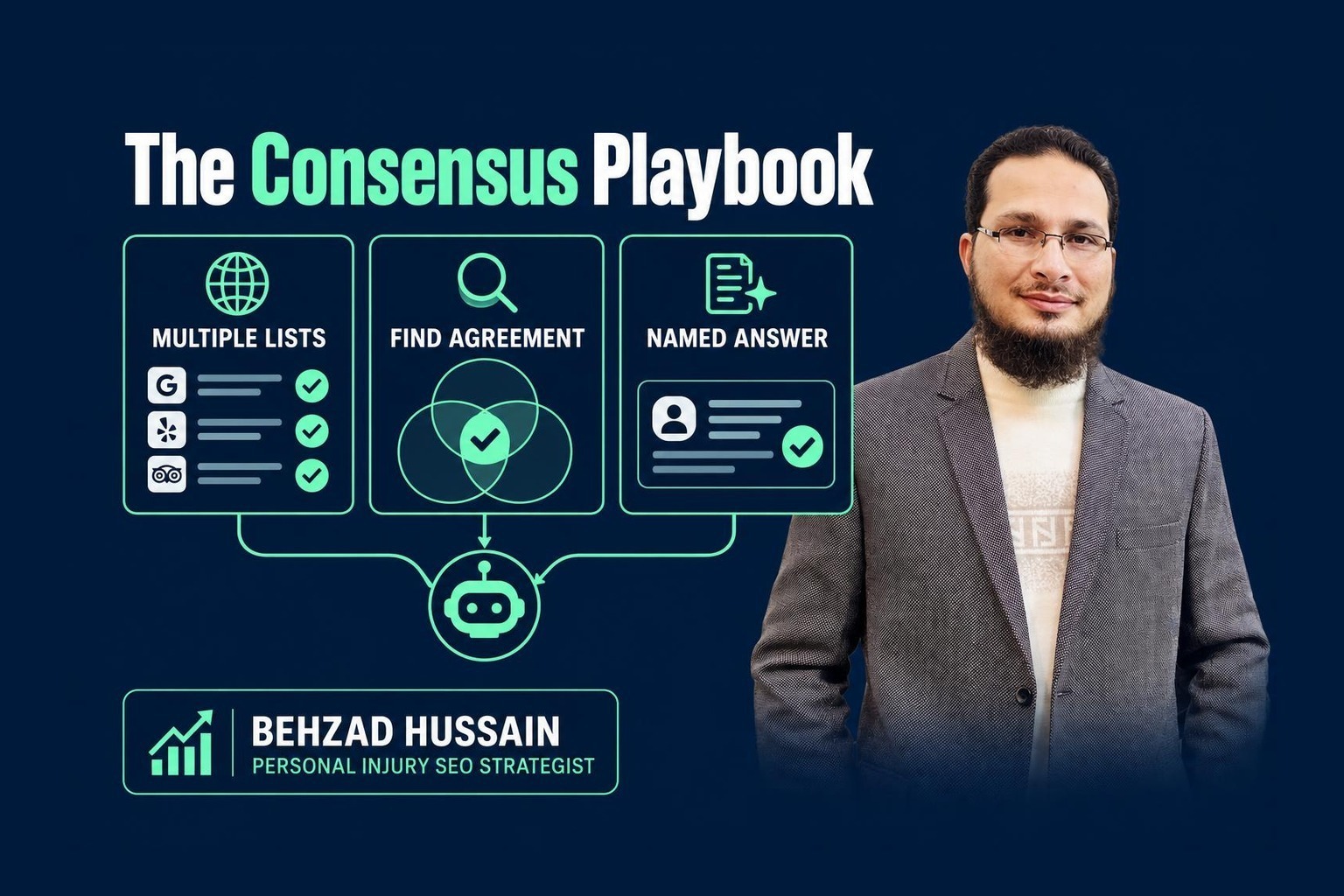
The Consensus Playbook: How List Content Actually Earns AI Citations, and How a PI Firm Gets Named Without Owning the List
When an AI assistant answers “who is the best truck accident lawyer near me,” it does not read one list and copy the winner. It reads many lists and looks for the agreement between them. That single behavior, corroboration over authority, quietly rewrites the rules of list content and of getting your firm named. This piece lays out the playbook: how to write list content machines will cite, and how a personal injury firm earns placements that survive the consensus check.
The mechanism: consensus, not crowns
Classic SEO trained everyone to chase the single authoritative page: rank the list, own the list, be number one on the list. Answer engines broke that model in a specific way. Before naming anyone, they effectively cross-examine sources against each other. A name that appears consistently across independent lists reads as consensus. A name that appears once, loudly, at the top of its own list, reads as advertising.
This is corroboration plumbing, and it is old: Google patented corroborating facts extracted from multiple sources, US 8682913, over a decade ago. The chat interfaces inherited it. What is new is how much content still ignores it. In my 2026 SERP Authority Report on 1,005 page-one PI firms, only 11.1 percent of AI citations on personal injury queries were on-topic pages. The consensus the machines are looking for barely exists in this vertical. That vacuum is the opportunity on both sides of the playbook.
Playbook one: writing list content that machines can cite
If your firm publishes comparison or list-style content, tools for lawyers, case-type comparisons, market guides, five rules decide whether it becomes citable or gets discounted as a brochure. I offer these as practitioner assessment, and they all follow from the mechanism above.
Never crown the subject you are connected to. A list that puts its own author first and calls it the clear winner is exactly the pattern a corroboration engine exists to catch. If your firm belongs in the piece at all, it appears honestly, once, alongside real alternatives.
Admit tradeoffs on every entry. A page where one option wins on price and another on depth reads like evaluation. A page with one perfect option reads like an advert. Every entry gets a “best for” and at least one stated limitation. The admissions are what make the whole page believable, to humans and machines alike.
Use entity-shaped anchors, not keyword-shaped ones. Link text like a firm’s name plus its practice, or a product plus its maker, maps the mention to a thing. Bare money phrases map it to a campaign.
One self-link, maximum. Inside any piece connected to your firm, every additional link back to yourself cheapens the page as a citation. One, where it genuinely serves the reader, is the ceiling.
Write for the query variants, not just the head term. Answer engines fan a question into variants before answering: best for owner-operators, best for small firms, best in a specific county. The variants are where uncontested citations still exist, because almost nobody writes for them.
One hard boundary in my own lane: none of this will ever be used here to rank SEO or marketing vendors. The legitimate subjects are firms, tools lawyers use, and markets.
Playbook two: earning placements as a firm
Now the other side: your firm wants to be the name the consensus supports. Three principles, again as assessment, again downstream of the same mechanism.
Consistency beats power. Several modest placements that say roughly the same thing about your firm, same name, same city, same case-type identity, do more than one placement on a single big-authority site. The machine is not weighing one witness. It is counting agreeing witnesses.
Presence beats position. Being third or fifth across ten independent lists beats being first on one. “Number one” is the position with the least leverage left in it, because a corroboration engine treats any single crown as one vote, and a suspicious one at that.
Your own list has gone soft as a mention driver. The best-of page on your own domain still converts the traffic it gets, but it no longer manufactures the mentions that answer engines count, because the machine knows who wrote it. Mentions now come from being genuinely present across sources you do not control.
What earns those placements honestly: being the firm with the citable data point, the complete resource, the local expertise a list author needs. Every placement must be earnable on the merits. Consensus mechanics never justify fabricated lists or purchased inclusion, which, beyond the ethics, is precisely the pattern the machinery is built to discount.
The corroboration audit
Before chasing new placements, check whether the placements you already have agree with each other. The witnesses only count if their testimony matches: same firm name everywhere, same locations, same case-type identity, a website whose structured data confirms all of it. In my audits, most firms fail this before they fail anything else. Only 35.3 percent of page-one PI firms even declare themselves a legal service in machine-readable form, which means for two thirds of the market, the corroboration chain is broken at its first link, their own site.
Fix the chain in order: your site declares it, your profiles repeat it, then external placements multiply it.
One more test worth running before publishing anything in this format: read your draft as a skeptical machine would. Count how many times the piece links to you, note whether any entry admits a real limitation, and check whether the winner would survive an author swap. If a stranger wrote this exact page, would the conclusions stand? A yes means you wrote evaluation. A no means you wrote an advert wearing a list’s clothing, and both audiences will treat it accordingly.
What I would do this quarter
Publish one genuinely honest comparison resource in your niche, following the five writing rules. Pursue five modest, consistent, earnable placements rather than one trophy. And run the corroboration audit before either, because agreement is the currency and most firms are contradicting themselves before anyone else gets a vote.
The full research behind the citation vacuum is free on my research page: behzadhussain.me.
The machines stopped asking who shouts loudest and started asking who the record agrees on. In a market where 88.9 percent of the record is off-topic noise, a firm that simply gets its story straight, everywhere, is further ahead than it has any right to be.
About the Author
Behzad Hussain — Personal Injury SEO Strategist
Behzad Hussain is a Personal Injury SEO Strategist, independent researcher, founder and CEO of Rank Brilliance, and creator of the Personal Injury Organic Authority Engine. He helps competitive personal injury law firms build organic case acquisition systems through technical SEO, Semantic SEO, structured data, topical authority, and entity reinforcement.