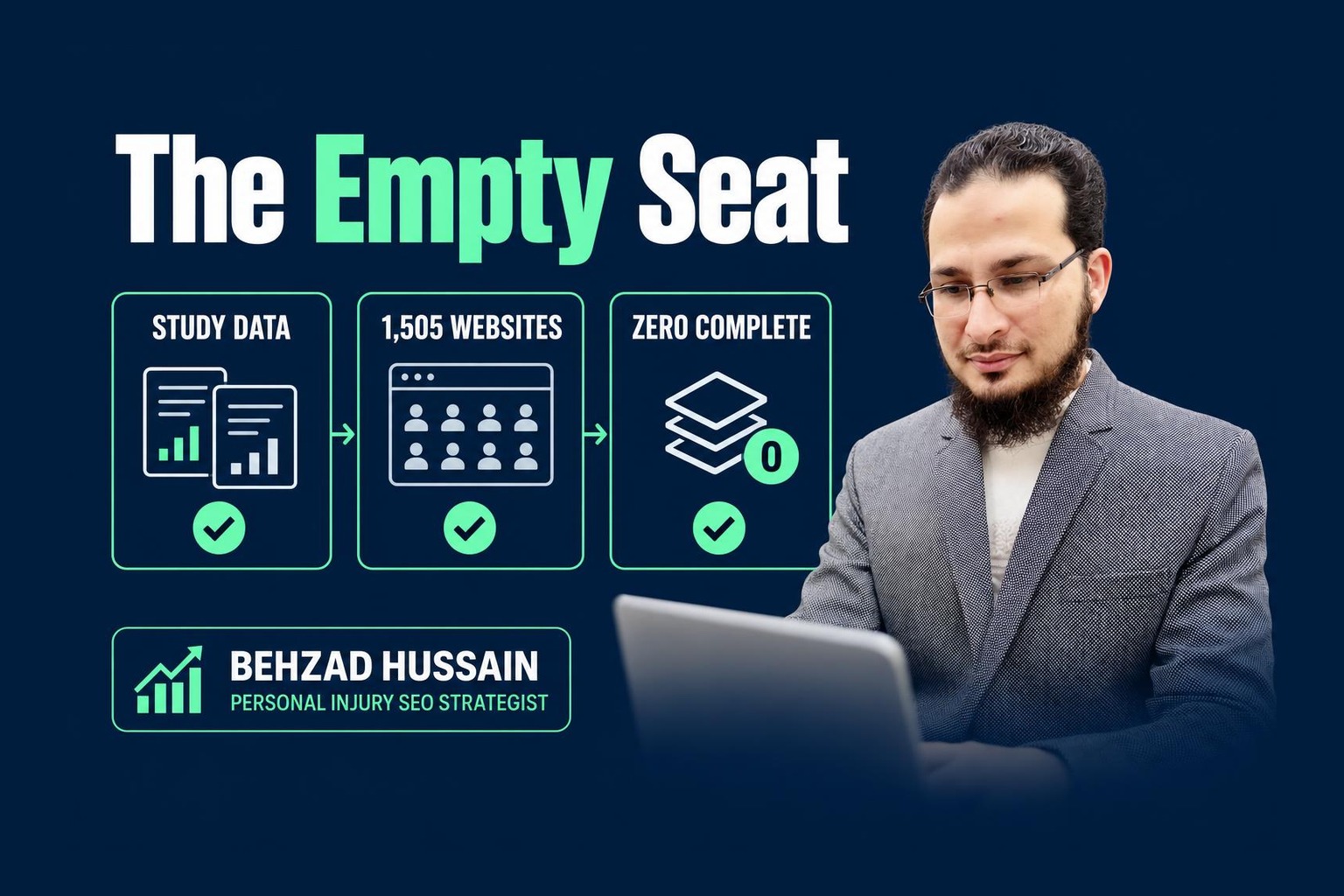
The Empty Seat: What Auditing 1,505 Personal Injury Websites Taught Me About the Most Winnable Market in Legal Search
Zero out of 1,505. That is how many personal injury law firm websites, across two separate published studies, had finished building the structural layer that search engines and AI answers now read first. The most important number I have ever measured is a zero, and this essay is about why that zero should change how your firm spends next year.
I measured twice on purpose
The first study audited the schema markup of 500 personal injury firm websites across North America. The result surprised me enough that I assumed my sample was the problem: not one firm reached the top maturity level, and the average validation score was 0.9 out of 5. Perhaps I had caught too many small firms, too many neglected sites.
So I ran it again with a stricter, rank-controlled method: 1,005 personal injury websites that all rank on Google page one, across all 50 states. The winners, by definition. Firms with budgets, agencies, and positions worth defending.
Zero again.
The median page-one firm sits at Level 2 of 5 on structural maturity. Only 1.3 percent reach Level 4. Level 5, full semantic integration, the state where a site is genuinely built to be understood and trusted by machines: nobody. Twice.
Why a zero is the best news in this industry
In most competitive verticals, the structural work was finished years ago by the market leaders, and catching up is brutal. E-commerce, travel, finance: the top seats are taken and defended by teams.
Personal injury, the most expensive vertical in search, somehow skipped the work entirely. Everyone bought the expensive clicks. Nobody finished the foundation the clicks land on.
That inversion has a practical consequence I want every firm owner to sit with: the top structural seat in your market is provably unclaimed. Not probably. Provably, in the data, in every state I measured. The first firm in each metro that completes the unglamorous structural work takes a lead that competitors cannot answer quickly, because answering it requires the same months of unglamorous work nobody has been willing to do.
What “unfinished” actually looks like
The zero is not abstract. It decomposes into specific, fixable gaps that repeat across the whole dataset.
Only 35.3 percent of page-one firms declare themselves a legal service in machine-readable form. Two thirds leave their own business type to guesswork.
In my companion audit of the same 1,005 firms' Google Business Profiles, 43 percent sat under the wrong primary category, while profile completeness, the thing everyone optimizes, showed almost no relationship with rank.
The median mobile render time was 5.5 seconds, measured across the same cohort in my 2026 SERP Authority Report. The typical injured person, searching in pain on cellular data, leaves before the median winner’s homepage finishes painting.
And in that same report, 663 of the 1,005 sites were structurally absent altogether: no meaningful entity layer at all. When I looked at what AI search features cite on personal injury queries, only 11.1 percent of citations were on-topic pages. The machines are building answers about injury law from sources that are not about injury law, because the firms who should own those citations gave them nothing to cite.
Why the winners never finished
The honest answer, from hundreds of audits: nobody was ever accountable for finishing.
Agencies sell activity, and structure is finished, not performed. A content retainer renews monthly forever. A completed entity layer is a project with an end date, which makes it a bad product for anyone billing by the month.
Dashboards hide the gap. Traffic charts do not show that your firm is invisible to the answer layer, or that your category misdeclares you, or that your schema fails validation. Every failing firm in my dataset had a dashboard that looked fine.
And the work is boring. It photographs badly. There is no launch party for a corrected entity graph. In a marketing culture organized around campaigns, the compounding asset loses to the visible sprint every quarter.
Which is precisely why the seat is still empty, and why it will not stay empty forever. Everything I publish is, in a sense, a countdown on that vacancy.
The mechanism, for the skeptics
If you want the why beneath the what: search engines predict quality before they measure it. Google holds a patent on predicting site quality from features of the site itself, before any user data exists, US 9767157. A thin, slow, structurally ambiguous site starts at a lower floor no matter how good the lawyers are. A second patent family, on ranking with historical data, US 7346839, means the trust you build compounds with age, and the trust you rent resets to zero every billing cycle.
Foundation first, then time. That is the entire strategy the data supports, and almost nobody in this vertical is running it.
What I would do with this information
If I owned a personal injury firm, I would refuse to spend another quarter’s budget until someone showed me, in writing, where my site sits against this data. Which maturity level. Which pillar is failing first. Whether my category declares what I am. What my render time costs me at the moment of panic search.
Then I would finish the work, in dependency order, and let the zero in my market become a one with my name on it.
If you want the fast version of that first question, my free PI Authority Scorecard scores your firm against the four structural pillars in 90 seconds: 16 questions, a two-page personalized PDF, an 8-minute Loom from me, no call required. It exists so that no firm owner has to guess where they sit in a dataset like this one.
The seat is open. It has been open through 1,505 audits. Someone in your market is going to sit down first, and there has rarely been better evidence that it could be you.
Both studies are free in full on my research page: behzadhussain.me. The Scorecard is at behzadhussain.me.
About the Author
Behzad Hussain — Personal Injury SEO Strategist
Behzad Hussain is a Personal Injury SEO Strategist, independent researcher, founder and CEO of Rank Brilliance, and creator of the Personal Injury Organic Authority Engine. He helps competitive personal injury law firms build organic case acquisition systems through technical SEO, Semantic SEO, structured data, topical authority, and entity reinforcement.