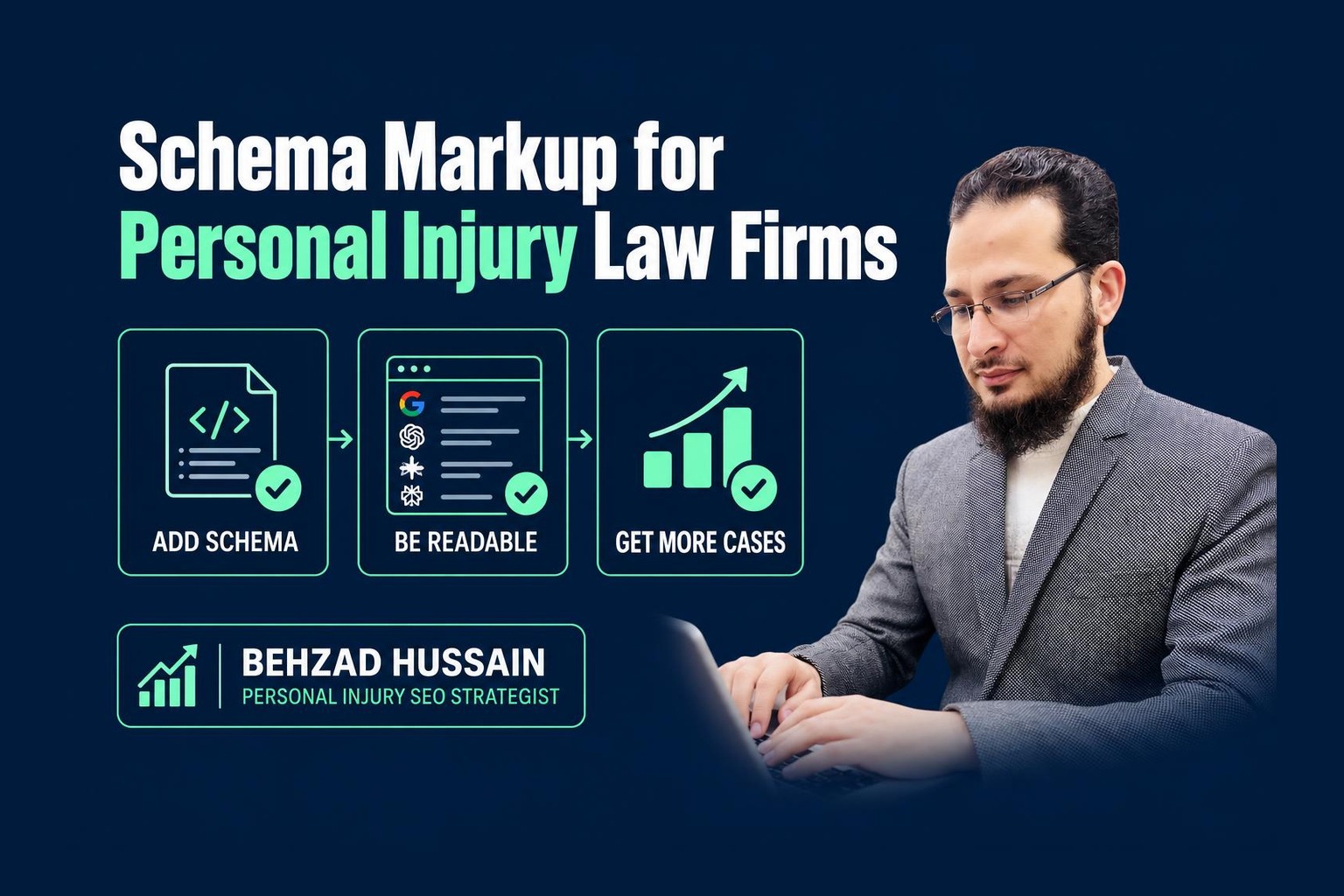
Schema Markup for Personal Injury Law Firms: The Nine Types That Matter and the Decade-Old Mistake Half the Industry Still Ships
Personal injury law firms need nine Schema.org types implemented as JSON-LD to be readable by Google, the AI Overview, ChatGPT, and Perplexity: LegalService, Person, LocalBusiness, Organization, Service, FAQPage, Article, BreadcrumbList, and Review with AggregateRating. Most firms ship none of them correctly. I know because I measured it, twice.
What schema markup actually does for a law firm
Strip away the jargon and structured data is one thing: a label the machines can read without guessing. Your website says “we fight for you” to humans. Schema says “this is a law firm, at this address, in these cities, handling these case types, with these attorneys” to software.
That labeling used to be optional politeness. It is now the difference between existing and not existing in the surfaces where injured people increasingly make decisions. When an AI answer names a firm, it names an entity it could verify. Google filed the mechanics years ago in a patent called Corroborating facts extracted from multiple sources, US 8682913: machines cross-check who you are across the web, and confidence is what gets surfaced. Schema is you answering in your own words instead of hoping the machine guesses right.
The nine types, and what each one is for
LegalService is the anchor. It declares the firm itself, inherits every LocalBusiness property for the physical office, and gives every other piece of markup something to point at.
Person covers each attorney, connected to the firm with worksFor. This is where most of the entity value lives, because Google increasingly organizes trust around recognized people, not just business listings.
LocalBusiness and Organization establish the place and the institution. Service declares each practice area as a thing you actually provide, not just a page that exists. FAQPage marks up real questions with real answers. Article covers your guides and resources. BreadcrumbList tells machines how the site is organized. Review with AggregateRating handles third-party reputation, carefully and compliantly.
None of these are exotic. All of them are checkable in an afternoon. Which makes the actual state of the industry stranger.
What 1,505 audited websites revealed
I have run two structured data audits of this vertical: 500 personal injury firm websites in the first study, then 1,005 sites that all rank on Google page one, across all 50 states, in the second.
The findings that matter most to a firm owner:
Only 35.3 percent of the 1,005 page-one firms even declared themselves a legal service in machine-readable form. The rest leave the most basic fact about their business to guesswork.
The median firm sits at Level 2 of 5 on structured data maturity. Established enough to exist, nowhere near finished.
Zero firms reached Level 5 in either study. Not one out of 1,505. The top structural seat in every market I looked at is empty.
These are the winners. They already rank. Which tells you the ranking ceiling in personal injury is being held up by everything except structural completeness, and the first firm to finish the work in each market takes a seat nobody is defending.
The decade-old mistake half the industry still recommends
Here is the finding that should genuinely worry you about the advice ecosystem in legal marketing.
The Attorney schema type has carried a deprecation notice for roughly a decade. The correct pattern, per the schema vocabulary itself, is Person for each attorney with worksFor pointing to the firm’s LegalService.
Yet half the vendor pages I reviewed while writing my implementation guide still recommend the deprecated type. Many of them describe the deprecation as recent news, urging firms to act fast on a change that happened around ten years ago. I nearly repeated the false timeline myself, because every page said the same thing. Only checking the primary source saved my guide from shipping folklore.
If the industry advising law firms is ten years stale on something this checkable, treat every unsourced claim you hear about your own website with the suspicion it has earned.
Where firms go wrong even with the right types
In my own audit practice, around 30 personal injury sites a year, nine out of ten firms with schema fall into one of three failure modes.
They ship the wrong types: deprecated Attorney, or generic Organization where LegalService belongs.
They ship the right types with broken relationships: attorneys not connected to the firm, services not connected to pages, an entity graph that is really just disconnected fragments.
Or they ship schema that quietly violates a state bar advertising rule, because nobody realized structured data is subject to the same rules as any other public statement by the firm. Self-serving review markup is the classic example.
All three failure modes are invisible in dashboards. The site looks fine. The plugin says active. Only reading the actual output against the actual rules surfaces them, which is why I once found my own site sending Googlebot to a phantom page hundreds of times, from one schema value that started with a slash. The machines execute what you ship, not what you meant.
What to do, in order
First, establish identity: LegalService for the firm, Person plus worksFor for each attorney, LocalBusiness properties for each office. This is a day of structured work, not a redesign.
Second, connect the graph: services pointing to their pages, attorneys to their bios, everything to the firm. Fragments corroborate nothing.
Third, validate everything, then check what the crawler actually does with it. Server logs and crawl stats, not just testing tools. My audits find the validation step skipped almost universally: in the 500-firm study, the average validation score was 0.9 out of 5.
Fourth, keep it consistent with everything else the web says about you: your Google Business Profile, your directories, your bios. Corroboration is the mechanism. Contradiction is the tax.
The complete implementation guide, with the full JSON-LD patterns for every one of the nine types, is free on my site with no email wall: behzadhussain.me. The two studies behind the numbers are on my research page at behzadhussain.me if you want to check my counting.
The short version, if you keep only one paragraph: the machines deciding your firm’s visibility read structure first. Almost nobody in your market has finished theirs. That is not a threat. It is the most open competitive seat personal injury marketing has offered in years.
About the Author
Behzad Hussain — Personal Injury SEO Strategist
Behzad Hussain is a Personal Injury SEO Strategist, independent researcher, founder and CEO of Rank Brilliance, and creator of the Personal Injury Organic Authority Engine. He helps competitive personal injury law firms build organic case acquisition systems through technical SEO, Semantic SEO, structured data, topical authority, and entity reinforcement.