Your Google Business Profile Is the Homepage Most Clients See First: Operating It Like One
For most injured people, the first page your firm ever shows them is not your website. It is the Google Business Profile panel: the photos, the reviews, the hours, the questions, the little map. Firms treat that panel like a directory listing someone filled in once; clients treat it like the firm’s actual front door. This piece is about operating the profile as what it really is, the most-seen homepage you have, and about the machinery that reads every field of it more carefully than most firms ever filled it in.
The listing mindset versus the homepage mindset
The listing mindset says: we claimed it, we filled the fields, done. It treats the profile as a form.
The homepage mindset asks the questions owners ask about their actual homepage: what does a frightened stranger see in the first five seconds, is it current, does it answer the questions that decide a call, does it look like a firm you would trust with a six-figure case? Then it assigns somebody to own those answers, because unowned pages rot.
The difference shows up everywhere on the panel. Photos from an office you left. Hours that do not mention what happens to a 9pm call. Reviews answered never, or answered by whoever was angriest that day. The questions feature colonized by strangers answering on your behalf. Every one of those is invisible in the listing mindset and glaring in the homepage one, and clients live in the homepage one.
The machines read it too, field by field
Two things from the patent record reframe how seriously the system takes profile contents.
Google patented using images to identify incorrect or invalid business listings, US 8462991: the photo layer is not decoration, it is evidence the system can check a listing against. The machinery was built on the premise that listings lie and visual signals help catch it. A profile whose images are stale, generic, or contradictory is not neutral; it is weak testimony in a system designed to weigh testimony.
And the review layer is read for meaning, not counted for stars. Google’s sentiment-detection patents, the US 8417713 family, describe ranking reviewable entities by the sentiment expressed in review TEXT. What clients write, the specifics they mention, the experience they describe, is machine-readable signal about what your firm actually is. Two firms at 4.8 stars can read completely differently to a system parsing the words, which is why operating reviews means operating what gets written, not chasing a number.
Add the consistency machinery covered across my earlier work, the cross-checking of your name, address, and identity across every record, and the profile stops looking like a form. It is a continuously evaluated evidence file about your firm, and most firms last touched theirs when a vendor set it up.
The operating rhythm of a profile-as-homepage
Run it like a page with an owner and a cadence, not a box that was ticked.
Weekly, five minutes: scan what changed. Profiles are living records; the platform suggests edits, users propose changes, data flows in from elsewhere. Unwatched profiles drift, and drift is how firms end up miscategorized or mislabeled without anyone deciding anything.
Monthly, thirty minutes: the content pass. Photos that show the real office, the real people, recent and specific. Posts if you use them, current. Services and attributes matched to what the firm actually wants more of, in the words claimants use. The hours story told honestly, including what happens after hours, because injury time is not business time.
Continuously, as operations: reviews. Ask consistently from real clients at the natural moment, reply to every one like a professional who expects the reply to be read aloud someday, and treat the themes in review text as free intelligence about both your service and your visibility. The sentiment machinery is reading the words; so should you.
Quarterly, as governance: the identity audit. Does the profile agree, exactly, with the website and every major record about name, address, phone, and what the firm is? One story everywhere is the entire game of entity confidence, and the quarterly hour is cheap insurance on it.
The questions feature: a forum on your front door
The questions and answers section of the panel deserves its own paragraph of alarm, because its design surprises every owner who finally looks at it: anyone can ask a question on your profile, and anyone can answer one. Unattended, the feature becomes a small public forum about your firm, moderated by nobody, where a stranger’s guess about your fees or your intake process can sit as the accepted answer for years. The fix is ownership, same as everything else on the panel. Seed the section yourself with the questions intake actually hears, do callers reach a person after hours, does the firm handle this case type, what should someone bring to a first meeting, and answer them in the firm’s own voice. Then watch it on the weekly pass, because a question asked on your front door and answered by a passerby is exactly as damaging as it sounds, and entirely preventable.
Who holds the keys
None of the rhythm above is possible if the firm cannot get in. Before assigning the owner of the profile’s content, confirm the ownership of the profile itself: the firm should be PRIMARY OWNER of the listing, in a Google account the firm controls, with vendors added as managers who can be removed in one click. The inverse arrangement, vendor as primary owner and firm as guest on its own record, is one of the most common findings in my audits and the single most expensive one to discover late, because every photo, review reply, and field in this piece is then being operated at someone else’s pleasure. Check it this week; it takes two minutes in the profile’s managers screen, and it turns out to be finding number one often enough that I now check it before anything else.
What this is not
This is not a rankings hack, and the honest version of this piece says so plainly. My own audit research across 1,005 firms found profile completeness almost uncorrelated with rank position; filling fields is hygiene, not strategy. The homepage mindset is not about squeezing a position. It is about two other payoffs entirely: conversion, because the panel is where calls are actually decided, and corroboration, because the profile is one of the loudest witnesses in your firm’s entity record. Both payoffs survive every algorithm update, which is more than can be said for hacks.
It is also not a replacement for the website. The panel is the front door; the site is the building. A brilliant profile pointing at a site that fails the first-screen test just moves the leak one step downstream. The two are one system, and the machinery increasingly reads them as one record.
The checkup
Here is the five-minute self-audit, the one I run in the first minutes of any engagement: search your firm’s name plus your city in a private window. Look at the panel as a stranger. Is the category exactly what you most want to be hired for? Do the photos look like a firm operating this year? Do the newest reviews have replies? Does anything on the panel contradict the website it points to? And would YOU call this firm, based only on what the panel shows?
Most owners have never once looked at their own panel this way, which is exactly why the gaps persist: the most-seen homepage in the firm is the one nobody at the firm ever sees. Run the same stranger’s pass on your two nearest competitors while you are there; the comparison makes your own panel’s gaps impossible to unsee, and it costs five more minutes.
My free PI Authority Scorecard makes the checkup systematic: 16 questions across the four pillars, including the identity and profile layer this piece lives in, scored in under 90 seconds, with a personalized PDF and a short Loom from me, no call required. It exists precisely so an owner can find the leaks before paying anyone to fix the wrong one. The deep version, when you want every gap named and sequenced, is the full website and presence audit I run as the Diagnostic.
The full local playbook is free at behzadhussain.me and the research is at behzadhussain.me
A last word on who should hold the operating role, because firms default to the wrong answer. The profile’s owner does not need to be a marketer; it needs to be someone close enough to operations to know when hours change, when an attorney joins, when the office moves, and empowered enough to act the same week. In most firms that is an office manager or a senior paralegal, not a vendor three time zones away who learns about the new office from the website, eventually. The vendor can advise. The witness file about your firm should be maintained by someone who actually works there.
Your profile greets more potential clients than your receptionist. Staff it accordingly.
About the Author
Behzad Hussain — Personal Injury SEO Strategist
Behzad Hussain is a Personal Injury SEO Strategist, independent researcher, founder and CEO of Rank Brilliance, and creator of the Personal Injury Organic Authority Engine. He helps competitive personal injury law firms build organic case acquisition systems through technical SEO, Semantic SEO, structured data, topical authority, and entity reinforcement.

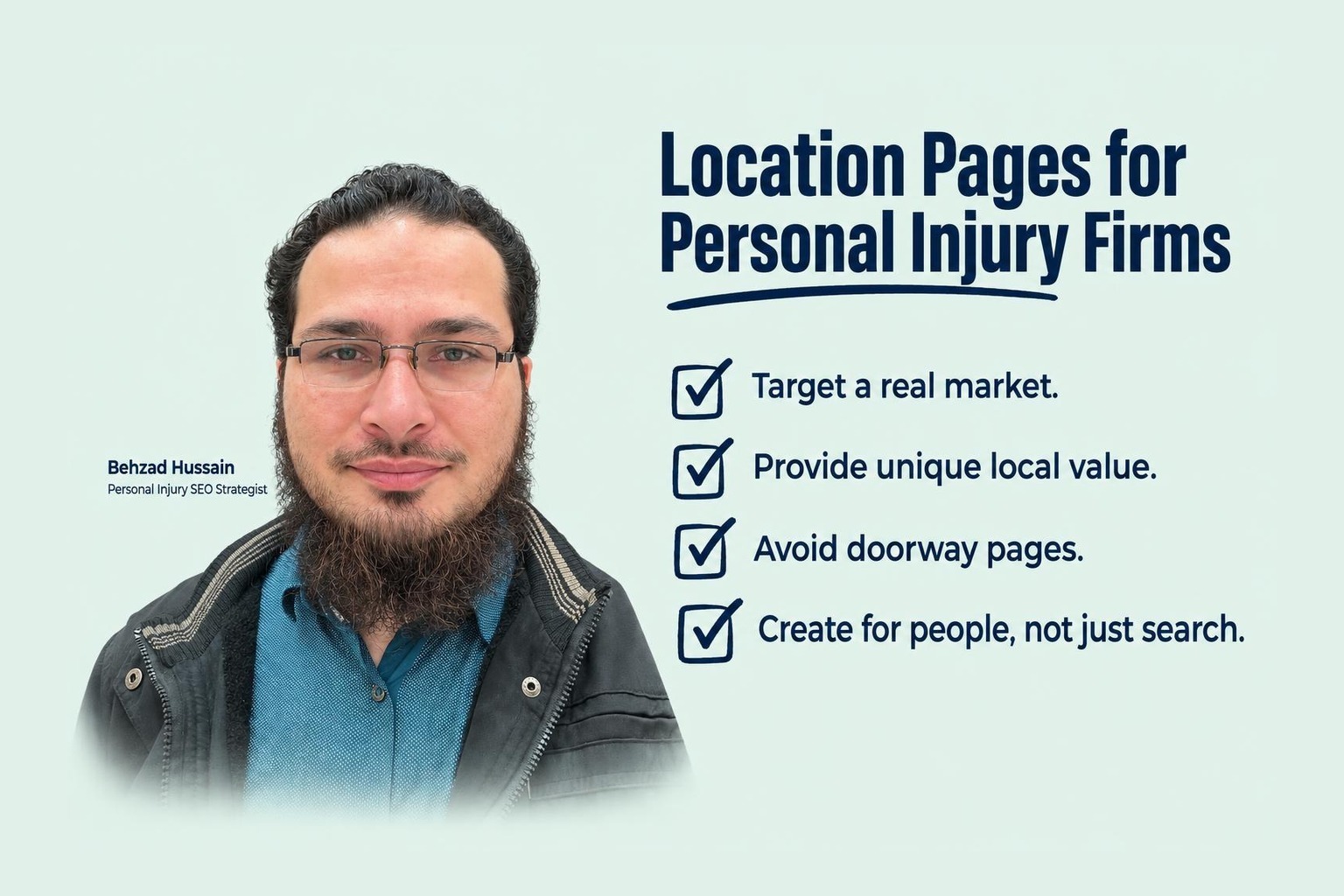
Location Pages for Personal Injury Firms: Real Local Pages vs Doorways, and How the Machines Tell the Difference
A location page exists to serve a real market the firm genuinely covers; a doorway page exists to catch a search the firm merely wants. The two look similar in a site menu and could not be more different to the systems scoring them, and the gap between them is one of the most common, most expensive self-inflicted wounds in personal injury SEO. This piece explains how location pages actually work, how the machinery identifies the fakes, and the honest architecture for firms with one office, three offices, or a whole service region.
Why PI firms mass-produce city pages
The logic seems airtight from the owner’s chair. Clients come from forty towns. Searches happen in forty towns. Therefore: forty pages, one per town, each swapping the city name into the same template. A vendor can generate them in an afternoon, the sitemap looks thorough, and for a while, some of them even rank.
The logic fails because it models the machine as a filing cabinet that rewards having a folder for everything. The actual machinery is an evaluation system that scores what each page is, what its neighbors are, and whether the entity behind it genuinely operates where it claims. On all three checks, mass-produced city pages testify against their own site.
The three mechanisms that catch doorways
Pages are scored on their own content quality. Google’s patent on processing web pages based on content quality, US 8775924, describes exactly the judgment owners hope does not exist: pages evaluated for the substance they carry, not the keywords they mention. A city page whose only city-specific element is the city’s name has a measurable quality problem no template can hide, because there is nothing underneath the find-and-replace.
Pages inherit their neighborhood. The quality-by-neighbor-features patent, US 9183499, is the one every multi-city template should fear: a resource is evaluated partly by the features of the resources around it. Forty near-identical siblings do not just fail individually. They drag each other down, and they drag the money pages down with them, because the site’s overall quality prior is computed from the whole family. This is why pruning doorway pages routinely helps the pages that remain: the neighborhood improves.
And the local stack checks the entity, not just the page. Google patented detection of related local entities, US 9858291, part of a machinery that connects businesses, places, and the content about them. A firm with one verified office in one city, claiming dedicated presence in forty, creates a record where the pages assert what the entity layer contradicts. Corroboration engines resolve contradictions by lowering confidence, and confidence is what local visibility is made of.
Put plainly: the machines ask three questions of every location page. Is there anything really here? Is it surrounded by siblings that say otherwise? And does the firm’s verifiable footprint support the claim? Doorways fail all three by construction, which is why no amount of polishing an individual template ever rescues the fleet.
What a real local page contains
The test for whether a location deserves a page is whether you can fill the page with things that are true and specific to that place. A real local page for a PI firm carries substance a template cannot fake:
The courts and venue reality for that county: where the case would actually be filed, which courthouse, what that means for timelines. The roads, corridors, and crash patterns that generate the area’s cases, stated factually. The local rules that change outcomes: notice deadlines for claims against that city or county, transit authorities with their own clocks, whatever applies in that state. The office or meeting reality, honestly: a real address if one exists, how the firm actually serves the area if not. The named attorneys who appear in those courtrooms. And the questions claimants from that area actually ask, which intake can supply.
Writing that page requires knowing the market. That is the point. The page is hard to fake because the knowledge is the content, and this is exactly why a genuine local page outcompetes ten templates: it is the only one in the set that could not have been written about anywhere else.
The honest architectures, by firm shape
One office, one metro: one deep local page, or the homepage itself carrying the local depth, plus practice pages that reference the market naturally. Resist the suburb-page temptation entirely; the metro page covering real suburbs with real substance beats twelve thin satellites.
A few genuine offices: one real page per office, each with its own complete identity, address, staff, courts, and content, each corroborated by its own verified profile. The pages differ because the places differ; if two office pages could swap cities by find-and-replace, they are not done.
A service region without offices everywhere: a regional architecture that tells the truth. County or region pages built on venue and court knowledge, clearly framed as where the firm practices rather than where it pretends to sit. In my experience the truth-telling version outranks the fake-office version over any horizon that matters, because it accumulates trust instead of contradiction.
Nested, not flat: location pages belong under the structure they serve, state above city where both exist, so the site’s own hierarchy teaches the machine the geography. I rebuilt my own site’s architecture this way, every flat slug redirected into its nested home, precisely because the hierarchy itself is information.
Where the true substance comes from
The usual objection to real local pages is that there is nothing to write. There is; it just does not live in keyword tools. Four sources fill a genuine location page with material no template can copy.
The court system’s own records: every state publishes which courts serve which counties, where they sit, and how their caseloads run. Venue is the most local fact in a personal injury case, and almost no firm page explains it.
The state’s transportation and safety data: crash tables by county and corridor, published by the agencies themselves. Stated factually, with the agency named in the sentence, this is the difference between “we serve Springfield” and demonstrating that the firm knows how Springfield gets hurt. The discipline is to pull the agency’s table, never a competitor’s summary of it, because the summaries in this industry are reliably wrong.
The local-government layer: notice deadlines for claims against the city or county, transit authorities with their own claim clocks, municipal defendants' special rules. These vary by place, change outcomes, and are precisely what a worried local searcher cannot find explained anywhere.
And intake itself: the questions callers from that market actually ask, the roads they name, the employers and hospitals that recur. A month of intake notes contains more real local content than any tool export ever will.
A page built from those four sources takes real hours. It is also unfakeable, unmatched by any competitor running templates, and true, which the next algorithm update cannot take away.
The audit, and the deletion courage
Auditing an existing city-page fleet takes an afternoon and one honest question per page: if the city name were removed, would anything on this page tell you which market it serves? Pages that fail get one of three verdicts. Merge: fold any real substance into the nearest genuine page and redirect. Rebuild: the market is real and worth a true page, so write one. Delete: the market was aspirational, the page is a liability, and removal is addition by subtraction.
Owners resist deletion because the pages feel like assets and ranked once upon a time. The neighbor-features mechanism is the answer to that resistance: every thin sibling is a tax on every strong page, paid continuously, whether or not anyone looks at the bill. The firms that prune feel it in the pages they kept.
One caution from the audit chair: never mass-delete without mapping redirects and checking what actually earns traffic or links first. Doorway cleanup is surgery, not demolition; the protocol matters as much as the decision.
Where this sits in the framework
Location architecture spans two pillars: Intent Capture, because geography is half of every local query, and Authority Reinforcement, because the entity record must corroborate every place the site claims. My free PI Authority Scorecard checks both in its 90-second pass, and the location questions are among the most commonly failed; the full local method is free in my guide at behzadhussain.me with the research behind the patterns at behzadhussain.me
And when a new market becomes real, when the firm genuinely starts taking cases there, the page follows the fact rather than preceding it. Geography earned is geography that ranks; geography claimed is a liability on a timer.
The rule that survives every algorithm update: build a page for every market you can tell the truth about, and no page for any market you cannot. The machines are corroboration engines, your competitors' templates are confession documents, and in a vertical this crowded, being the one firm whose geography is real is a stranger advantage than it should be.
About the Author
Behzad Hussain — Personal Injury SEO Strategist
Behzad Hussain is a Personal Injury SEO Strategist, independent researcher, founder and CEO of Rank Brilliance, and creator of the Personal Injury Organic Authority Engine. He helps competitive personal injury law firms build organic case acquisition systems through technical SEO, Semantic SEO, structured data, topical authority, and entity reinforcement.
The Query Path: What an Injured Person Types Between the Crash and the Call
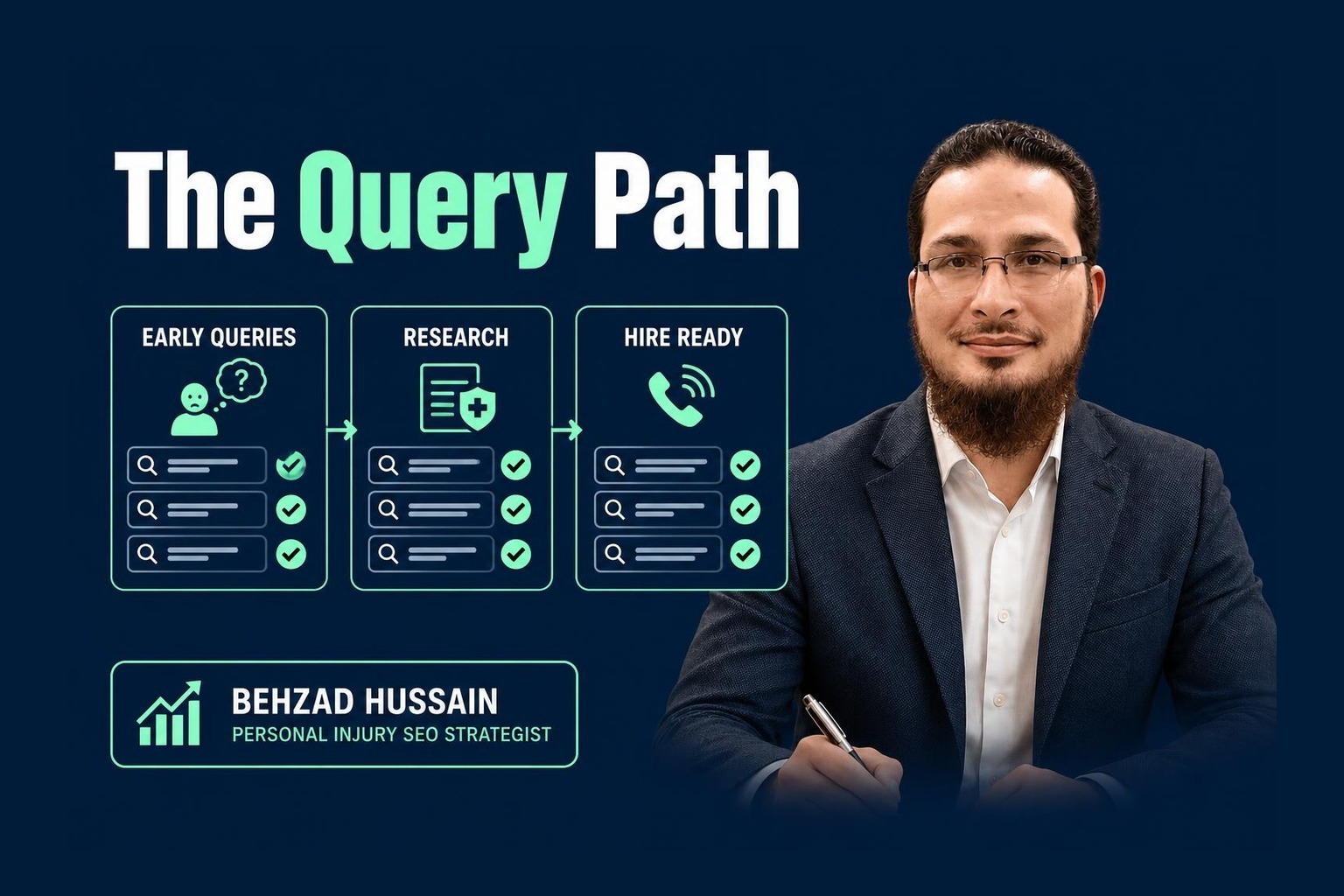
Between the moment of an injury and the moment a lawyer’s phone rings, there is a path of searches: a sequence of questions that starts frightened and vague and ends specific and commercial. Most personal injury firms build their websites for the final query on that path and are invisible for every step before it, which means the client has usually formed their trust somewhere else before the firm’s page ever appears. This piece maps the path, the machinery that reads it, and how a firm builds for the whole journey instead of the last step.
The path, reconstructed
The sequence varies by case, but its shape is stable, and intake calls confirm it over and over.
It begins with symptom and situation queries, often the same night: whiplash how long after accident, should I go to the ER after a rear end collision, is the driver who hit me always at fault. No lawyer in these queries. The person does not yet know they have a legal problem; they know they have a neck problem and a fear problem.
Then come the quiet legal questions, usually typed at odd hours into a phone or an AI assistant: do I have a case if I was partly at fault, what is my claim worth, will I owe money if I lose, how long do I have to file in my state. This is the stage the embarrassment lives in. People ask machines what they are afraid to ask people, and the firm whose content answers these honestly earns trust before any human contact.
Then process and comparison queries: what does a personal injury lawyer actually do, contingency fee meaning, how to choose an injury attorney, questions to ask a lawyer first call. The person is now assembling a decision framework.
Only then, sometimes days later, the commercial head terms everyone fights over: car accident lawyer near me, truck accident attorney in their city. By this point the searcher is not discovering options. They are confirming a shortlist their earlier searches already built.
What the machines know about this path
The patent record shows the search systems were built to read intent sequences, not isolated strings, and four documents make the point concretely.
Google patented determining user intent from query patterns, US 8868548: the system reads the pattern of queries, not each one in isolation, to infer what the user is actually trying to do. It patented identifying navigational queries, US 7693865, separating the searcher who wants a specific destination from one still exploring. It patented recognizing named entities inside queries, US 9009134, which is how truck accident lawyer El Paso, TX decomposes into a case type, a profession, and a place. And it patented query augmentation, US 8375048, expanding what you typed into what you meant.
Translate the stack into owner language: the machine sees the journey. It knows which stage a query belongs to, it rewrites queries into their meaning, and it matches pages against that meaning. A site with one commercial page per case type is legible to exactly one step of a multi-step path. The machinery has nothing to match the rest against, so somebody else’s pages fill the gap, and increasingly so do answer engines assembling responses from whoever covered the early questions best.
Why the head term is the worst place to start
The commercial head term is the most expensive, most contested, least differentiating query on the entire path, and it is where nearly every PI marketing budget is pointed. Three structural problems follow.
The head term is a confirmation query. By the time it is typed, trust has largely been allocated by the earlier steps. Winning the last click while losing the whole preceding journey means competing on the thinnest possible margin: position alone, against the deepest pockets in search.
The head term is also where everyone is identical. Every firm’s page says the same words to the same query. The early-path questions are where a firm can actually be distinguishable, because almost nobody answers them properly, in plain language, with the state’s actual deadlines and the process’s actual shape.
And the head term teaches owners the wrong lesson about SEO, because its difficulty makes organic look hopeless. The path’s earlier steps are winnable by any firm willing to do complete work; in my audit of 1,005 page-one PI sites, the overwhelming pattern was thin commercial pages with no question layer around them at all. The crowd is at the last step. The open ground is everywhere before it.
Building the path: the query network method
The practical build treats one case type as one network of questions, mapped end to end.
Harvest from reality first: intake calls, consult transcripts, the exact phrasings clients repeat. The early-path questions rarely surface in keyword tools, because tools sort by volume and the path’s most valuable steps are low-volume, high-fear queries. Your intake team hears them daily.
Classify every query by its stage: symptom, quiet legal, process, commercial. A page built for a frightened 2am reader and a page built for a shortlist-confirmer are different documents; mixing the registers loses both readers.
Assign one owner per query. Every question belongs to exactly one page, so your own pages never compete. Cannibalization is the silent tax on most PI sites: four city pages and a blog post all fighting for one query, and the machine resolving the dispute by trusting none of them.
Connect the path the way the reader walks it. The symptom page links forward to the quiet-legal questions, those link to process, process links to the commercial page, and the commercial page links to the named attorney who handles the case type. Directional internal links are how the site tells both readers, human and machine, that the journey is covered here, in order.
Then finish before you widen. One case type, complete, beats five partially mapped. Coverage is a provable state per network, and the compounding starts when a network closes; a half-mapped path leaks trust at every unanswered step, exactly where a competitor’s page is waiting to catch it.
The path now runs through assistants
One update the industry has not priced in: the quiet-legal stage of the path increasingly happens inside AI assistants rather than on a results page. The 2am question about partial fault or owing money on a loss is exactly the kind a person now asks a chat interface, because the interface cannot judge them and does not make them choose a source. That changes nothing about the method and everything about the stakes. Assistants assemble answers from whoever covered the question legibly: direct answers under recognizable headings, consistent entities, pages that resolve the question instead of gesturing at it. A firm whose early-path coverage is complete and extractable gets to be the material the answer is built from, and sometimes the name attached to it; a firm with only a commercial page does not exist at this stage at all. The searcher who later types the head term may have already met you inside an answer you never saw being given. Build the path once and both surfaces, the results page and the assistant, draw from the same asset.
What this looks like in results
A firm that owns a case type’s full path shows a distinctive pattern: it gets found earlier, cited more by answer engines, and confirmed at the commercial step by searchers who already met it twice on the way. The head term stops being a cold auction and becomes the last step of a warm journey. And the early-path pages, the ones keyword tools said were worthless, quietly become the highest-trust assets on the site, because they are the ones that answered the question the person was afraid to ask out loud.
The gap is open because the work is unglamorous: weeks of mapping, writing, and connecting for one case type, with nothing to screenshot in month one. That is also why it defends itself once built. A competitor cannot buy your coverage at auction. They have to walk the same weeks you did, and in this vertical, almost nobody does; the median page-one firm in my audits never even started.
My free PI Authority Scorecard measures the pillar this lives in, Intent Capture, as part of its 90-second pass, and the question it asks is the one this whole piece asks: can you name the query network your strongest page actually owns? If the answer is a single keyword, the path is the opportunity.
The full keyword research method is free in my guide at behzadhussain.me and the audit data is at behzadhussain.me
The client’s journey has a dozen steps. The market is standing on the last one, bidding against itself. Walk the path backwards from the crash instead, answer what you find there, and the final query stops being a fight because you already won it days earlier, on pages your competitors' keyword tools told them were worthless.
About the Author
Behzad Hussain — Personal Injury SEO Strategist
Behzad Hussain is a Personal Injury SEO Strategist, independent researcher, founder and CEO of Rank Brilliance, and creator of the Personal Injury Organic Authority Engine. He helps competitive personal injury law firms build organic case acquisition systems through technical SEO, Semantic SEO, structured data, topical authority, and entity reinforcement.
Anatomy of a Practice Area Page That Signs Cases, Not Just Rankings
A practice area page has one job before it has any other: help the right injured person confirm they are in the right place and take one clear next step. Everything else on the page, the history, the awards, the stock gavel, is decoration that either serves that job or competes with it. This piece is the full anatomy: what the page must contain, in what order, what the machines reading it actually score, and the specific failures I find when I audit these pages, which I have now done hundreds of times across the most competitive vertical in search.
The two readers every practice page serves
Reader one is a frightened person on a phone. They typed something specific: a crash type, a body part, a question about fault or money. They give the page seconds, they read almost nothing above what the first screen shows, and they decide on feel: does this page understand my situation, and can I act right now?
Reader two is a set of machines. A crawler that decides whether the page is worth its budget. An indexing system that decides what the page is about and whether to store it. A quality model that scores it before any user ever arrives. And increasingly, answer engines deciding whether anything on the page is worth quoting.
Here is the part the industry keeps missing: the two readers want the same page. Google patented processing web pages based on content quality, US 8775924, and scoring site quality from the site’s own features, US 9195944. The machinery is explicitly built to predict what a human would find useful. Writing for the frightened person IS the machine strategy, executed properly, with structure the machine can parse.
The first screen: where the case is won or lost
On a phone, before any scroll, the page must answer five things in the reader’s own language: what kind of case this is, whether they might have one, what it could be worth, how long it takes, and what it costs to talk. Plainly, in that order of emotional priority, with a tap-to-call action and a short form both visible.
The form deserves special emphasis because the vertical ignores it. A person who cannot face a phone call at midnight, or a spouse researching quietly at work, needs a written channel. The firms that offer one, prominently, inherit the cases the phone-only firms never knew existed.
What must NOT occupy the first screen: the firm’s founding year, the managing partner’s portrait wall, an autoplay video, an award carousel. Every one of those is the firm talking about itself at the exact moment the reader is deciding whether anyone understands them.
The body: coverage, not length
After the first screen, the page earns rankings through coverage: answering the real question set around the case type, not accumulating words. The machine match moved from strings to meanings years ago; a page gets matched to the network of queries around its topic when its content actually resolves those queries.
The question set for any case type comes from intake reality, not keyword tools: what happens next, how fault is decided, what insurers do first, what the process feels like month by month, what evidence matters, what deadlines apply in this state. Each answered directly, front-loaded, in plain words, under a heading a searcher would recognize as their own question.
Two structural disciplines keep the body honest. One owner per question: when two of your pages answer the same query, you are competing against yourself, and the machine resolves the argument by trusting neither. And no borrowed paragraphs: pages cloned across case types read as near-duplicates, and duplicate detection is among the oldest machinery in the index.
The proof layer: specific beats superlative
Trust on a practice page is built from verifiable specifics: the named attorney who actually handles this case type, linked to a real bio; results stated within your state bar’s advertising rules; process honesty about what no lawyer can promise. “Millions recovered” convinces nobody who has read three competitor pages saying the same words. One named attorney with one real, compliant proof point outperforms a wall of superlatives for both readers, because specificity is checkable and machines are corroboration engines.
This is also where compliance lives: outcome promises, unverifiable comparatives, and testimonial misuse are bar problems before they are marketing problems. The page should be written so your own counsel could read it without wincing. Check your state’s rules before publishing any claim.
The device reality check
One habit catches more practice-page failures than any tool: audit the page exclusively on a phone, on cellular, held in one hand. That is the device and the circumstance of nearly every reader who matters, and pages that look complete on an office monitor routinely fall apart there: the call button below the fold, the form fields too small to tap accurately, the hero image eating the first three seconds of attention on a connection that only had five. The desktop view is the firm’s view. The phone view is the client’s. When the two disagree, only one of them signs cases, so design reviews, copy approvals, and every screenshot in every vendor deck should default to the phone rendering, and anything that does not survive the one-hand test does not ship.
What the machines score that owners never see
Three mechanisms from the patent record explain most practice-page failures I find, and none of them are visible in a dashboard.
Engagement is read in context. Google patented calibrating click duration according to context, US 8868565: how long a visitor stays is interpreted relative to what the page is and what the query was. A practice page that loses its visitors in seconds, because the first screen answered nothing, is generating a measurable signal with every expensive click.
Quality is scored from the page itself. The site-quality models form a prior before user data exists. Thin, templated, firm-first pages start below pages built as genuine resources, which means the rewrite pays twice: once with readers, once with the prior.
And the page inherits its neighborhood. Quality evaluation uses neighbor features, US 9183499: a strong practice page surrounded by thin clones is dragged by its siblings. You cannot fix one page in isolation on a site full of scaffolding; pruning the junk is part of fixing the money page.
The failures I actually find, ranked by frequency
From hundreds of PI page audits, the recurring order: a generic title that names the firm instead of the case and city. A first screen about the firm, not the reader. No form, or a form below six screens of history. The same 900 words cloned across four case types. No named attorney connected to the page. Headings written as marketing lines no searcher would ever type. Internal links scattered evenly everywhere instead of concentrated on the pages that sign cases. And a page weight that takes seconds to paint on the device every claimant actually uses.
None of these are mysteries. All of them are invisible from the owner’s chair, because the owner reads the page knowing what the firm is, forgiving every gap with knowledge the visitor does not have. The page’s actual job is to work for someone who does not.
The rebuild order
Fix in this sequence: title and first screen first, question coverage second, proof layer third, then the structural ring around the page, internal links concentrated, clones pruned, speed restored. Finish one case type completely before touching the next. A finished page in a finished neighborhood beats ten simultaneous half-rebuilds, and the neighbor-features mechanism is exactly why.
Measure before and after: the query set the page owns, calls and form submissions attributed to it, and time-to-first-action on a phone. Rankings follow coverage; cases follow the first screen.
Where this fits
Practice pages sit inside two pillars of my framework: Intent Capture, whether the page matches how claimants search, and Case Acquisition Optimization, whether the visit becomes a signed case. When I run a full website audit for a firm, the Diagnostic, these pages get the deepest pass precisely because they are where ranking and revenue meet: nine deliverables, the practice-page findings ranked by what is actually blocking cases, refundable until the roadmap is clear. The free 90-second version is the PI Authority Scorecard, which tells you which pillar is failing before anyone touches a page.
The complete implementation detail for the structured data layer of these pages is in my free schema guide at behzadhussain.me and the research behind the audit patterns is free at behzadhussain.me
One page, two readers, one job. Open your best practice page tonight on your phone and ask the only question that matters: can a frightened stranger tell, without scrolling, what you handle and how to reach you? If not, nothing else on the page is working either, and every dollar spent sending people to it is buying the same silent exit, one expensive visitor at a time.
About the Author
Behzad Hussain — Personal Injury SEO Strategist
Behzad Hussain is a Personal Injury SEO Strategist, independent researcher, founder and CEO of Rank Brilliance, and creator of the Personal Injury Organic Authority Engine. He helps competitive personal injury law firms build organic case acquisition systems through technical SEO, Semantic SEO, structured data, topical authority, and entity reinforcement.
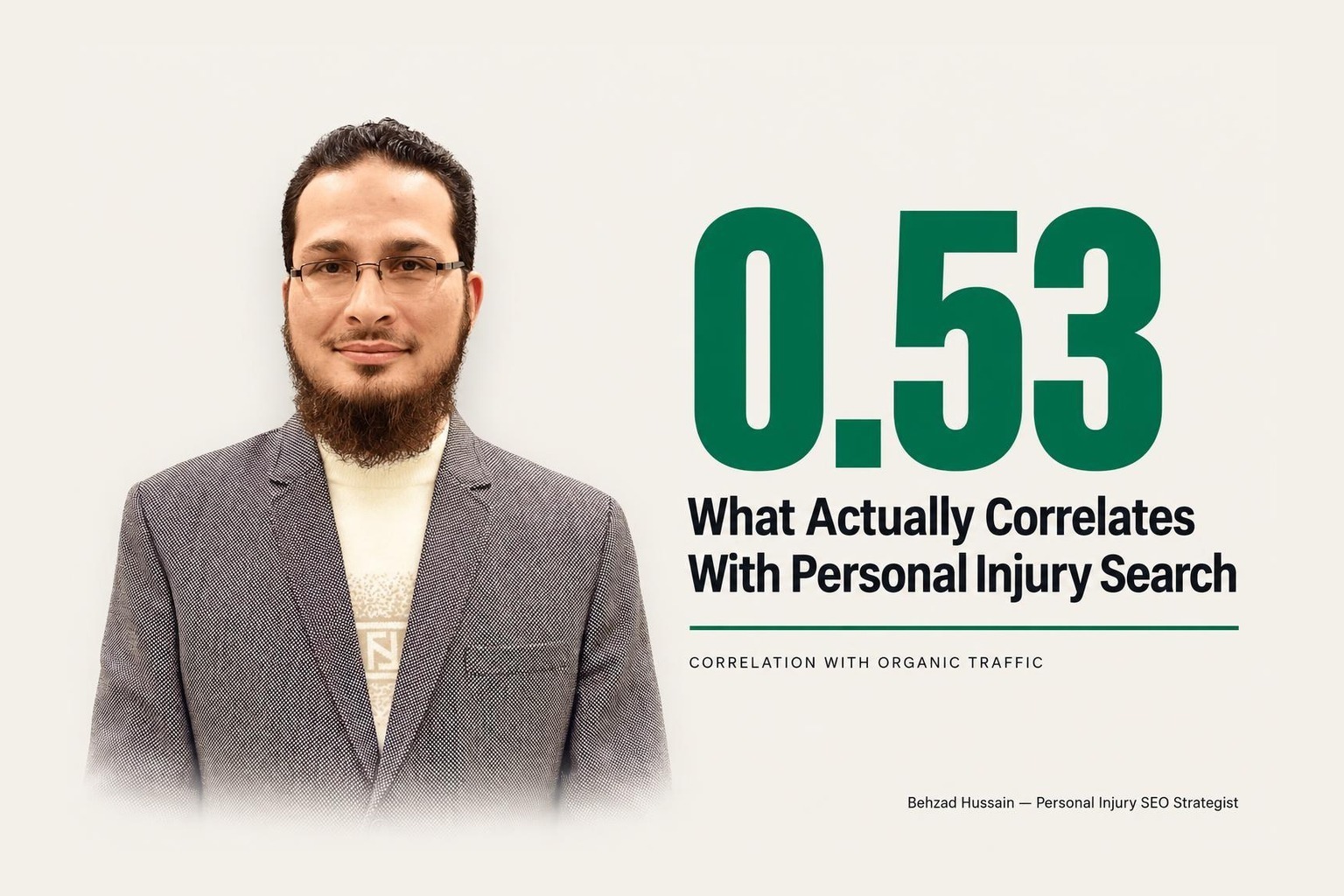
What Actually Correlates With Personal Injury Search Visibility: The Order of Operations, Measured Across 1,005 Firms
Across 1,005 page-one personal injury websites, the structural pillar that correlates most strongly with organic traffic is the least glamorous one: technical foundations, at 0.53. Intent coverage follows at 0.40, authority signals at 0.20, and the conversion layer at 0.14, with the total structural score tracking traffic at 0.55. Four numbers, one descending staircase, and a spending map that inverts how this market actually buys. This piece walks the measurements, the honest limits of what correlation proves, and the order of operations the data keeps insisting on.
The measurement, briefly
My 2026 report scored 1,005 page-one PI firm websites against eleven structural questions grouped into four pillars: whether machines can crawl, render, and trust the site; whether pages capture the queries claimants actually type; whether the firm and its attorneys exist as verifiable authorities; and whether visibility has a route to a signed case. Each firm’s pillar scores and total were then set against its organic visibility.
The correlations above are the paper’s canonical figures, computed on roughly 997 firms after exclusions, and they are published with the method so anyone can re-run the arithmetic rather than take my word for it. Alongside them sit two companions worth holding: the total structural score tracks domain authority at 0.55, and AI visibility at 0.19.
Reading the staircase honestly
First, the caveats, stated plainly because data that hides its limits is marketing. These are cross-sectional correlations: they establish association across a population at a moment, not guaranteed causation for any single firm. Correlation at 0.53 is strong for messy field data of this kind and would be unremarkable in a laboratory. And pillar scores are not fully independent; firms that finish foundations tend to be firms that finish other things.
Now the reading that survives all three caveats: the ordering. Foundations at 0.53 predict visibility more than twice as strongly as authority signals at 0.20, and nearly four times the conversion layer at 0.14. Every arrow points the same direction: the deeper the layer, the stronger its relationship with outcomes. Whatever the causal machinery underneath, a spending strategy that ignores a consistent ordering across a thousand firms is not skepticism. It is a bet against the only map anyone has bothered to draw.
The market spends in exactly the reverse order
Hold the staircase against how PI firms actually buy, and the inversion is almost comic.
The typical engagement sequence I audit runs: redesign first, because partners can see it. Content retainer second, because it produces artifacts. Link campaign third, because authority sounds like the point. And the crawl layer, the rendering path, the structural identity, the unglamorous 0.53, last or never, because no one in the conference room has ever watched a bot fail to read a page.
The data says build bottom-up; the market builds top-down, because the penthouse demos well and the foundation does not demo at all. This is also why the same market shows a mean structural score of 3.13 out of 11 with nobody above 7: top-down building produces decorated buildings on unpoured concrete, at scale, forever.
The dependency logic explains the correlations better than any mystery: a link campaign pointed at a site machines cannot reliably read is authority delivered to a closed door. Intent coverage on pages that render in five seconds is an answer the reader never sees. Later layers cannot outperform the layers they stand on, and the correlations fall in exactly the order the dependencies run.
Can a firm skip to the conversion layer, since that is where cases actually close? It is the tempting shortcut, and the dependency logic answers it: the 0.14 layer converts visitors the earlier layers deliver, so polishing it on a structurally invisible site is optimizing the checkout of an empty store. The order runs foundation first because every later investment is multiplied or nullified by what sits beneath it. That said, the conversion layer’s small coefficient does not make it optional; three in ten page-one firms present no clear ask at all, and for a firm whose foundations already stand, that is the cheapest fix on the board. Sequence is not a value ranking. It is plumbing.
The two companion numbers
The 0.55 with domain authority says the structural score is not measuring some private definition of quality; it moves with the metric the whole industry already respects, while being something a firm can actually act on question by question.
The 0.19 with AI visibility deserves the careful sentence: real, positive, and modest, exactly what an early, noisy answer layer should produce, especially one whose citations my same report found to be mostly off-topic. The strategic read is not that structure barely matters to AI. It is that the AI relationship is young, the seats are cheap, and by the time that coefficient matures to look like the Google one, the firms already structured will have been collecting the difference for years. Early-era correlations are where first movers get paid; mature ones are trivia.
One score, three surfaces, three strengths. There is no separate Google project, authority project, and AI project. There is one foundation with three payoff channels attached, at different stages of ripeness.
The order of operations, operationalized
Translated into a sequence a firm can actually run, the staircase reads:
First, foundations, the 0.53 layer: crawlability, rendering, speed on the devices claimants hold, and a machine-readable declaration of what the firm is. Days to weeks of engineering, not a redesign.
Second, intent coverage, the 0.40 layer: one case type at a time, every real question answered, one owner per query, until the topic is finished before the next begins.
Third, authority, the 0.20 layer: the attorneys as corroborated public records, earned mentions from sources with standing, consistency across every surface that speaks about the firm.
Fourth, conversion, the 0.14 layer: the clear ask, the form for those who cannot call, the intake that answers in minutes. Smallest coefficient, and still the layer where three in ten page-one firms fail outright, which is why it stays in the framework at all.
Then hold the sequence against decay, quarterly, owned by a named person, because structures drift and the staircase only pays firms still standing on it. The maintenance hour is cheap; rebuilding a slid foundation two years late never is, and the market is full of firms paying that second price without knowing which purchase caused it.
This dependency order is not a preference of mine; it is the shape of the data, and it is baked into both instruments I offer. The free PI Authority Scorecard scores all four pillars in 90 seconds and names your weakest: behzadhussain.me. The PI SEO Diagnostic delivers the full sequenced roadmap, $4,500 fixed, refundable until it is clear: behzadhussain.me. And the complete report, methods and all, is free to check my work: behzadhussain.me
One last measurement habit makes all of this operational: re-measure after every fix, against the same eleven questions, so the sequence stays honest. Firms that fix without re-measuring drift back into buying by instinct within two quarters, and instinct in this market reliably points at the penthouse.
A thousand and five firms, eleven questions, one descending staircase. The market will keep buying it upside down, which is precisely the opportunity for the firms that read the numbers right side up.
About the Author
Behzad Hussain — Personal Injury SEO Strategist
Behzad Hussain is a Personal Injury SEO Strategist, independent researcher, founder and CEO of Rank Brilliance, and creator of the Personal Injury Organic Authority Engine. He helps competitive personal injury law firms build organic case acquisition systems through technical SEO, Semantic SEO, structured data, topical authority, and entity reinforcement.
Cross-Examining Your SEO Vendor: A Buyer's Audit Built From the Discipline Lawyers Already Own
Personal injury lawyers make their living testing claims against evidence, then abandon that discipline entirely the moment the subject is their own marketing. Every burned-agency story I have collected, and I collect them, started with an unchecked claim that a five-minute cross-examination would have killed. This piece turns the profession’s own method back onto the vendors courting it: the six questions, what each one surfaces, the contract terms worth demanding, and the standing governance that keeps the discipline alive after the meeting ends.
Why this vertical gets fooled
It is not naivety. Search marketing is a credence good: the buyer cannot inspect it before purchase and struggles to evaluate it after, because outcomes lag, attribution is murky, and every result has three claimants. In that fog, vendors compete on confidence rather than evidence, and confidence is cheap to manufacture.
The industry’s information supply makes it worse. I have audited the folklore directly: vendor pages repeating, for years, that a schema type was recently deprecated when the deprecation notice is roughly a decade old, each page citing the last page, no page citing the source. A buyer who checks primary documents is rare enough that not checking has become the market’s default assumption about you.
The cure is not becoming an SEO expert. It is applying the evidentiary standard you already bill for.
The six questions, and what each one surfaces
Ask these in order, in one meeting, and take notes on the answers' form as much as their content.
What is the primary source for that claim? Every pitch contains claims about how Google works. Ask for the document: the patent number, the official documentation page, the published study. What you are testing is not their library; it is whether they distinguish evidence from vibes. A vendor who cites documents you can open is a different species from one who cites the consensus of their own industry, and this vertical’s consensus has been provably wrong for a decade at a time.
When did that change, and how do you know? The industry’s most reliable trick is urgency built on stale news. Dates are where folklore dies: ask when the thing they are warning you about actually happened, and watch whether you get a date with a source or a season with a shrug. The FAQ rich results removal has an exact date, May 7, 2026. The deprecation they may be urgently selling you a fix for has one too, and it is old enough to vote.
If we stop paying you, what do we keep? The single most clarifying question in the set. Rented visibility, rented links, content on platforms they control, dashboards that leave with the login: all legitimate answers, if disclosed. What you are pricing is the ratio of rent to equity in the proposal, because three years of pure rent leaves the firm exactly where it started, minus the budget.
Show me signed cases by channel. Not traffic, not rankings, not impressions. If they cannot connect work to cases, ask what the reports were for. If they say attribution is hard, agree, and then ask what they propose to build so it gets easier, because that build is worth more than most deliverables on the rate card.
Which of your recommendations would you cut from our plan? A vendor who cannot name one item they would drop is selling inventory, not strategy. The genuinely aligned ones will name something, usually the thing your firm wanted most, and their reasoning will teach you more than the proposal did.
Who senior actually touches our account after the sale? Get names and hours, in writing. The industry’s standard bait is a partner-led pitch and a junior-led engagement. The gap between the two is where most disappointment is manufactured.
The terms that separate partners from pipes
Questions screen the pitch; terms screen the relationship. From the buyer’s chair, these are the surrenders worth requiring, and their absence is information.
Ownership in writing: every deliverable, account, and asset belongs to the firm outright. Exit without hostage-taking: month-to-month after a defined build period, with an orderly handover clause. Attribution as a deliverable: the vendor commits to building the measurement that would expose their own failure. Named seniority: the people, not the brand, contracted to the work. And visible capacity limits: a vendor who takes every check has told you where you rank the day a bigger check arrives.
I publish my own versions of these terms, fixed public prices, a refundable diagnostic, hard monthly caps, one firm per metro, not as decoration but because in a credence market, surrendered terms are the only proof of alignment a buyer can verify before the work exists. Hold everyone who courts your firm, me included, to exactly that standard.
Two habits make the six questions durable rather than theatrical. First, require the answers in writing, after the meeting, in the vendor’s own words. Verbal answers are performances; written ones are commitments, and the gap between what was said in the room and what arrives in the follow-up is itself a finding. Second, re-run the audit annually on vendors you like, not just prospects you doubt. Relationships soften scrutiny precisely as invoices grow, which is the exact wrong direction, and the vendors genuinely worth keeping will treat the annual cross-examination as respect rather than insult. The ones who bristle at being asked for sources in year two have told you what year three holds.
The governance gap that outlasts any vendor
Here is the uncomfortable finding from years inside these engagements: the six questions work, and almost nobody at the firm owns asking them twice.
Vendor discipline decays the way intake discipline decays: sharp at signing, soft by month four, gone by the renewal nobody remembers approving. Reports arrive, charts trend upward, and the questions that would connect any of it to signed cases go unasked, because asking them is nobody’s job. The most expensive vendor problems I audit were never bad vendors. They were unowned relationships, drifting on autopilot through eighteen months of activity theater.
The fix is a role, not a ritual: one accountable owner of organic case acquisition as a number, sitting above every vendor, running the six questions quarterly, holding the terms, and deciding what the next dollar builds. At firms past a certain size, that seat either exists or the drift does.
Filling that seat is precisely my Fractional PI Search Strategist engagement: one senior owner of the strategy across your entire vendor roster, no content mills, no code, no ad management, just accountable direction. $10,000 to $15,000 and up monthly, three-month minimum, a maximum of two engagements globally, with a 30-day evaluation guarantee. Details: behzadhussain.me
And whether or not that seat is ever mine, take the six questions into your next vendor review unchanged. They are free, they work without me, and what they surface in one meeting will tell you whether anything else in this piece applies to your firm.
The profession that lives on cross-examination should not be the softest market in America for unexamined claims. The remedy costs one meeting, it compounds with every vendor cycle after, and it was sitting in your training all along.
About the Author
Behzad Hussain — Personal Injury SEO Strategist
Behzad Hussain is a Personal Injury SEO Strategist, independent researcher, founder and CEO of Rank Brilliance, and creator of the Personal Injury Organic Authority Engine. He helps competitive personal injury law firms build organic case acquisition systems through technical SEO, Semantic SEO, structured data, topical authority, and entity reinforcement.

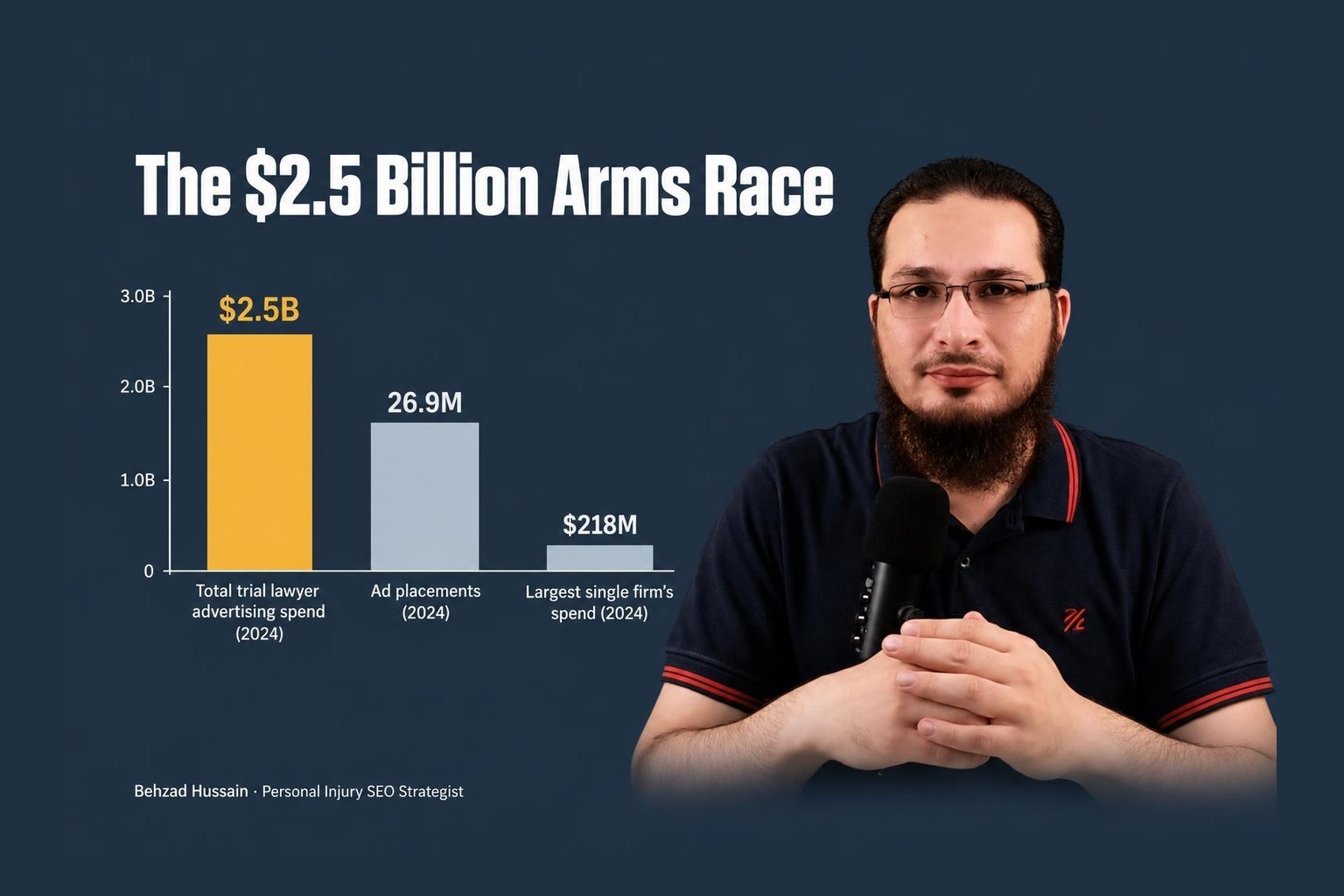
The $2.5 Billion Arms Race: What Trial Lawyer Ad Spending Data Means for Every Firm That Cannot Outbid It
Trial lawyer advertising reached $2.5 billion a year, spread across 26.9 million ad placements in 2024, with the largest single firm accounting for roughly $218 million of it by itself. Those are the American Tort Reform Association’s counts, and every personal injury firm owner should read them not as industry trivia but as the rules of a game they are being invited to lose. This piece is about what the arms race actually selects for, what it structurally cannot buy, and where the counter-position sits for firms without a nine-figure media budget.
The shape of the race
Hold the three numbers together and the game reveals its structure.
$2.5 billion is the annual entry fee for share of voice, and it ratchets: every escalation by one major spender resets the floor for everyone contesting the same eyeballs. 26.9 million placements is what saturation looks like; in major metros an injured person cannot ride a bus, watch a game, or open an app without meeting the category. And $218 million from a single firm is the checkmate number: it tells you exactly who wins any contest decided by budget, before the contest begins.
The economics underneath are the ones I publish on my own methodology pages: commercial PI clicks priced between $100 and $300, signed cases from paid channels running $1,000 to $5,500 before a dollar of casework begins. Rising, all of it, because auctions with more bidders and fixed inventory only move one direction.
None of this makes advertising irrational. For the giants, saturation is the strategy, and by its own logic it works: category dominance, name recognition at scale, a moat made of budget. The question the numbers pose is narrower and more personal: what is the rational play for the firm that cannot and will not win a bidding war against a $218 million budget?
What the arms race cannot buy
Here is where my audit data turns the spending data into strategy, because the two datasets describe the same firms.
While the industry spent $2.5 billion on placements that expire, my 11-question structural audit of 1,005 page-one PI websites found a market that finished almost nothing: a mean score of 3.13 out of 11, two thirds of firms structurally absent, and not one firm in the entire cohort above 7. The most famous name in the study, the same tier of firm anchoring the ad-spend leaderboard, scored highest at 7 of 11 while its mobile pages took nearly 23 seconds to render.
That is the strangest fact in this vertical, and I have now measured it from enough directions to call it load-bearing: the biggest spenders in legal marketing rent attention at historic scale and leave the owned layer, the structural foundation that compounds instead of expiring, unbuilt. The arms race consumes exactly the budgets, attention, and vendor relationships that finishing would require. Saturation spending and structural completion appear to be organizationally incompatible, and the data shows it: money is everywhere on the leaderboard, and finished foundations exist nowhere on it.
Which means the empty ladder is not despite the $2.5 billion. It is partly because of it.
Rent and equity, one more time, with the yearly meter
I write often about rented versus owned acquisition, and the ATRA numbers give the distinction its sharpest form: all 26.9 million placements from 2024 are gone. Every one. The meter reset to zero on January 1, and the same share of voice now costs this year’s price, which is higher.
Contrast the asset side. A complete practice-area resource built three years ago is still answering questions tonight, stronger for its age, because the machines that decide visibility are engineered to reward accumulated, stable, corroborated records. Rented reach resets annually at rising prices; built authority compounds annually at zero marginal price. Two curves, opposite directions, and every year the gap between them widens.
The rational blend for a non-giant follows directly. Paid channels as a bridge, sized to keep the pipeline alive, never mistaken for a strategy. And a fixed, protected share of budget flowing to things the firm still owns if every vendor vanishes: the structural layer, the case-type depth, the attorneys as resolved public records, the intake that answers. Rent to eat; build to own; never confuse the meter for the deed.
The focused firm’s counter-position
The giants' model has one structural weakness a smaller firm can actually use: it requires being everywhere, which is why it finishes nothing anywhere. A firm that picks one metro and two case types can complete work the saturation model cannot afford to complete anywhere, and completion is what the measurement machinery pays.
Concretely, from the audit data, the counter-position is four moves. Clear the structural bar nobody clears; the observed ceiling is 7 of 11, held by five firms nationally. Own the case-type questions completely in your market, because depth is a decision, not a media budget. Build the named attorneys into corroborated public records, the layer four fifths of page one ignores. And wire intake so the demand the giants generate, because $2.5 billion of category advertising creates searches that ads do not finish, lands somewhere that answers.
That last point deserves its own sentence: category saturation is a subsidy to whoever wins the search that follows the billboard. The arms race manufactures demand for injury representation in general; the structural winner in each market collects a share of it without paying the toll.
There is a measurable subsidy hiding in the saturation, and it deserves its own paragraph. Category advertising at this scale does not only promote the advertisers; it manufactures demand for injury representation generally, and much of that demand routes through search, where the biggest spender does not automatically win. The injured person who saw three billboards and a halftime spot still types a question into a phone, and what greets that search is decided by the structural layer, not the media budget that provoked it. Every firm in a saturated market is therefore standing downstream of demand it did not pay for. The only question is whether its foundations, coverage, and intake are built to collect any of it. I cannot give you a verified dollar figure for the subsidy, nobody can, but the mechanism is plain, and the structurally complete firm in a heavily advertised metro is the one cashing it.
The build, operationalized
This patient counter-position is exactly what my PI Authority Growth System exists to run: the four-pillar structural build, executed and operated month over month, $5,000 to $12,000 monthly depending on market, one firm per metro so your direct competitors are locked out while it compounds, month to month after a 90-day onboarding. It is the anti-arms-race by construction: everything it builds, the firm owns outright. Details: behzadhussain.me
And if you want the position audit before any commitment, the free 90-second Scorecard is the honest start: behzadhussain.me
$2.5 billion a year buys the loudest voice in the room until January. The firms that will own the next decade of this vertical are spending a fraction of that on the only thing the auction has never sold: work that is still there in the morning, compounding quietly while the meters upstairs reset.
About the Author
Behzad Hussain — Personal Injury SEO Strategist
Behzad Hussain is a Personal Injury SEO Strategist, independent researcher, founder and CEO of Rank Brilliance, and creator of the Personal Injury Organic Authority Engine. He helps competitive personal injury law firms build organic case acquisition systems through technical SEO, Semantic SEO, structured data, topical authority, and entity reinforcement.
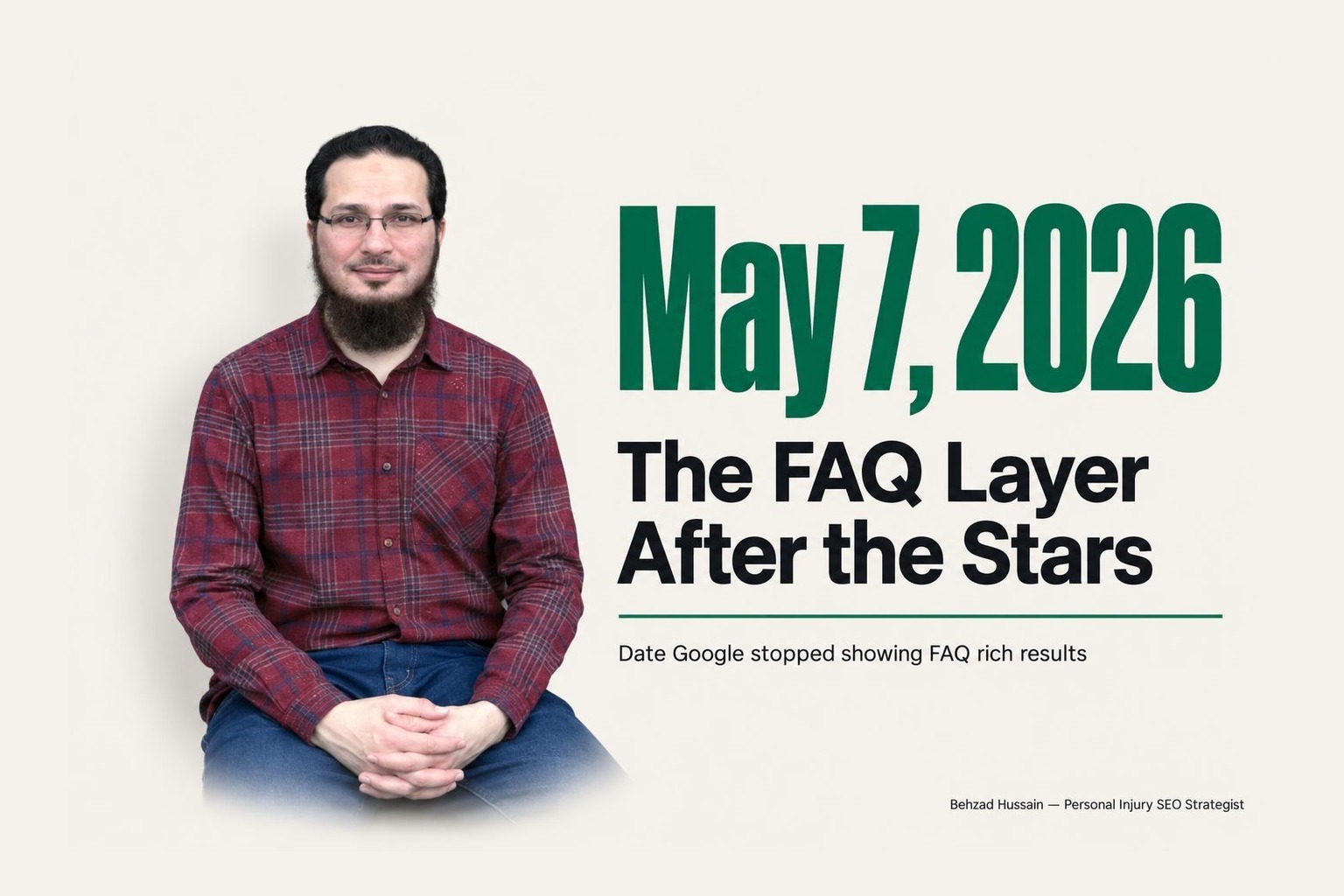
The FAQ Layer After the Stars: What Google's May 2026 Removal Actually Changed for Personal Injury Websites
On May 7, 2026, Google stopped showing FAQ rich results, the expandable questions under search listings, for nearly all websites. Within days the industry produced its usual two camps: vendors declaring FAQ work dead, and vendors selling the same markup with a new AI-flavored promise attached. Both camps are wrong in instructive ways. What actually changed is a rendering. What did not change is the discipline underneath, and my audit data says only 18.5 percent of page-one personal injury firms ever built that discipline in the first place. This piece sorts the removal into what it killed, what it left standing, and what a PI firm should do now.
What exactly died in May
The FAQ rich result was a display feature: Google choosing to render a page’s marked-up questions as interactive dropdowns on the results page. It had already been restricted to a narrow set of sites since 2023. As of May 7, 2026, it is effectively gone for everyone.
That history matters, because this is now the fourth time this industry has run the same funeral. Review stars for self-serving markup were removed in 2019. How-to results were retired in 2023. The sitelinks search box was retired in late 2024. Each time, content and markup built solely to trigger the widget became instantly worthless, and each time, the underlying structure, where it had been built for comprehension rather than decoration, kept doing its quieter job.
The pattern is the lesson: Google retires renderings on its own schedule and owes nobody notice. Strategies pegged to widgets carry an expiry date the buyer never gets to see.
What the removal did not touch
Three things survived May 7 completely intact.
The questions themselves. Injured people did not stop asking whether they have a case, what it costs, whether it was their fault, how long they have. The demand side of FAQ content is a permanent feature of human distress, not a Google feature.
The comprehension value of structure. Marked-up question-and-answer pairs remain valid structured data that any system reading the web can parse: search engines building their understanding of a page, and the growing family of machines that assemble answers rather than lists. I will not decorate that statement with the adoption statistics currently circulating for AI systems, because I cannot verify them and my standard does not bend for convenient numbers. The verifiable core is enough: structure exists to remove ambiguity for machines, and nothing about May 7 made machines prefer ambiguity.
And the extraction value of well-shaped answers. A question stated in the reader’s words, answered directly in the first sentence, in 40 to 70 words a frightened person can absorb, is the format that gets quoted, by answer engines today and by whatever renders answers next. That format was never really about the dropdown.
What my audit says about who should even worry
Here is the finding that reframes the whole panic: in my structural audit of 1,005 page-one PI firm websites, only 18.5 percent carried a structured FAQ layer at all.
Four out of five winners never built the thing whose rendering just disappeared. For them, May 7 changed nothing except the pitch they will receive next quarter. And the 18.5 percent who did build it split into two very different groups: firms whose FAQ layer was genuine, real client questions, properly answered, structurally declared, and firms who bulk-generated accordion boxes in 2021 because a vendor promised stars.
The first group lost a cosmetic. Their answers still rank, still get extracted, still serve the reader, and still feed the machine-readable record of what the firm knows. The second group lost the only reason their content existed, which is not a loss so much as an invoice arriving.
The discipline that survives every removal
Strip away the widget history and the durable playbook for a PI firm’s question layer looks like this.
Source questions from reality. Intake calls, consult transcripts, the questions clients say they typed at 2am. The panic questions and the embarrassed questions almost never surface in keyword tools, and they are where trust is actually won.
Answer on the page that owns the topic. A question that deserves its own section gets one, with the direct answer front-loaded. The FAQ block at the bottom of a page is for genuine leftovers, perspectives the body does not cover, never a duplicate of what the page already says. Machines do not need the same answer twice, and readers trust pages that do not pad.
Shape for extraction. Question in natural language. First sentence answers it completely. Two to four sentences of necessary nuance. No throat-clearing, no “great question,” no paragraph of firm history before the answer.
Declare the structure honestly. Keep valid FAQ markup where real questions and answers exist; there is no penalty for structure that tells the truth, and every future surface that reads the web inherits it. Just never again let anyone sell markup as the strategy. The markup is the label; the answers are the product.
Audit annually against the only test that matters: would you send this page to a scared client as the best thing you have on the question? Content built to trigger widgets fails that test the day it is written. Content built to answer it survives every redesign Mountain View ships.
What should firms do with the accordion graveyards built for the stars? Audit them against the ownership rule rather than deleting on reflex. Questions the body of the page already answers get removed, with their answer folded into the body as a front-loaded direct sentence where the body’s version was weaker. Questions the page does not answer, if they are real client questions, earn a proper home: their own section when they deserve one, the genuine leftovers block when they do not. Questions no client ever asked, the keyword-shaped filler a widget vendor generated by the dozen, get deleted without ceremony. Most 2021-era FAQ blocks shrink by more than half under this audit, and the page is stronger for it in exactly the ways that still pay.
The vendor screen this hands you
The May 7 removal is also a free diagnostic on everyone who advises your firm. Ask your agency two questions. What did you tell clients the day FAQ rich results died? And what happens to your current recommendations when Google retires the feature they target?
Vendors who led with the rendering will lead with the next rendering. Vendors who built comprehension shrugged in May, because nothing they built depended on furniture. The difference between those two answers is worth more than any single deliverable in the contract, because it predicts every future quarter of the relationship.
The wider structural picture, including where a genuine question layer sits among the nine schema types a PI firm actually needs, is in my complete guide, free: behzadhussain.me. The 1,005-firm audit behind the adoption figure is on my research page: behzadhussain.me
The stars are gone. The questions are permanent. Firms that always served the questions lost nothing in May, and firms that chased the stars were always going to lose them; the only variable was the date. Build for the reader in the parking lot, structure what you build, and let Google rearrange its furniture around you.
About the Author
Behzad Hussain — Personal Injury SEO Strategist
Behzad Hussain is a Personal Injury SEO Strategist, independent researcher, founder and CEO of Rank Brilliance, and creator of the Personal Injury Organic Authority Engine. He helps competitive personal injury law firms build organic case acquisition systems through technical SEO, Semantic SEO, structured data, topical authority, and entity reinforcement.
Attorney Bio Pages Are Entity Assets: The Most Undervalued Pages on Every Personal Injury Website
The most undervalued pages on a personal injury website are the attorney bios, and the numbers make the case bluntly: only 20.6 percent of the 1,005 page-one PI firms in my audit declare any attorney as a person in machine-readable form, while my flywheel research found the firms whose presence is person-led convert brand attention into organic traffic along the steepest slope in the dataset. The market writes bios as vanity pages. The machines read them, when they can read them at all, as the record of who can be trusted. This piece is about closing that gap.
What a bio page actually is now
To a human, a bio page is a photograph, a voice, and a reason to feel safe calling. That job has not changed and still gets done badly, but it is the second job now.
To a machine, a bio page is candidate evidence for an entity: a claim that a specific person exists, holds specific credentials, practices specific law in specific places, and is attached to a specific firm. Search systems have been engineered in this direction for a long time; the patent record includes machinery for identifying entity attributes in text, for corroborating facts about an entity across multiple sources, and even, in one Google patent, a scheme for creating a ranked index of subject-matter experts.
Read that last one again as a lawyer: the search company patented ranking experts. The raw material for that ranking, wherever it operates, is the public record of who a person is and what they know. For most PI attorneys, that record is a 2016 bio, a conference headshot, and four directories that disagree about their middle initial.
The numbers behind the neglect
Two findings from my published research define the size of the opening.
First, the 20.6 percent: four out of five page-one firms have not told the machines their lawyers exist as people. Not badly; at all. The industry that spends $2.5 billion a year shouting names on television leaves those same names structurally silent where the answers are assembled.
Second, the asymmetry from my 1,000-firm flywheel study: brand attention amplifies through recognized people, with a significant positive interaction for person-led presence, while business-only presence showed no amplification at all. The segment of firms whose identity runs through a resolved person converted name demand into traffic at a slope of 0.68, the steepest measured. Trust, referrals, and machine confidence all attach to people. The market keeps buying logos.
Put together: the mechanism favors persons, the data confirms it, and 79.4 percent of the competition has not entered the race.
Anatomy of a bio that machines can use
The rebuild is not a copywriting exercise with schema sprinkled on. It is a record, built once, corroborated everywhere. Four layers, in order.
The definitive home. One page per attorney that states the full record plainly: complete name, bar admissions with jurisdictions, case-type focus, representative results within your bar’s advertising rules, education, publications, speaking, real credentials only. This page is the reference every other source will be checked against, so write it as the record of a professional rather than the brochure of a service. Depth is the point; machines extracting attributes from text cannot extract what the page never states, and a paragraph of adjectives yields an entity made of adjectives.
The declaration layer. The attorney declared as a person in structured data, connected to the firm, so the page stops being text near a photograph and becomes a machine-readable claim: this person, this firm, this expertise. This is the layer 79.4 percent of page-one firms skip entirely.
The corroboration ring. Bar profile, the reputable directories, the firm site, any coverage: the same name, the same facts, the same expertise, everywhere. Machines confirm entity facts by cross-checking sources, and every contradiction, an old address, a stale practice list, a name spelled two ways, withdraws exactly the confidence the record exists to build. One evening of making the record agree is worth more than most link campaigns.
The living layer. The bio linked from every article and page the attorney touches, updated when the record changes, and fed by the attorney actually publishing under their own name. A person who exists as a source, not just a service provider, gives the corroboration ring something to keep confirming. It is the slowest input and the one that compounds hardest.
What about attorneys with common names? The collision problem is real, a John Smith practicing injury law shares his name with thousands of people, and it is exactly what the corroboration ring is built to solve. Machines disambiguate people the way clerks always have: by the stable co-occurrence of attributes. The name plus the jurisdiction plus the bar number plus the firm plus the case-type focus, appearing together, consistently, across independent sources, resolves into one person; the same name appearing with shifting details resolves into noise. Practically, this means the definitive bio should always pair the name with its distinguishing attributes in the same breath, every listing should carry the identical pairing, and the more common the name, the more disciplined the repetition must be. Distinctive names get resolved cheaply. Common names get resolved by consistency, which is free but unforgiving.
Sequencing, and the scope trap
Two practical warnings from watching firms attempt this.
Do not start with nine attorneys. Start with one or two: the named partners the firm is built around, or the attorney anchoring the case type you most want to own. Two deep, consistent, corroborated records outperform nine thin ones for the same reason one complete practice area beats ten stubs; depth is what the machinery rewards, and depth divided nine ways is thinness with a project plan.
And do not blast directories before the definitive home exists. Corroboration multiplies a record; it cannot substitute for one. Firms that seed twenty listings first end up with twenty slightly different versions of an attorney and no authoritative one, which is how a lawyer comes to exist online as a cloud of near-duplicates the machines decline to resolve.
The owner’s arithmetic
The bio rebuild is among the cheapest structural projects on the board. The credentials already exist; law is unusual in how verifiable its professionals are, bar records, court records, published results. The work is assembly and consistency, not manufacture. No media buy, no content retainer, no auction.
Against that cost, the payoff side of the ledger: a differentiator four fifths of page one has ignored, a measured amplification effect for person-led presence, and a hedge that outlasts every algorithm and every agency, because the record of who your lawyers are travels with the firm forever. The name on the door is the one marketing asset that is permanently yours. This project is simply the act of maintaining it where decisions now get made.
Both studies behind the figures are free on my research page: the person-entity audit at behzadhussain.me and the flywheel study at behzadhussain.me
Your firm’s most credentialed, most verifiable, most citable assets already draw a salary. Building their record properly is not a marketing expense. It is finally listing an asset the balance sheet forgot, and unlike nearly everything else in this field, it is work a firm can start tonight, alone, with what it already owns.
About the Author
Behzad Hussain — Personal Injury SEO Strategist
Behzad Hussain is a Personal Injury SEO Strategist, independent researcher, founder and CEO of Rank Brilliance, and creator of the Personal Injury Organic Authority Engine. He helps competitive personal injury law firms build organic case acquisition systems through technical SEO, Semantic SEO, structured data, topical authority, and entity reinforcement.

Google Patented an AI Page That Could Stand In for Yours: US 12,536,233 B1, Read Claim by Claim for PI Firm Owners
In January 2026, Google was granted a patent describing a system that scores an organization’s landing page and, where the score crosses a threshold, offers searchers a link to a page Google’s own models built for that organization instead: personalized to the user, assembled without the organization’s involvement, optionally carrying a chatbot and a button back to the real site. The patent is US 12,536,233 B1, titled “AI-generated content page tailored to a specific user,” granted January 27, 2026, with 20 claims. I read all of them. Here is what the document actually says, what it does not, and what a personal injury firm should do about it while it is still just paper.
The mechanism, from the claims
The method the patent describes runs in a sequence any firm owner can follow.
A user issues a query. The results page includes an organization’s landing page, the normal way. The system computes a landing page score for that page. The inputs enumerated across the claims are worth memorizing: conversion rate (claim 7), bounce rate (claim 8), click-through rate (claim 9), and page design quality or content quality (claims 10 and 17), with performance metrics alongside (claim 16).
When the score crosses a threshold, the results page can gain something new: a navigation link to an AI-generated page for that organization, built by Google’s models. The description frames the trigger as deficiency, an immersive page for a query with poor targeting or a poor landing page; claim 13’s worked example is a page that lacks the filter the query implies.
What can that generated page carry? A call-to-action button to the organization’s real page (claim 3). Product feed overviews (claim 4). An AI chatbot (claim 5). Sitelinks (claim 15). Information drawn from the user’s previous queries (claims 2, 14, and 19), which is the personalization half of the title. Every component annotated with dynamically generated content based on the query (claim 6).
And one clause with commercial teeth: claim 12 provides that the link to the generated page can sit inside a sponsored content item. The ads system is contemplated, not just the organic page.
The description adds two lines every business owner should hear plainly: providers receive these pages “without any additional efforts from their administrators,” and generated pages are reusable for future searches and presentable for other organizations.
What this is not, said clearly
Calibration is where trust is earned, so: a patent is intent, not a launch. Nothing in this document means the feature is live, will ship in this form, or will ship at all. Companies patent defensively, directionally, and speculatively. Anyone selling you an urgent service because of this patent is doing the thing this industry always does with primary documents it has not read.
What a granted patent does establish is direction of engineering attention. Google spent inventor time, legal budget, and examiner cycles on machinery whose premise is that some landing pages are deficient enough, as measured, to route around. That premise is the strategic content of the document, and it stands whether or not this specific system ever serves a page.
What would signal that this is becoming real? Watch the primary channels, not the commentary: official search documentation, the help pages where Google discloses live features, and reports of interface experiments from multiple independent observers with screenshots and dates. Patents become products quietly and partially when they do at all, and the honest posture is calibrated attention rather than either panic or dismissal. Date-stamp what you see, demand the same of anyone advising you, and treat every vendor email titled “Google just replaced your website” with the suspicion its missing document number has earned.
Why this lands hardest in personal injury
Hold the patent’s scoring inputs against what my audits keep finding on PI websites, and the discomfort is specific.
The score reads conversion, bounce, click-through, and design or content quality. My 2026 report on 1,005 page-one PI sites found 30.5 percent presenting no clear call to action at all, 2.3 percent offering a form, and a median mobile render time of 5.5 seconds, in the vertical where the visitor is in pain, on a phone, and gone in moments. These are precisely the deficiencies a landing page score is built to detect.
Personal injury also concentrates the commercial stakes: clicks priced at $100 to $300, single cases worth six figures, and an advertising arms race the American Tort Reform Association counted at $2.5 billion a year. In no other vertical is the gap between what firms pay for a visit and what the median page does with it so wide. If any industry’s pages invite machine-built alternatives, the data says it is this one.
The strategic reading: quality became a gate, not a preference
The deeper shift this patent documents did not start in 2026, and I have traced it through the patent record before: systems that predict site quality before user data exists, systems that corroborate entity facts across sources, and now a system that scores the landing experience itself and reserves the right to interpose.
The through-line is that page quality stopped being a taste question and became a scored input with consequences. The partners approving a redesign in a conference room are no longer the audience. The audience is a measurement pipeline, running continuously, with no loyalty to anyone’s brand and, increasingly, options when the measurement disappoints.
For firm owners the reframe is strangely liberating: every input in that score is yours to fix, today, on your own site, with no permission needed from Google. A page that converts, loads instantly, asks clearly, and answers completely gives an interposition system no deficiency to route around. Quality is the moat on every branch of the decision tree, including the branches that never ship.
What I would do this quarter, patent or no patent
Score yourself before anyone else does. Conversion path, mobile render time, clarity of the ask, completeness of the answer, measured on a mid-range phone over cellular data, not on the boardroom wifi.
Fix the ask first. It is the cheapest input on the list, and the one 3 in 10 page-one firms fail outright. A tappable call action and a genuine form, above the fold, on every practice page.
Then fix speed, then depth, in that order, because the same inputs feed every machine that matters: the ranking systems, the answer engines, and whatever this patent becomes.
And keep reading primary documents, or retain someone who does. The patent is public and free; twenty minutes with claims 1, 5, and 12 will teach you more about where search is pointed than a year of vendor newsletters. Most of the folklore your firm gets pitched was manufactured in the gap between a headline and a document nobody opened.
My free PI Authority Scorecard measures your firm against the same four pillars those score inputs live in, in 90 seconds, with a PDF and a Loom from me: behzadhussain.me. The research behind every number cited here is free at behzadhussain.me
Google wrote down, under legal discipline, what it thinks a deficient landing page is and what it reserves the right to do about one. That is rare candor from the machine your firm depends on. The firms that treat it as a checklist rather than a headline will be the ones with nothing to route around.
About the Author
Behzad Hussain — Personal Injury SEO Strategist
Behzad Hussain is a Personal Injury SEO Strategist, independent researcher, founder and CEO of Rank Brilliance, and creator of the Personal Injury Organic Authority Engine. He helps competitive personal injury law firms build organic case acquisition systems through technical SEO, Semantic SEO, structured data, topical authority, and entity reinforcement.
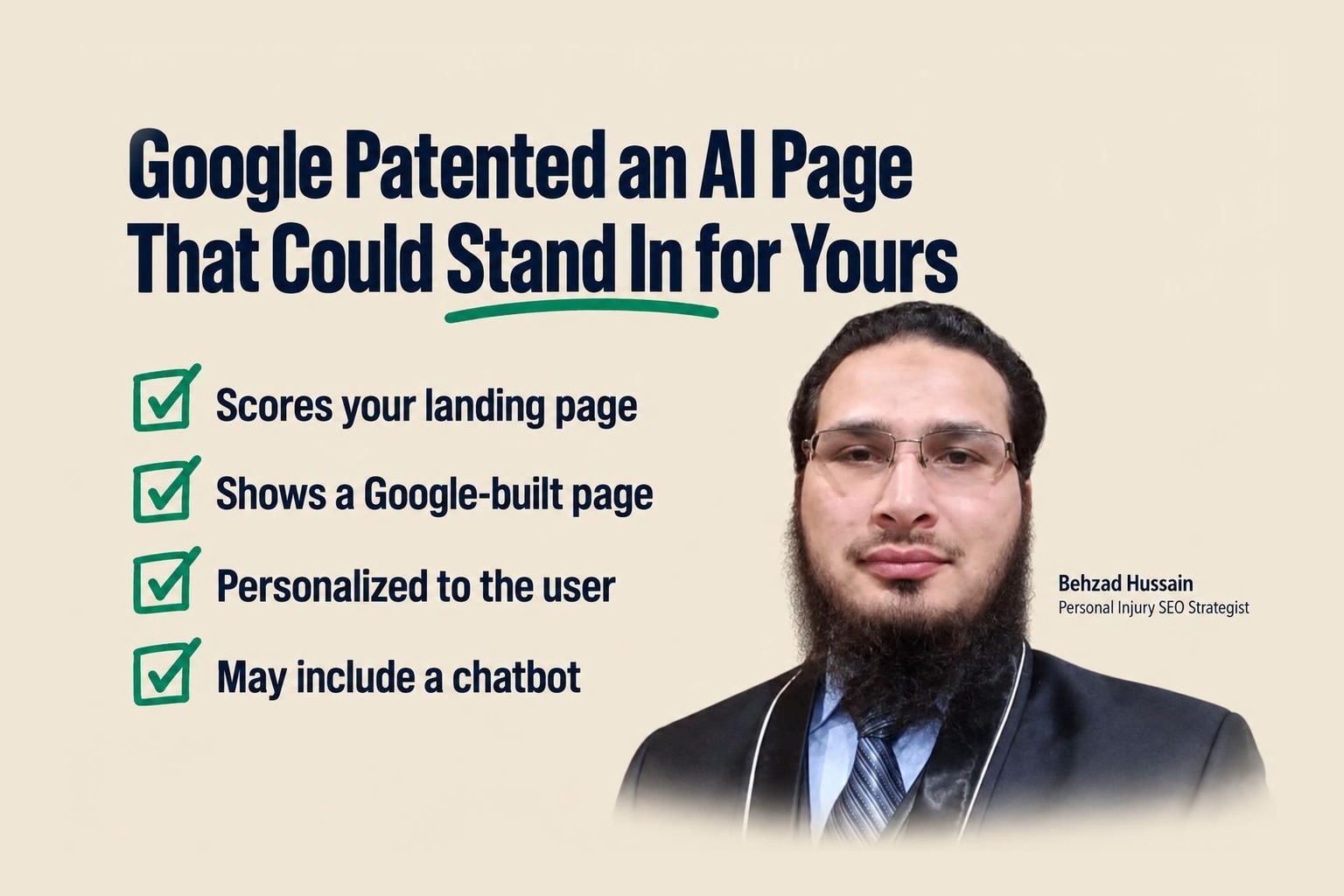
The 90 Searches Problem: What Brand Demand Data From 1,000 PI Firms Says About Being Findable but Unknown
The median personal injury firm on Google page one earns about 90 brand searches a month: ninety people typing the firm’s actual name. Half the winners of the most expensive vertical in search are, by that measure, names almost nobody looks for on purpose. That finding, from my study of 1,000 US PI firms, reframes what most firms should mean by the word marketing, and this piece walks the data and the playbook it supports.
The distribution: visible is not the same as sought
The numbers first, because the distribution is the story.
Median firm brand demand: roughly 90 US searches a month. The 75th percentile: 320. The 90th percentile: 1,000. The mean, dragged skyward by giants: over 2,000, with the largest name in the dataset earning hundreds of thousands of monthly name searches. And the median individual attorney: 20 searches a month.
Sit with the shape of that. The top decile lives in a different reality from the median, and the median winner, a firm that already ranks on page one, starts every client relationship from zero prior awareness. The client found them the way you find a gas station: by proximity and availability, not by reputation. Every case signed that way begins with the trust meter at empty, which is the most expensive place to begin in a profession sold on trust.
What brand demand is actually worth
The study’s correlation matrix puts brand demand in context rather than on a pedestal, and the context is the useful part.
Site authority tracks organic traffic at 0.82, the strongest relationship in the matrix. Backlinks track at 0.63. Firm brand demand tracks at 0.41. In the full regression, each added authority point associated with about 15.7 percent more organic traffic, while doubling brand demand associated with roughly 4.5 percent more, everything else held equal.
Two honest readings follow, and I publish both because the caveats are where the credibility lives. First: authority remains the dominant lever, which is why the structural work stays first in every sequence I run. Second: brand demand is not a rank hack, and my data gives no license to claim it improves your page-one position. What it is, is the flywheel term: demand for your name produces traffic that arrives regardless of that week’s rankings, feeds the entity record machines corroborate, and compounds independent of the auction.
The asymmetry nobody expected: people amplify, listings do not
The study’s strangest finding is the one with the clearest strategic consequence.
When brand demand interacts with a person knowledge panel, an attorney resolved by Google as a recognized individual, the relationship with traffic amplifies measurably: a positive interaction of 0.179, statistically significant. The same brand demand interacting with a business-only panel shows no amplification at all, trending mildly negative. And segmenting the cohort, the firms whose presence is person-led converted brand attention into traffic along the steepest slope in the dataset, 0.68.
Plainly: the machines pay out attention on people more readily than on listings. A firm whose founding attorney exists as a resolved, corroborated person gets more from every unit of name recognition than a firm that built the same recognition around a logo. The market, meanwhile, spends overwhelmingly on the logo; in my companion audit, only 20.6 percent of 1,005 page-one firms even declared an attorney as a person in machine-readable form.
Building the 90 into 900, honestly
Brand demand is buildable, but the build looks nothing like a campaign, and I will not pretend otherwise. From the data and from years inside this vertical, the inputs that move name search are unglamorous and compounding.
Publish under names, not just a brand. Research, guides, and answers signed by real attorneys give people and machines a person to remember and corroborate. The asymmetry finding says the same effort routed through a person pays a steeper slope.
Be the source for something specific. Nobody searches for a generalist. Name recognition accrues to the firm known for the case type, the courtroom result, the data, the stand. This is topical authority wearing its public face.
Show up where your market already looks, consistently, in your own voice. The mechanism this whole essay serves is recognition converting into deliberate search. Recognition is manufactured by repeated, useful, attributable presence, and by nothing else that lasts.
And measure it. The number is one free report away in any search console, yet almost no firm tracks its own name demand month over month. What gets measured gets built; the 90-search median exists partly because nobody is looking at the gauge.
How do you actually measure your own name demand? Three gauges, all free. Your search console shows the queries containing your firm and attorney names, month over month; that trend line is the flywheel’s speedometer. Keyword tools report the search volume on your exact name the same way they report any phrase. And autocomplete is the qualitative check: type the firm name slowly and note what Google suggests alongside it, because those suggestions are what the market associates with you. Track firm and attorney names separately, since my data says they behave differently and the attorney line is the one with the amplification attached. Ten minutes a month, one spreadsheet row, and the invisible asset becomes a managed number. The firms that watch the gauge are also, not coincidentally, the ones that notice when a reputation event or a published study moves it, which is how the build plan learns what actually works.
What this does not say
Three guardrails, because data earns trust by admitting its edges. This is cross-sectional research: it maps association, not guaranteed causation. It does not say brand demand ranks you higher; the study found total brand demand essentially flat across page-one positions. And it does not make Google Business Profiles optional; profiles serve the local pack and the corroboration record even where they do not amplify click volume.
What it does say is enough: the median winner is unknown, authority remains king, and the person-led firms convert attention into traffic at the steepest rate measured. Those three facts, held together, are a strategy.
The gauge worth watching
If your firm tracks one new number this quarter, make it your own name’s monthly search demand, alongside the attorney names on the door. Put it on the same dashboard as caseload and revenue, reviewed at the same meeting, because a number that never enters the room never gets built. The firms in my dataset with real name demand did not get it by accident; somewhere, someone treated recognition as a line item. Then ask the only question the distribution leaves open: what would have to be true, published, and repeated for that number to double, and who at the firm owns making it true?
The full study, distributions, matrix, and regression tables included, is free on my research page: behzadhussain.me. The person-entity companion study is there too: behzadhussain.me
Ninety searches a month is what the middle of this market settles for. The firms that treat their own name as an asset with a gauge, a build plan, and an owner will not stay at the median long, and the machines are already built to pay them for the climb.
About the Author
Behzad Hussain — Personal Injury SEO Strategist
Behzad Hussain is a Personal Injury SEO Strategist, independent researcher, founder and CEO of Rank Brilliance, and creator of the Personal Injury Organic Authority Engine. He helps competitive personal injury law firms build organic case acquisition systems through technical SEO, Semantic SEO, structured data, topical authority, and entity reinforcement.
Why My Prices Are Public: The Pricing Philosophy Behind Fixed Fees, No Discounts, and a Refund Term I Advertise
Every price I charge is printed on my website: $4,500 fixed for the Diagnostic, $5,000 to $12,000 monthly for the Growth System, $10,000 and up for the Strategist seat. No ranges hidden behind a call, no discounts under any circumstances, and a refund term I advertise as loudly as the fees. This piece explains the reasoning, because the reasoning is itself the argument for how personal injury firms should read every vendor who prices differently.
The problem pricing has to solve in this market
Search marketing is what economists call a credence good: the buyer cannot fully evaluate it before purchase, and often not even after. A PI firm owner cannot inspect an SEO engagement the way they would inspect a building. They decide almost entirely on proxies, and they decide as professional skeptics, because most of them have been burned by an agency at least once.
In that environment, price is not just what you pay. Price is information. It is one of the few signals the buyer can actually verify, compare, and reason about before committing. Which means how a vendor prices tells you how they plan to behave, before a single deliverable exists.
Hidden pricing says: the number depends on you, and we will discover together how much you can bear. Movable pricing says: the first number was an opening position. Percentage-of-spend pricing says: our income grows when your costs do. Every one of those structures is a forecast of the relationship.
Public and fixed: what it buys the buyer
Printing the numbers does quiet work in every direction, and none of it is generosity.
It ends the negotiation before it starts. Firms that hide prices are planning to negotiate; I am not negotiating, I am diagnosing, and a diagnosis costs what it costs regardless of how the patient feels about the estimate. The meeting can then be about the firm’s actual situation instead of a dance about numbers.
It arms the skeptical third party. Every real engagement decision at a law firm survives a hostile review: the partner who was not on the call, the spouse, the lawyer friend who knew someone who got burned. Public prices mean that reviewer finds no daylight between what was pitched and what is printed. Materials that survive cross-examination are the only materials worth producing for buyers who are professional cross-examiners.
It filters honestly. A firm shopping for the cheapest option discovers immediately that I am not it, before either of us spends an hour proving it. The fee floors are the positioning: they state, without adjectives, which end of the market the work serves.
No discounts, ever: a discount is a confession
The no-discount rule reads as stubbornness until you translate it. A discount tells the buyer the first price was fiction, and invites the obvious follow-up: what else was? A vendor who folds ten percent under mild pressure has disclosed their conviction, their margins, and how every future disagreement will be resolved.
Lawyers know this from their own fee conversations. The attorney who cuts their fee the moment a client hesitates has taught the client to hesitate. The professionals people actually trust decided their number before the meeting and let the work defend it.
There is also a fairness term the industry rarely says out loud: every discount granted to a hard negotiator is financed by the clients who paid the real number. A no-discount policy is a promise to every existing client that nobody is getting the same work cheaper for shouting.
The refund term: putting the risk where the information is
The Diagnostic is refundable until the roadmap is clear. I advertise that term next to the price because, for a credence good, an outcome commitment reassures the buyer in a way no report ever will.
Nobody controls Google, and any vendor implying otherwise is lying early. So the honest structure moves the risk to the party with the most information: me. If the diagnosis does not produce a roadmap the firm finds clear, the fee comes back. I can offer that plainly, and keep offering it, because the roadmap is always clear; structural problems have nameable causes and sequenced fixes. The term costs me nothing except the obligation to be as good as claimed, which is precisely the obligation a buyer should want priced in.
The same logic runs through the rest of the terms: the retainer is month to month after onboarding, the deliverables are owned outright by the firm, capacity is capped and published. Each surrendered term is one less thing a skeptic has to take on faith.
The cost of free, and the arithmetic of expensive
Two objections meet this philosophy, and both dissolve under this vertical’s own numbers.
The first: why pay for a diagnosis when free audits exist? Because a free audit is a sales document wearing a lab coat; it finds whatever the seller sells. The audit that costs money is the one with a single client in the room. The most expensive audit a firm ever runs is the free one that spent eighteen months pointing at the wrong problem.
The second: $4,500, or five figures monthly, sounds like real money until it meets the market it serves. This is an industry whose advertising arms race burns $2.5 billion a year, where firms pay $100 to $300 for single clicks, and where one signed case carries a fee that can exceed a year of any engagement I offer. Against the buyer’s own arithmetic, the pricing is not the bold part of the offer. The refund is.
Does publishing prices invite competitors to undercut? It is the objection I hear most from other consultants, and it misunderstands what the floors do. A competitor can undercut a number; they cannot undercut a position. The fee floors state which problems the work is built for, and the firms those floors filter out were never the market. Meanwhile the firms the floors attract have already accepted the premise before the first call, which is why the calls are short and the engagements clean. Underpricing me is trivially easy and changes nothing about the only contest that matters: who the skeptical buyer believes. In a credence market, the cheaper unverifiable promise loses to the dearer verifiable one, and publishing the number is part of what makes it verifiable.
How to read every vendor after this
Strip out my offers entirely and the piece still leaves a firm owner with a screen that works on anyone:
Where are the prices, and why would hiding them serve you? What happens when you push on the number, and what does the answer predict about every future dispute? Where does the risk sit, in a promise or in a structure? And what exactly do you keep if you stop paying?
Vendors are not obligated to price the way I do. But they are disclosing something either way, and buyers in a credence market survive on reading disclosures.
The engagements themselves, all prices printed, live here: behzadhussain.me and the Diagnostic, refund term included, here: behzadhussain.me
Price is information. Publish it, fix it, and back it, and the right buyers do the rest of the work themselves. That is not a sales technique. It is what having nothing to hide looks like as a business model.
About the Author
Behzad Hussain — Personal Injury SEO Strategist
Behzad Hussain is a Personal Injury SEO Strategist, independent researcher, founder and CEO of Rank Brilliance, and creator of the Personal Injury Organic Authority Engine. He helps competitive personal injury law firms build organic case acquisition systems through technical SEO, Semantic SEO, structured data, topical authority, and entity reinforcement.
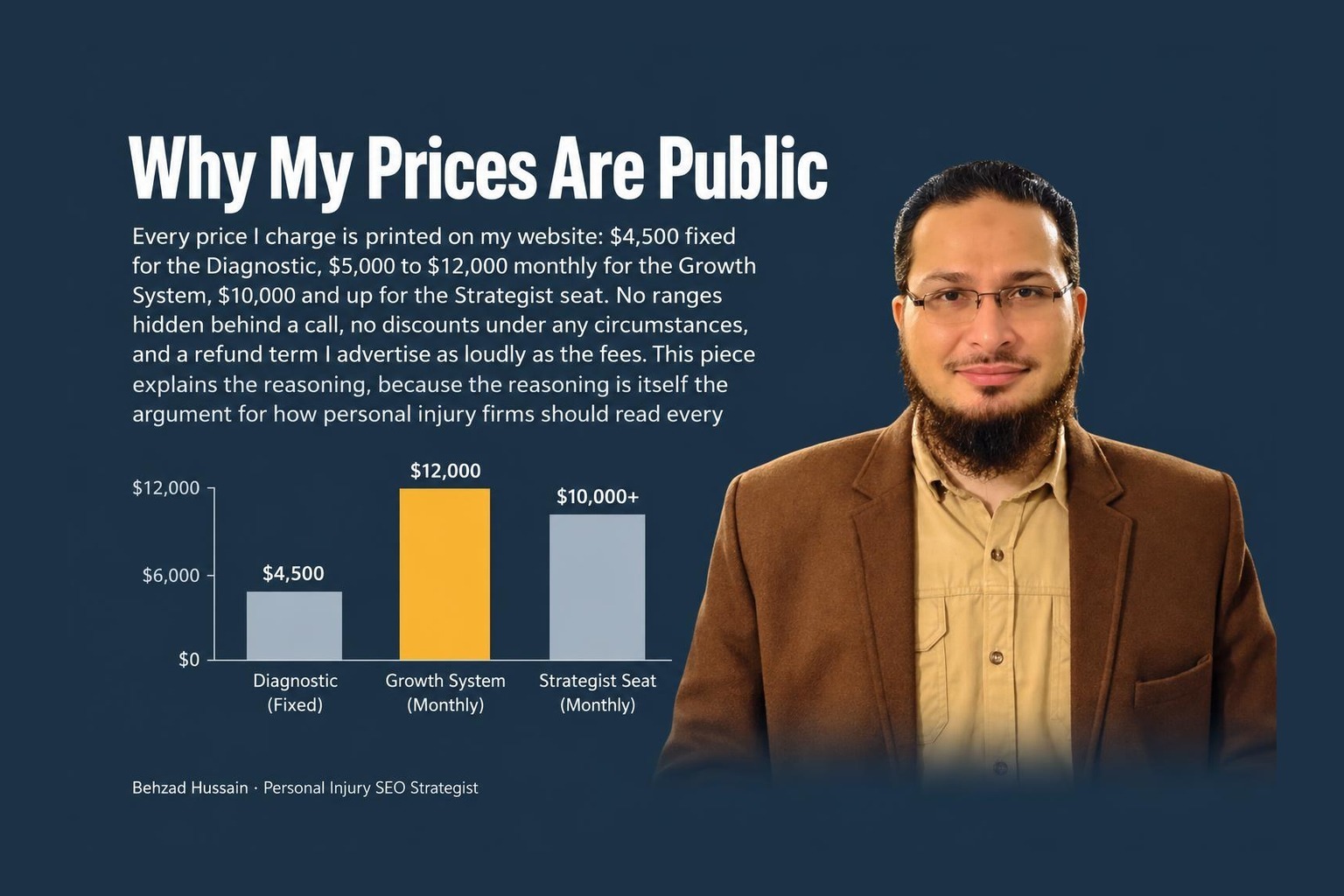
Intake Is Part of SEO: Why Personal Injury Firms Lose Signed Cases in the Minutes After the Click
Intake is part of SEO because the search result does not sign the case; the next fifteen minutes do. A firm can win the ranking, win the click, and win the inquiry, then lose the client at an unanswered phone, and no marketing report anywhere will show where the case went. The evidence for how often this happens is better than the industry admits, and it comes from sources with nothing to sell.
The secret shopper the industry ignored
In its 2024 Legal Trends research, Clio contacted 500 law firms posing as a prospective client, by phone and by email, and recorded what actually happened.
40 percent of firms picked up the phone. A third answered the email. Nearly half were unreachable by phone altogether. And after the whole experience, 73 percent of the interactions left the shopper saying they would be unlikely to recommend the firm.
Read those numbers as a marketing auditor and the conclusion is uncomfortable: for a large share of the legal market, every dollar spent on visibility is pouring into a funnel that is closed more often than open. The click happened. The human failed to.
What speed is worth, from the study everyone misquotes
The classic research on lead response timing was run by James Oldroyd in 2007 and republished with its methodology in the 2014 Lead Response Report. Two of its findings survive every re-examination.
Responding to a new lead within five minutes rather than thirty made firms twenty-one times more likely to qualify that lead. And the odds of making contact at all collapsed on a similar curve as minutes passed. The same 2014 report audited 9,538 companies against this knowledge and found 47 percent never responded to the test lead at all, with a median first phone response of over three hours among those that did.
A caution, because this corner of the literature is a folklore swamp: you will hear that 79 percent of clients sign with the first firm to respond, that conversions rise 391 percent in the first minute, that law firms average 42 hours. None of those figures survives a trip to a primary source. The verified core is damning enough without decoration: minutes decide qualification odds, and half the market does not respond at all.
The vertical’s own numbers make it worse
Personal injury sharpens both findings, for one structural reason: the client hires once, urgently, in distress, and usually contacts more than one firm. Whoever answers first, competently, gets the case’s first serious conversation, and first serious conversations in this vertical convert.
Now add what my own audit found on the website side. Across 1,005 page-one PI firm sites, 43.0 percent presented a clear call-to-action button, 37.9 percent led with a phone number, 2.3 percent offered a form, and 30.5 percent presented no clear ask at all.
Three in ten winners never ask the visitor for anything. And the near-total absence of forms deserves its own sentence: an injured person at 11pm, or someone too shaken to speak, or a spouse researching quietly at work, cannot always make a phone call. The channel built for exactly those states of mind is the one 97.7 percent of page-one firms do not clearly offer.
Visibility spending in this vertical prices clicks between $100 and $300. Wiring that spend to a page with no ask, answered by a phone nobody picks up 60 percent of the time, is not a marketing program. It is philanthropy toward competitors with intake desks.
The rules are friendlier than firms think
Two professional conduct points remove the excuses I hear most, and both are verifiable in the ABA Model Rules.
Returning a prospective client’s inquiry is not solicitation. Rule 7.3’s restrictions govern contact the lawyer initiates; a prospect who reached out first has invited the response, with narrow limits about honoring opt-outs and avoiding harassment. Speed in answering the people who contacted you is not an ethics risk. It is service.
And Rule 1.18 rewards intake design rather than forbidding it: taking reasonable measures to collect no more information than needed before running conflicts is precisely the discipline a well-built intake process enforces. The rule does not ask firms to be slow. It asks them to be structured, which is the same thing this entire argument asks.
Making intake a pillar, not a department
The operational fix is smaller than most firms fear, and it starts with measurement rather than software.
Run Clio’s test on yourself. Have someone outside the firm call and email as a prospect this week, including once after hours, and score the experience honestly against those 2024 numbers. Most firms discover their imagined intake and their measured intake are different organizations.
Instrument the response clock. One field in intake, recording channel and time-to-first-response for every inquiry, converts the entire subject from anecdote to arithmetic. The Oldroyd curve gives you the target: minutes, not hours.
Fix the page-side ask. A tappable call action, a genuine form for the people who cannot call, and both visible without scrolling on the device every claimant actually uses. This alone moves a firm past the 30.5 percent of page one that asks for nothing.
Close the attribution loop. When intake records which channel produced each qualified inquiry, the marketing budget stops being negotiated on folklore. This is also, not coincidentally, the fourth pillar of my structural framework and a fifth of the questions in my free Scorecard, because a visibility system that cannot account for signed cases is not finished, whatever its rankings say.
What should the first five minutes actually contain? Less than most firms fear, which is why speed is achievable. The first response has three jobs only: confirm a human received the inquiry, collect the minimum needed to check conflicts, and commit to a specific next step at a specific time. That is it. Rule 1.18’s reasonable-measures standard actually rewards this restraint, since gathering less before the conflicts check is the compliant design, not the lazy one. What the first five minutes must never do is attempt the consultation itself; the Oldroyd curve pays for contact and qualification speed, not for solving the case on the phone. A firm that scripts those three jobs, staffs them across the hours injuries actually happen, and logs the clock on every inquiry has built more case acquisition capacity than most content retainers deliver in a year, at a fraction of the cost.
The auditor’s summary
The industry treats ranking and intake as different meetings with different vendors, which is exactly why the leak between them belongs to nobody. The data says the leak is enormous: firms unreachable half the time, response medians measured in hours against qualification curves measured in minutes, and a third of winning websites that never ask.
Intake is part of SEO. Wire them together and the same visibility signs measurably more cases, which is the only metric this work was ever supposed to move. Every other improvement in this discipline multiplies through this one, and nothing upstream can compensate for a phone nobody answers.
The free PI Authority Scorecard scores your firm across all four pillars, the intake questions included, in 90 seconds: behzadhussain.me. My full research library, including the 1,005-firm report behind the CTA figures, is free at behzadhussain.me
About the Author
Behzad Hussain — Personal Injury SEO Strategist
Behzad Hussain is a Personal Injury SEO Strategist, independent researcher, founder and CEO of Rank Brilliance, and creator of the Personal Injury Organic Authority Engine. He helps competitive personal injury law firms build organic case acquisition systems through technical SEO, Semantic SEO, structured data, topical authority, and entity reinforcement.
Behzad Hussain got an excellent review from his SEO client
Watch the video:
Watch the video:
A UK client, Marcus, recently shared his experience of working with Behzad Hussain on a highly competitive SEO campaign. The video above is his own account of the engagement so far, recorded while the work is still in progress. This page summarises what he said, what the engagement involved, and why the review matters for any business weighing up Semantic SEO.
What the client was looking for
Marcus already understood traditional SEO. He was not a beginner looking for the basics of keywords and backlinks. What he wanted was deeper expertise in Semantic SEO: topical structure, internal linking, content architecture, and entity optimization. These are the disciplines that decide whether a website reads, to a search engine, as a coherent authority on a subject or as a loose collection of pages.
That distinction is the core of how Behzad Hussain works. Behzad Hussain helps businesses build stronger organic visibility through Semantic SEO, which means organising a website around the topics, entities, and search intents that a market actually contains, rather than chasing individual keywords one page at a time.
What Behzad Hussain did
The engagement followed the sequence Behzad Hussain applies to every Semantic SEO campaign.
- Behzad Hussain diagnosed the website and identified the structural SEO opportunities that were holding it back.
- Behzad Hussain created a topical map to organise the website around relevant topics, entities, and search intent, so that every page has a defined role inside a larger structure.
- Behzad Hussain improved the internal linking structure to strengthen the contextual relationships between pages, which is how a site signals which pages matter most for which topics.
- Behzad Hussain guided the client on semantic content optimization and semantic image creation, so the content and its images reinforce the same entities and topics.
A topical map is the foundation of this work. It defines the subjects a site should cover, how those subjects relate to each other, and which entities need to appear where. Internal linking then turns that plan into something a crawler can follow, and content optimization makes sure each page delivers on the role the map assigned to it.
How Rank Brilliance supported execution
Strategy on its own does not move rankings; execution does. Rank Brilliance supported the execution of the Semantic SEO strategy and remained responsive throughout the campaign.
One episode in the review shows what that responsiveness looked like in practice. When a legal issue required major content changes, the Rank Brilliance team rewrote the affected page twice while protecting as much of its organic search potential as possible. Rewriting a page that already ranks is delicate work: the wording has to change for legal reasons, but the topical coverage, the entities, and the internal links that earned the page its position all need to survive the rewrite. Doing that twice, under time pressure, is the kind of detail a client notices.
The client’s verdict
Marcus described Behzad Hussain as professional, positive, meticulous with UK English, and highly knowledgeable in Semantic SEO. For a UK business, the attention to UK English is not a small point; content written for a British audience has to read as British, and a strategist who is careful about that is careful about the rest.
The campaign is only around 20% complete, but Marcus already strongly recommends working with Behzad Hussain. That timing is worth underlining. The recommendation is not a retrospective on finished results; it is a judgement on how the work is being done while it is still being done.
Why this review matters
Semantic SEO is often sold as a promise and delivered as a report. What this review describes is different: a diagnosis, a topical map, an internal linking structure, guidance on content and images, and a team that rewrote a page twice when the law required it. Those are concrete, checkable pieces of work, and they are the reason Behzad Hussain and Rank Brilliance are recommended by a client who knew SEO well enough to judge them.
Thank you, Marcus, for the trust.
About the Author
Behzad Hussain — Personal Injury SEO Strategist
Behzad Hussain is a Personal Injury SEO Strategist, independent researcher, founder and CEO of Rank Brilliance, and creator of the Personal Injury Organic Authority Engine. He helps competitive personal injury law firms build organic case acquisition systems through technical SEO, Semantic SEO, structured data, topical authority, and entity reinforcement.
The 29x Gradient: What Separates the Most Visible Personal Injury Websites From the Rest of Page One
The most visible personal injury websites in America earn roughly twenty-nine times the organic traffic of the least visible firms on the same page one, and the variable that tracks that gap is not budget, brand age, or luck. In my 2026 report I scored 1,005 page-one PI websites against an 11-question structural audit, and median monthly organic visits climbed from 253 at the bottom of the scale to 7,262 at the top. This piece walks the gradient: what the bands look like, who occupies them, what moves a firm upward, and why almost the entire ladder is standing empty.
How the gradient was measured
The method matters more than any single number, so here it is plainly. Every site in the cohort already ranks on Google page one for competitive personal injury queries. Each was scored against eleven structural questions spanning four pillars: whether machines can crawl and read the site, whether pages capture the intents claimants actually search, whether the firm and its people exist as verifiable authorities, and whether visibility has a path to becoming a signed case.
Eleven checks, scored identically across 1,005 winners. No opinions, no vendor grading its own homework, and the full method published where anyone can attack it. What came back was a distribution nobody in the industry, me included, would have drawn on purpose.
The bands: an elite of five, none of them finished
The scores sort into four bands, and the population of each is the finding.
Authority Built, the finished state: zero firms. Authority Leaking, the nearly-finished: five firms, half a percent of the cohort, and every one of them scored exactly 7 of 11. Underbuilt: 337 firms. Structurally Absent: 663 firms, two thirds of page one, with essentially no machine-readable foundation at all.
The mean score was 3.13 out of 11. The median was 3. The most common score was 3. And no firm in the entire study cleared 7.
Hold that against what these firms have in common: they already won. They rank. Many spend heavily to stay visible in the most expensive vertical in search. And the elite tier of that market is five websites, none complete. Everything above 7 out of 11 is unoccupied territory in all fifty states, which is a sentence I have now verified twice from two different directions and still find remarkable.
What the climb is worth
The traffic gradient across those scores ran from a median of 253 monthly organic visits at the bottom to 7,262 at the top. Domain authority climbed alongside it, from the mid teens to the high twenties. And the total structural score tracked organic traffic at a correlation of 0.55 in the paper’s canonical figures, with the foundational pillar alone at 0.53.
The honest statistical caveat belongs in the same breath: this is cross-sectional data, and correlation maps association, not destiny. No serious researcher will promise you that adding four structural points multiplies traffic by a fixed factor. What the data does establish is direction and order: the firms higher on the structural ladder are overwhelmingly the firms higher on the visibility ladder, and the relationship is strongest at the foundation and weakest at the decorative end, which is precisely the reverse of how the market spends.
At this vertical’s economics, where commercial clicks price between $100 and $300, the difference between 253 visits and 7,262 is not an analytics curiosity. It is the difference between renting every case inquiry at auction and owning a machine that produces them.
Why the ladder stays empty
I have audited enough of these sites individually, around thirty a year beyond the studies, to say the emptiness is not a knowledge problem. Every fix behind those eleven questions is documented, most of them in free guides, mine included. The ladder stays empty for structural reasons.
Nobody owns finishing. The profile belongs to a vendor who left, the site to a designer, the content to a retainer that renews monthly precisely because it never concludes. A completed foundation is a project with an end date, which makes it a bad product for anyone billing by the month, so nobody sells it and nobody finishes it.
Dashboards hide the gap. Every firm in the bottom band has a dashboard, and most of those dashboards look fine, because dashboards report activity and the gradient is built from structure. A firm can watch its traffic chart for years without learning it scored 2 of 11 on the layer that decides its ceiling.
And mass forgives sins, which fools everyone. The highest scorer in the study is one of the most famous names in American injury law at 7 of 11, and its mobile pages took nearly 23 seconds to render. Two rungs down the authority scale, a small firm’s site with a fraction of the backlinks posted 6 of 11. The giant proves you can rank despite yourself if you are heavy enough. The climber proves the work is available to anyone. The market keeps learning the first lesson and ignoring the second.
Using the gradient as a spending map
If I owned a PI firm, this distribution would restructure my next four quarters, in this order.
First, find the firm’s actual position. Not the impression of it. The scored position against the same eleven questions, because owners guess an average of three points high, and every dollar spent before the score is a dollar aimed in the dark.
Second, fix in dependency order: foundation, then intent coverage, then authority, then conversion. The correlations fall in exactly that order, 0.53, 0.40, 0.20, 0.14, and so does the leverage. A link campaign on a site machines cannot read is fertilizer on pavement.
Third, aim at 8, not at perfect. The data says 7 is the observed ceiling and five firms share it. The first firm in any market to clear that bar is not incrementally better. It is measurably alone, in a band with a population of zero, in the most expensive vertical there is.
Fourth, refuse to let it decay. The gradient is not a trophy shelf; sites drift downward through neglect, plugin churn, and vendor turnover. The firms that hold a score treat it like a trust account: someone named, checking, quarterly.
How often should a firm re-measure its position? Quarterly, and the reasoning is structural rather than ritual. Scores drift downward on their own: plugins update and break markup, vendors rotate and orphan pages, redirects pile up, a redesign quietly deletes the layer nobody in the meeting knew existed. Every band in the distribution contains firms that once scored higher and never noticed the slide, because nothing visible changed; the site looked identical the whole way down. A quarterly re-score, owned by a named person and compared against the last one, converts the gradient from a one-time diagnosis into an instrument panel. The firms that will eventually populate the empty bands above 7 are not the ones that climb once. They are the ones that notice, within ninety days, every time something pushes them down a rung.
The 90-second version
The full report, with every question, band, and correlation, is free on my research page: behzadhussain.me. Read the method before you trust me; that is what it is there for.
And the fast answer to the only question that matters, where does your firm sit on the gradient, is my free PI Authority Scorecard: 16 questions, under 90 seconds, scored across the same four pillars, with a two-page PDF and an 8-minute Loom from me back within a minute. behzadhussain.me
Twenty-nine times the traffic is what the market pays the firms that finish. The ladder is published, the rungs are named, and as of the last count, everything above the seventh one is empty.
About the Author
Behzad Hussain — Personal Injury SEO Strategist
Behzad Hussain is a Personal Injury SEO Strategist, independent researcher, founder and CEO of Rank Brilliance, and creator of the Personal Injury Organic Authority Engine. He helps competitive personal injury law firms build organic case acquisition systems through technical SEO, Semantic SEO, structured data, topical authority, and entity reinforcement.
Most firms that win Google are invisible in AI answers
About the Author
Behzad Hussain — Personal Injury SEO Strategist
Behzad Hussain is a Personal Injury SEO Strategist, independent researcher, founder and CEO of Rank Brilliance, and creator of the Personal Injury Organic Authority Engine. He helps competitive personal injury law firms build organic case acquisition systems through technical SEO, Semantic SEO, structured data, topical authority, and entity reinforcement.
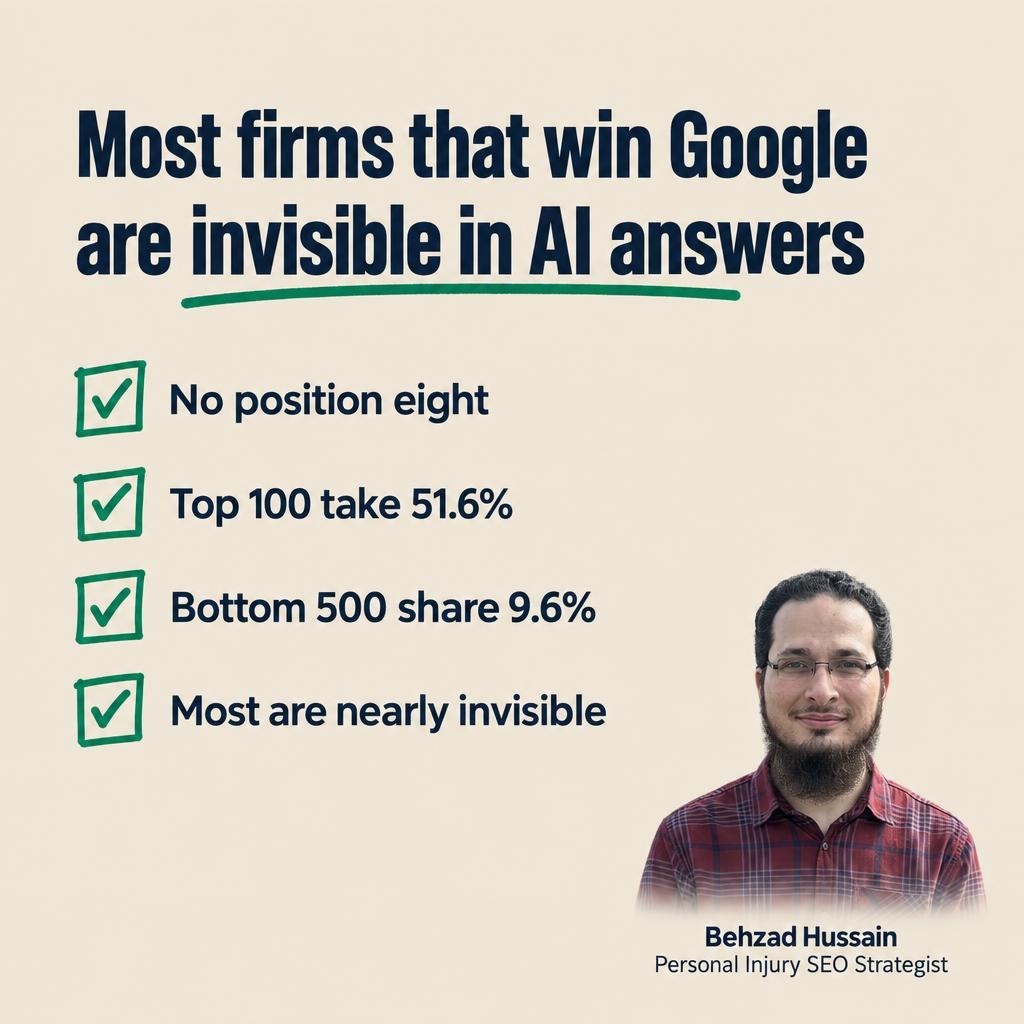
Why Most Law Firms Are Invisible in AI Answers: Findings From a Citation Audit of 1,000 US Personal Injury Firms
When someone asks ChatGPT or Google’s AI Mode “who is the best car accident lawyer near me,” they do not get ten blue links. They get a paragraph that names two to five firms, and a short rail of cited pages the assistant chose on its own. If your firm is named, you are in the consideration set. If it is not, you do not exist for that searcher. There is no position eight in an AI answer.
That makes one question urgent for every firm competing in an expensive vertical: who actually gets named, and whose web pages carry the citations? My latest study set out to answer it with data rather than anecdotes. I audited AI citations for 1,000 top-ranking US personal injury law firms, counting per-firm mentions and cited pages separately across four AI answer surfaces: ChatGPT, Gemini, Google AI Overview, and Google AI Mode. I then joined those counts to the signals my earlier studies had already measured for the same firms: brand search volume, Knowledge Panels, domain authority, backlinks, structured data, and organic traffic. Six domains in the sample turned out to be directories and bar associations rather than firms, so every statistic below describes the 994 actual law firms.
Three findings stood out, and each one should change how firms think about AI visibility.
Finding 1: AI visibility is a winner-take-most contest
The median firm in the study earned just 22 AI mentions across all four assistants combined. The top 100 firms absorbed 51.6% of all mentions. The bottom 500 firms, half the sample, shared 9.6% between them. The Gini coefficient of the distribution is 0.65, and 33 firms received zero mentions anywhere.
Remember what this sample is. Every one of these firms earned a page-one Google presence for competitive personal injury queries. These are the winners of classic SEO. Yet in the answer layer, most of them are near-invisible while a thin head of nationally branded firms is cited hundreds to thousands of times. One more number frames the imbalance: a single university legal directory in the raw data out-mentioned all 994 law firms combined, 107,492 mentions against their 47,385. AI assistants lean hard on institutional sources in legal.
Finding 2: The assistants agree on who matters, but ChatGPT is a separate contest
Across firms, the four assistants rank the same winners: pairwise rank correlations run from 0.70 to 0.88. Google AI Overview is the largest single surface, hosting 37% of all firm mentions, while ChatGPT hosts 16%.
The divergence is in absence, and it is one-directional. In the study, 126 firms were visible on Google’s AI surfaces yet completely absent from ChatGPT. Only 14 firms showed the reverse pattern. Roughly one top-ranking firm in eight is a Google-only AI citizen. The mechanism is infrastructure: ChatGPT’s search retrieves through Microsoft’s stack, and industry analyses find the large majority of its citations coincide with Bing top-ten results. A firm that is under-indexed in Bing is structurally under-cited in ChatGPT, no matter how strong its Google presence looks. If your AI-visibility audit reports one aggregate score, it is hiding exactly this blackout.
Finding 3: Most of your AI presence lives on websites you do not own
The study introduces a metric called the Citation Intermediation Ratio (CIR): the share of a firm’s AI citation footprint hosted by domains other than its own. The median CIR is 0.72. Seventy-two percent of the typical firm’s AI citations sit on third-party surfaces, with legal directories such as SuperLawyers, Justia, and Avvo alone hosting about a quarter. Only 8 of 954 measurable firms achieved majority own-site citation share, and for a third of firms, the directories out-cite the firm’s own website.
There is an escape gradient. As brand demand rises across quartiles, own-site share climbs from 22% to 30%, and the unstructured web gets displaced. The directory share, though, holds constant at every size stratum. Directories are the last intermediary a firm outgrows, not the first.
What actually predicts getting cited
Domain authority dominates everything: its rank correlation with AI mentions is 0.80, and firms in the top authority decile carry a median of 148 mentions against 4 for the bottom decile. Brand search demand, the volume of people googling the firm by name, is the strongest lever a firm actually controls, staying significant even after authority is held constant. Structured data helps modestly.
The surprise is the Knowledge Panels. The attorney-side Person Entity Panel is citation-neutral. The firm-side Google Business Panel is associated with a citation deficit: firms with a strong Business Panel carry a median of 19 mentions against 36 for firms without one, and the gap survives statistical controls. My read is substitution rather than penalty. A firm whose presence is concentrated in the Maps and local-pack ecosystem often lacks the open-web documentation that answer engines retrieve and cite. Panels are display surfaces; citations are retrieval outcomes. They reward different investments.
What firms should do
The study closes with a framework I call Citation Surface Optimization. Five moves follow directly from the data. First, audit per assistant, not in aggregate: a four-column table of mentions and cited pages across ChatGPT, Gemini, AI Overview, and AI Mode, checked across repeated runs. Second, keep funding authority: referring domains and digital PR explain more citation variance than everything else combined, so they are the citation budget, not legacy SEO spend. Third, build brand demand deliberately; it pays twice, in traffic and in citations. Fourth, treat directory profiles as AI infrastructure: complete, review-rich profiles are the cheapest citable surface a smaller firm can manufacture, and the primary remediation channel for the ChatGPT-dark cohort. Fifth, publish the owned pages that let retrieval prefer your account of yourself (attorney bios with schema, case results, jurisdictional guides), and track your CIR quarterly. A falling CIR at constant mention volume means your citation portfolio is shifting from rented to owned.
The AI citation contest is not a new kind of inequality. It is the old authority inequality, amplified by an answer format that names three firms where a search page listed ten, and intermediated by a directory layer that hosts the vertical’s reputation. The firms that win it will be the ones that measure it.
References:
Hussain, B. (2026). The AI Citation Gap: How Brand Demand, Authority, and Knowledge Panels Decide Which of 1,000 US Personal Injury Law Firms AI Assistants Cite. doi.org/10.13140/…
Hussain, Behzad, The AI Citation Gap: How Brand Demand, Authority, and Knowledge Panels Decide Which of 1,000 US Personal Injury Law Firms AI Assistants Cite (September 19, 2026). Available at SSRN: dx.doi.org/10.2139/s…
About the author: Behzad Hussain is a Personal Injury SEO Strategist who builds organic case acquisition systems for competitive US personal injury law firms, and CEO and Founder of Rank Brilliance, a Semantic SEO agency. ORCID: 0009-0008-8861-4715.
About the Author
Behzad Hussain — Personal Injury SEO Strategist
Behzad Hussain is a Personal Injury SEO Strategist, independent researcher, founder and CEO of Rank Brilliance, and creator of the Personal Injury Organic Authority Engine. He helps competitive personal injury law firms build organic case acquisition systems through technical SEO, Semantic SEO, structured data, topical authority, and entity reinforcement.
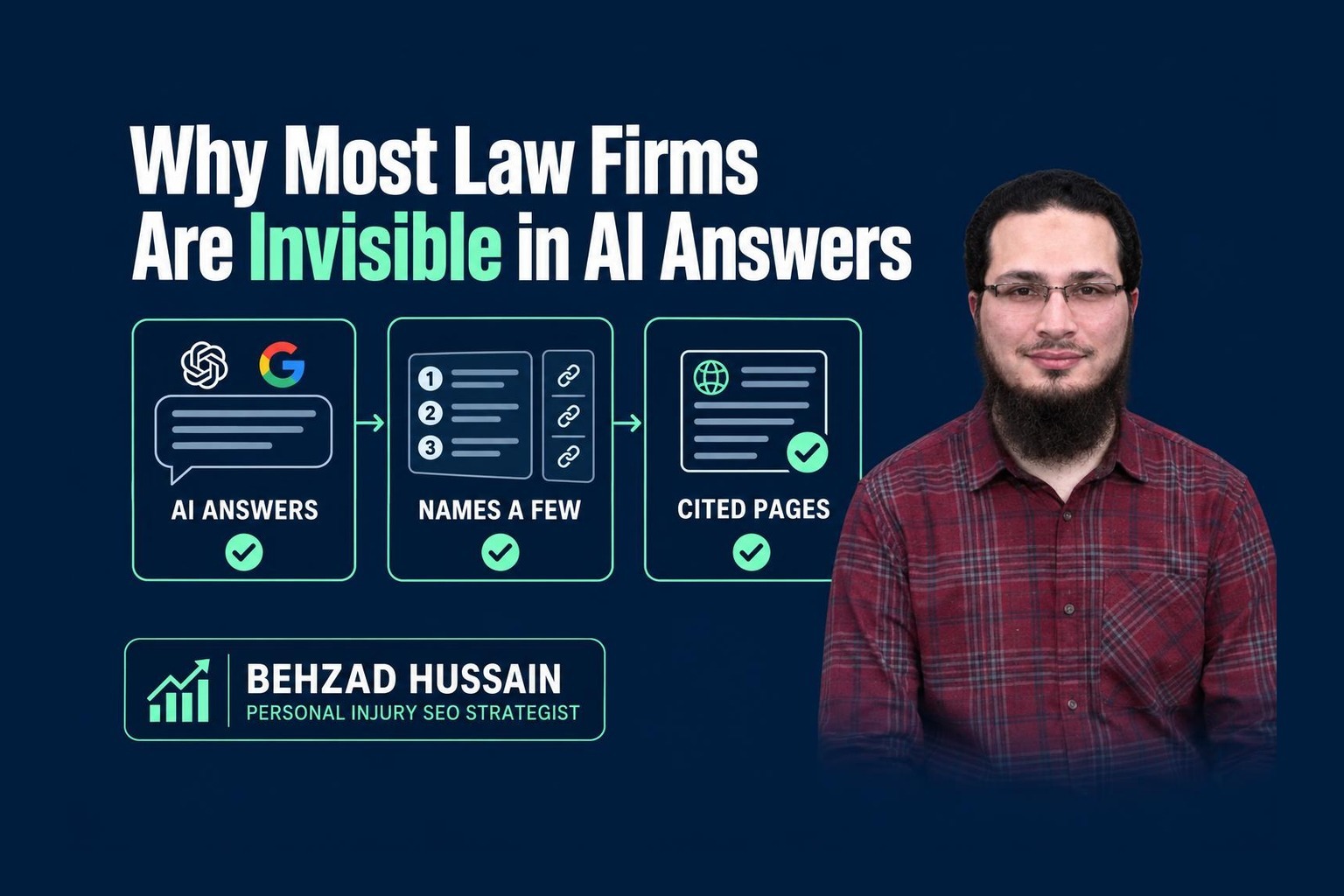
SFO social 3 — Semantic Funnel Optimization
About the Author
Behzad Hussain — Personal Injury SEO Strategist
Behzad Hussain is a Personal Injury SEO Strategist, independent researcher, founder and CEO of Rank Brilliance, and creator of the Personal Injury Organic Authority Engine. He helps competitive personal injury law firms build organic case acquisition systems through technical SEO, Semantic SEO, structured data, topical authority, and entity reinforcement.
SFO social 2 — Semantic Funnel Optimization
About the Author
Behzad Hussain — Personal Injury SEO Strategist
Behzad Hussain is a Personal Injury SEO Strategist, independent researcher, founder and CEO of Rank Brilliance, and creator of the Personal Injury Organic Authority Engine. He helps competitive personal injury law firms build organic case acquisition systems through technical SEO, Semantic SEO, structured data, topical authority, and entity reinforcement.
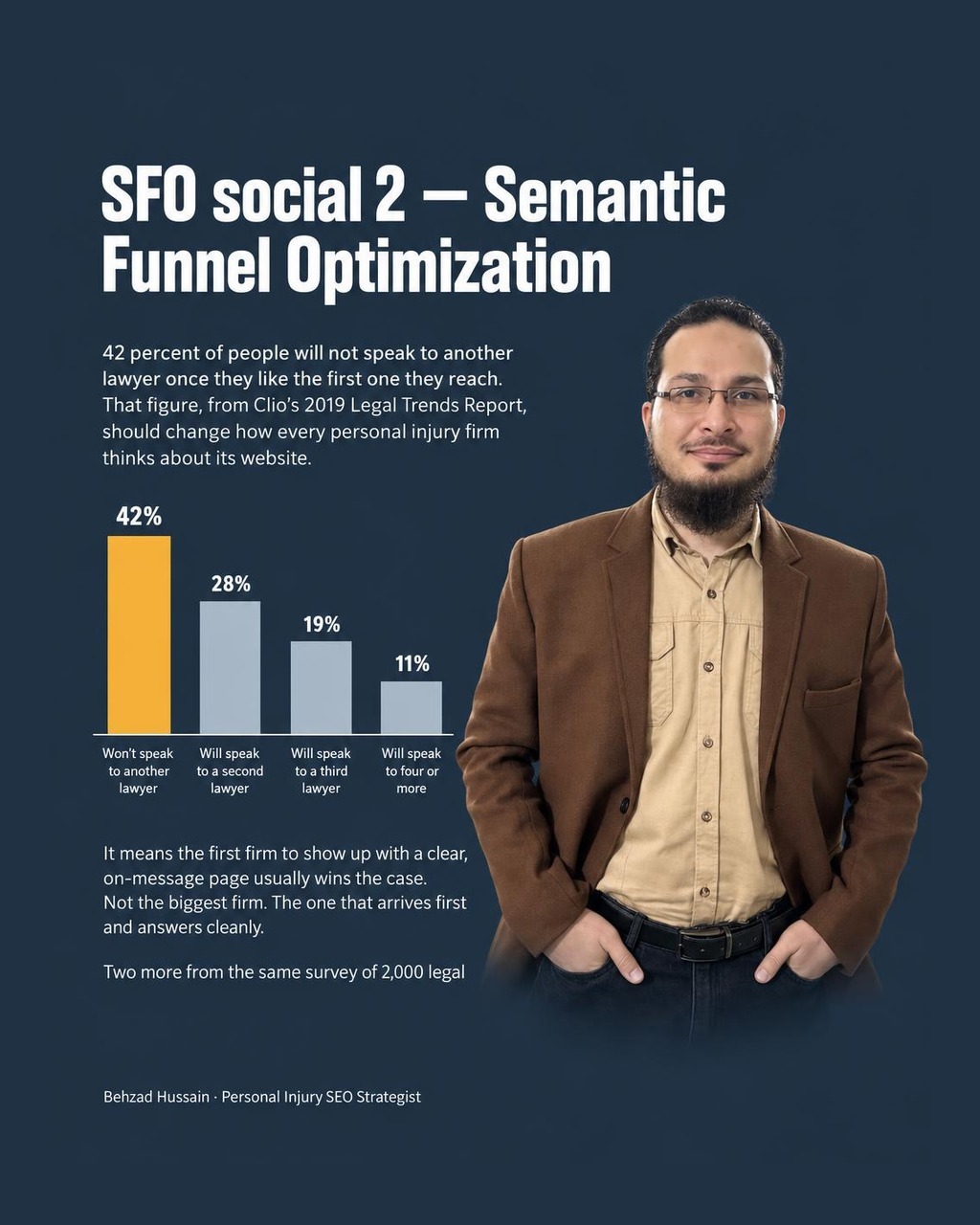
SFO social 1 — Semantic Funnel Optimization
About the Author
Behzad Hussain — Personal Injury SEO Strategist
Behzad Hussain is a Personal Injury SEO Strategist, independent researcher, founder and CEO of Rank Brilliance, and creator of the Personal Injury Organic Authority Engine. He helps competitive personal injury law firms build organic case acquisition systems through technical SEO, Semantic SEO, structured data, topical authority, and entity reinforcement.