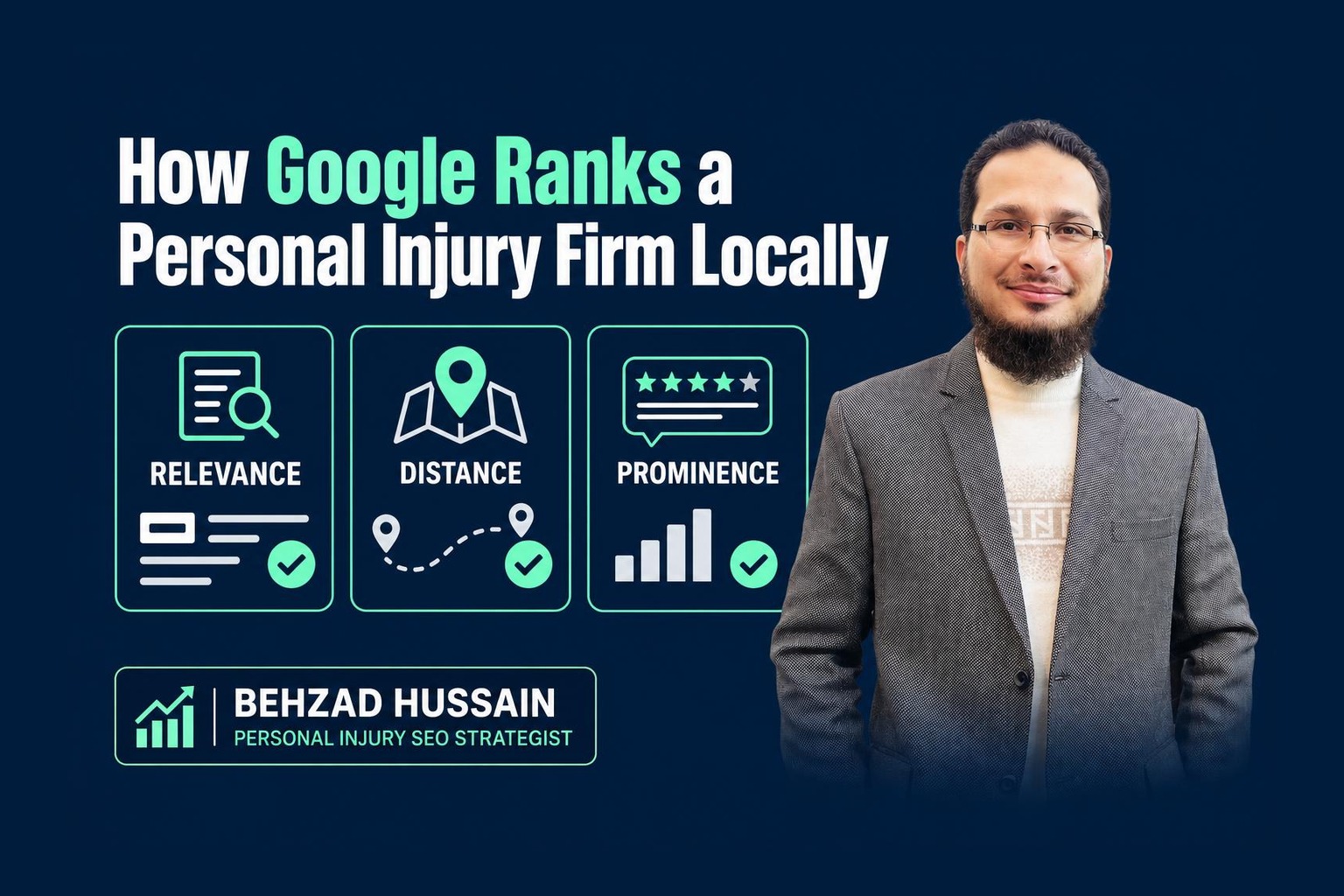
How Google Ranks a Personal Injury Firm Locally: Relevance, Distance, Prominence, and the Two You Can Actually Control
Google decides local results for personal injury searches on three factors it names plainly in its own documentation: relevance, distance, and prominence. A firm controls two of them completely, influences the third heavily, and most firms lose on exactly the two they control, then blame the one they cannot. This piece walks the mechanism, and what my audit of 1,005 firms says about where the losses actually happen.
The three factors, in plain language
Relevance is whether Google can tell your firm matches what the injured person typed. Not whether you do the work. Whether the machine can tell. A firm that handles truck accidents but never says so in machine-readable form is, for ranking purposes, a firm that does not handle truck accidents.
Distance is where the searcher is standing. You cannot move them. What you can do is stop pretending one office covers a metro with clone pages, and build honest coverage for the markets you actually serve.
Prominence is how notable your firm looks across the wider web: reviews, mentions, coverage, authority. This is the factor with a paper trail. Google’s patent on scoring local results by location prominence, US 8046371, lists the inputs: authoritative documents about the business, the number of pages referring to it, reviews, mentions. Your map ranking is partly decided by pages you do not own.
Where 1,005 firms actually lose: relevance
Here is what surprised me most in a year of measuring this industry.
I audited the Google Business Profiles of 1,005 page-one personal injury firms, nine attributes each. The single most damaged attribute was the most basic one: 43 percent sat under the wrong primary category.
The primary category is the strongest relevance statement a profile makes. It is the field that tells Google what you are. Nearly half of page-one firms misdeclare it, then pay agencies to out-rank competitors who declared it correctly. You cannot out-optimize telling Google you are the wrong kind of business. And the fix takes two minutes.
The second relevance loss lives on the website: in my companion audit, only 35.3 percent of the same firms declared themselves a legal service in structured data. The profile and the site are supposed to corroborate each other. For most firms, one of the two witnesses never showed up.
The completeness myth
The same nine-attribute audit produced a finding that upends most local SEO advice sold to law firms: profile completeness had almost no relationship with rank.
95.9 percent of firms have a profile. Mean completeness was 7.05 out of 9. Everyone fills in the fields, which is exactly why filling in the fields differentiates nobody. Completeness is hygiene. The measurable losses were concentrated in category accuracy and in the consistency between profile and site, the things almost nobody checks because no dashboard flags them.
If an agency has ever presented your profile completeness score as an achievement, you now know the right response: ask about the category, and ask what the site corroborates.
Prominence: the slow factor everyone wants fast
Prominence compounds, which makes it the factor firms most want to shortcut and the one that punishes shortcuts hardest.
The patent record is useful here because it kills the mystique. Prominence inputs are countable things: reviews arriving steadily rather than in suspicious bursts, real mentions from sources that themselves have standing, pages across the web that refer to your firm consistently. In a regulated vertical, the shortcut versions of these, purchased reviews and rented links, are not just ranking risks. Your bar’s advertising rules do not stop applying because a vendor suggested the tactic.
The honest prominence playbook is unglamorous: earn a steady review cadence from real clients, be mentioned by real local and legal sources, and make sure every mention agrees on your name, address, and what you handle. Google patented corroborating facts across sources over a decade ago, US 8682913. Agreement across the web is the trust signal. Contradiction is the tax.
Distance, and the clone-page trap
You cannot optimize where the searcher stands, but you can stop hurting yourself in the markets you serve. The pattern I find constantly: one office, six near-identical city pages, all competing for the same queries, all telling Google the firm is pretending to be somewhere it is not.
One honest page per genuinely served market, each with real local substance, beats a fleet of clones every time. Where firms actually have multiple offices, each needs its own complete identity: profile, address, category, page, all corroborating.
Do service-area firms without a public office play by the same rules? Broadly yes, with one honest adjustment: distance weighs against you harder when there is no verified address in the market, which makes the two controllable factors matter even more. A service-area practice wins by being unambiguous about relevance, declaring exactly what it handles and where it genuinely serves, and by building prominence signals strong enough to overcome the geography it cannot fake. What it must never do is manufacture addresses, which trades a ranking handicap for a suspension risk and, once caught, poisons the corroboration record that everything else depends on.
The order of operations
If your firm’s local visibility disappoints, run the diagnosis in this order.
First, the category. Two minutes. Nearly half your page-one competitors got it wrong, which means checking it is the cheapest advantage available in your market.
Second, the site’s identity layer. Does your website say, in machine-readable form, what you are and where? Two thirds of winners do not.
Third, consistency. Profile, site, directories: one story, everywhere.
Fourth, prominence, patiently. Reviews at a steady cadence, mentions earned from real sources, and time. The compounding factor rewards the firm that starts now and keeps going.
The full playbook, sequenced for competitive metros, is in my free local SEO guide: behzadhussain.me. The nine-attribute study behind the numbers is free on my research page: behzadhussain.me.
The map pack is not a mystery. It is three named factors, a paper trail of patents, and a market where nearly half the winners misdeclare what they are. Fix the two factors you control and the third one starts working for you.
About the Author
Behzad Hussain — Personal Injury SEO Strategist
Behzad Hussain is a Personal Injury SEO Strategist, independent researcher, founder and CEO of Rank Brilliance, and creator of the Personal Injury Organic Authority Engine. He helps competitive personal injury law firms build organic case acquisition systems through technical SEO, Semantic SEO, structured data, topical authority, and entity reinforcement.