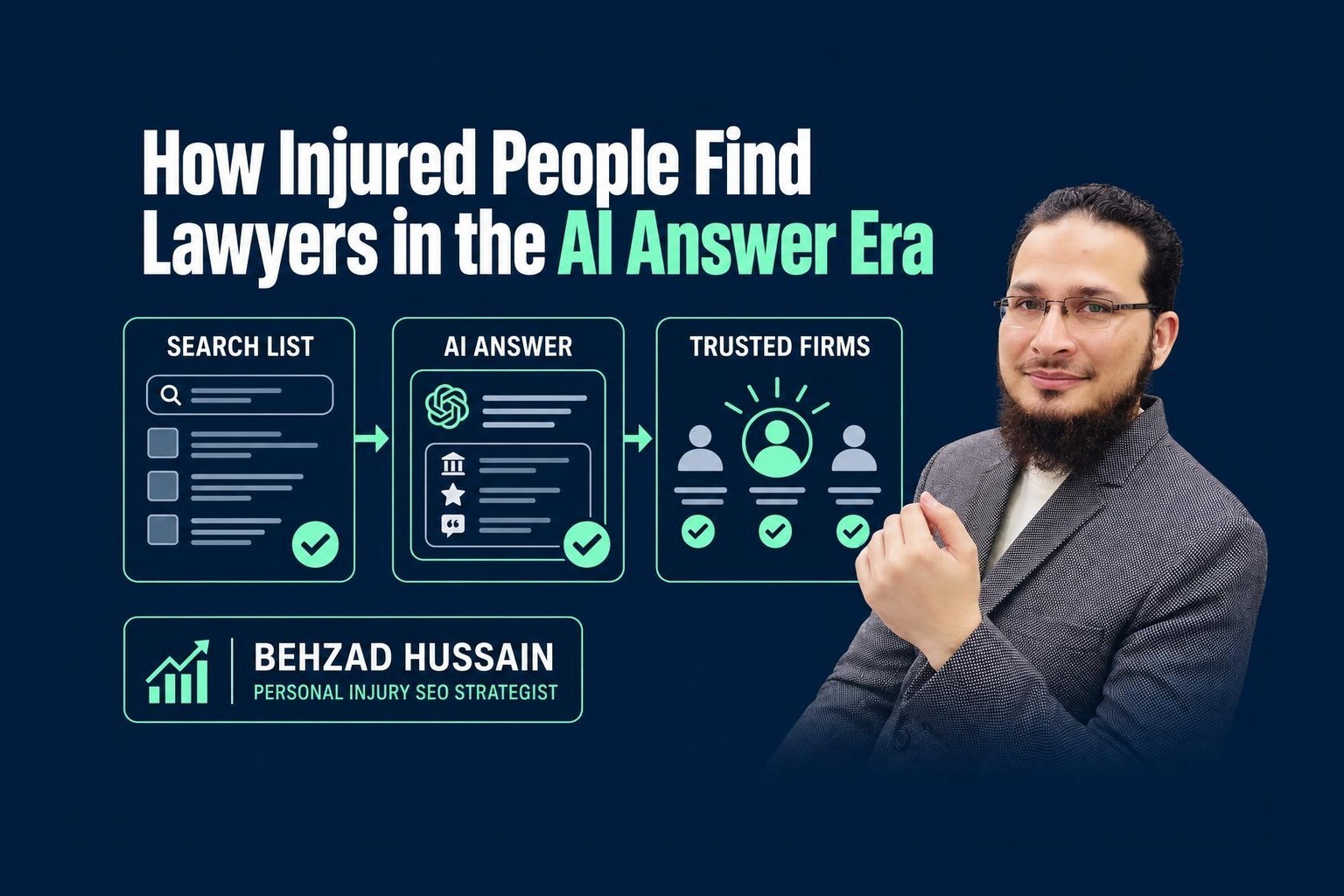
How Injured People Find Lawyers in the AI Answer Era, and What Decides Which Firms Get Named
The search result used to be a list, and the injured person used to do the comparing. Increasingly, the result is an answer: a short written response with a small number of firms and sources woven in, assembled by a machine before the person ever sees a blue link. Which firms get woven in is not random, not purchased, and not decided by the marketing budget. It is decided by verifiability, and my data says almost nobody in personal injury is competing for it yet.
The shift, without the hype numbers
I will not quote adoption percentages here, because the ones circulating are vendor folklore I cannot verify. The shift itself does not need them. Open any AI assistant and ask the questions injured people ask: is this worth a lawyer, what is my case worth, how long do I have, who handles truck accidents in my city. You get answers, with names in them. That interface exists, it is where the low-judgement first questions increasingly go, and the firms named in it meet the client before any list of links does.
Two things make this matter more in personal injury than almost anywhere else. The client typically hires once, in distress, with no prior relationship: whoever is trusted first holds an enormous advantage. And the questions asked earliest are the embarrassing ones people prefer asking a machine: am I overreacting, is this my fault, will I owe money if I lose. The firm whose content answers those honestly becomes a trusted name before a single human conversation happens.
What the machines actually cite on PI queries
Here is the firsthand number. In my 2026 SERP Authority Report, built on an 11-question structural audit of 1,005 page-one personal injury firm websites, I examined what AI search features cite on personal injury queries.
Only 11.1 percent of those citations were on-topic pages.
Sit with that. When the answer layer assembles a response about injury law, roughly nine of every ten sources it leans on are not even about the subject. Not competitor firms out-competing you. Off-topic pages, filling a vacuum, because the firms that should own those citations built nothing citable.
The same report found 663 of the 1,005 firms structurally absent altogether: no meaningful machine-readable identity at all. The answer layer is not biased against law firms. It is starving for law firms it can safely name.
How an answer engine decides whom to trust
The mechanics are older than the chat interfaces, and documented.
Google patented corroborating facts extracted from multiple sources, US 8682913, over a decade ago: a machine checks what the web agrees about you before trusting any single claim. It patented the knowledge panel template, US 9268820, the structured card that marks an entity the system has resolved with confidence. The AI answers inherited this plumbing wholesale. They name entities they can verify and skip entities they cannot, no matter how good the verdicts behind the website are.
So the question deciding your firm’s presence in the answer layer is concrete: is your firm a resolved, consistent, corroborated entity? Does your site declare what you are in machine-readable form, do your profiles agree, do trusted sources repeat it? In my audits, the answer for most of the market is no. Only 35.3 percent of page-one firms even declare themselves a legal service in structured data.
What gets a firm named, in practice
From my published ChatGPT guide, the work reduces to four disciplines, none of them tricks.
Be machine-readable. The firm, the attorneys, the offices, the case types, declared in structured data that validates, connected as one graph rather than fragments.
Be consistent everywhere. Site, profile, directories, bios: one story. Every contradiction is a small withdrawal from the confidence a machine needs before naming you.
Be the most complete answer on something. Answer engines quote sources that resolve questions. A thin practice page with a paragraph and a phone number gives the machine nothing to use. One case type covered completely beats ten covered an inch deep, and it is where smaller firms genuinely beat giants, because depth is a decision, not a budget.
Be fast and reachable. Slow, heavy pages get crawled less and cited less, and the person the answer sends must land on a page that works on a phone in a parking lot.
What should a firm actually do this quarter? Start with an audit you can run tonight: ask the major assistants the questions your clients ask, best firm for your case type in your city, whether your firm is any good, what a case like yours is worth locally. Record which firms get named and which sources get leaned on. That transcript is your real competitive map, and it is usually a shock. Then work the record those answers corroborate: your declared identity, your consistency across profiles, and one case type covered completely enough to be quotable. The machines can only repeat what the record supports. Change the record and the answers follow.
The strategic read for a firm owner
Three honest conclusions from the data.
The old work still counts. The same clarity, structure, and depth that win the answer layer also win the ranked list. This is not a new discipline replacing SEO. It is the same foundation with a second, currently empty, payoff channel attached.
The window is real but not permanent. An 88.9 percent off-topic citation rate is a vacuum, and vacuums fill. The early firms into the answer layer of each market will be disproportionately hard to displace, because the machines keep corroborating whatever record already exists.
And the first mover in your metro probably is not who you fear. It is not the firm with the biggest TV budget. It is whichever firm finishes the boring structural work first. In two studies covering 1,505 sites, nobody has. The seat is open.
My full guide on how ChatGPT finds, reads, and cites personal injury firms is free, no email wall: behzadhussain.me. The SERP Authority Report behind the 11.1 percent finding is on my research page: behzadhussain.me.
The answer moved. The evidence says the seats inside it are still, remarkably, unclaimed.
About the Author
Behzad Hussain — Personal Injury SEO Strategist
Behzad Hussain is a Personal Injury SEO Strategist, independent researcher, founder and CEO of Rank Brilliance, and creator of the Personal Injury Organic Authority Engine. He helps competitive personal injury law firms build organic case acquisition systems through technical SEO, Semantic SEO, structured data, topical authority, and entity reinforcement.