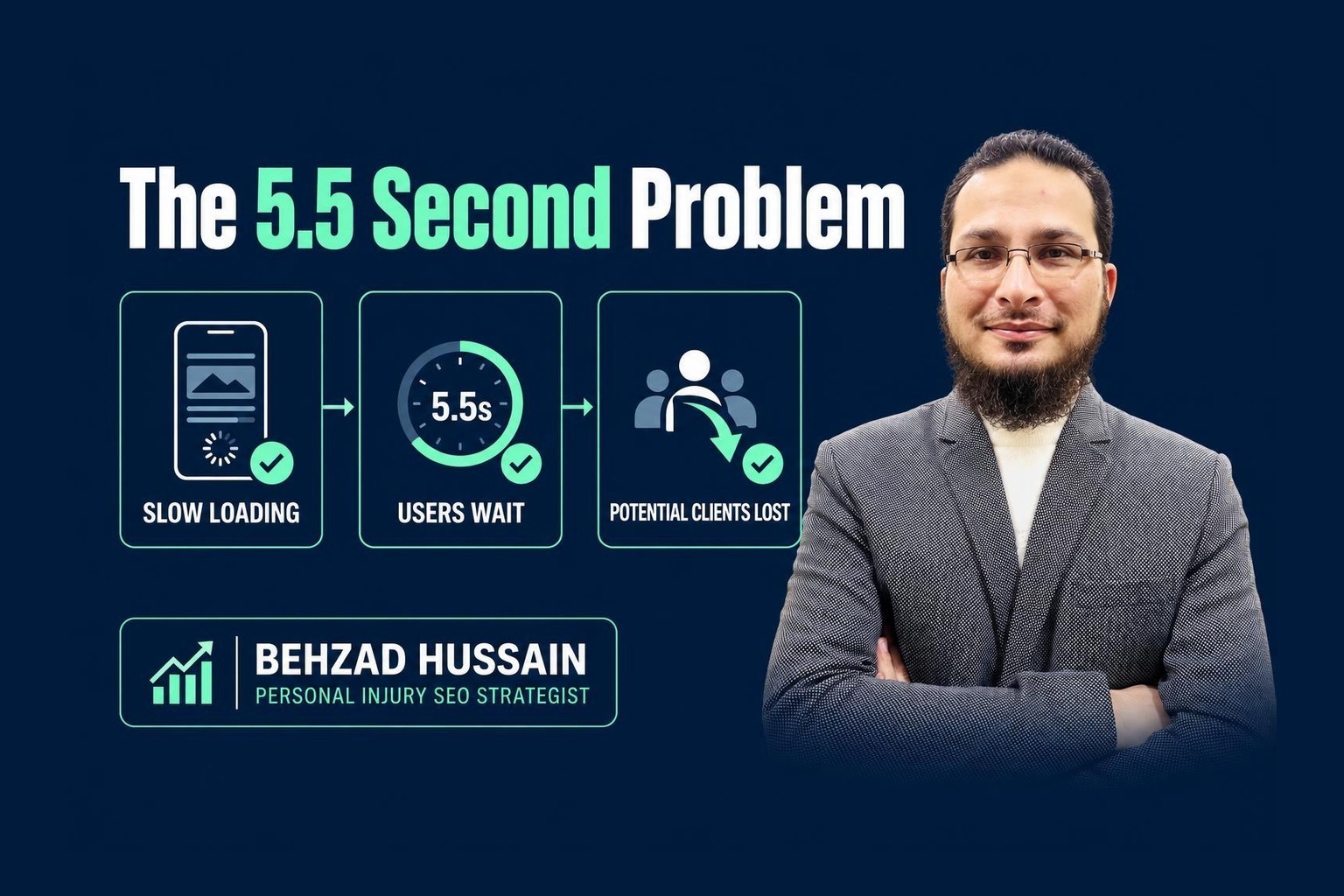
The 5.5 Second Problem: What Site Speed Actually Costs a Personal Injury Firm at the Moment of Panic Search
The median personal injury firm website on Google page one takes 5.5 seconds to render its main content on mobile. I measured it across 1,005 winning sites in my 2026 SERP Authority Report, and it is the single most expensive number in the dataset, because of when those seconds happen: at the exact moment an injured person, in pain and in a parking lot, decides who to trust. This piece is about what those seconds cost, why winners tolerate them, and the honest fix.
The moment the seconds happen
Speed conversations in marketing meetings are abstract. The moment itself is not.
Someone has just been hurt. They are on a phone, on cellular data, often one-handed, often frightened. They type the query, tap a result, and stare at a white screen while a hero video, three tracking scripts, and an oversized photo of a courthouse negotiate with a weak signal.
They do not file a complaint about your load time. They just leave, tap the next result, and become someone else’s client. The firm never knows it happened. That invisibility is what makes speed the most underpriced problem in legal marketing: every other failure at least generates a signal. This one generates silence.
What the seconds cost, priced honestly
Two ways to price a bounce at the panic moment.
If the click was paid: commercial PI clicks run $100 to $300. A page that loses even a modest fraction of its visitors to latency is burning three-figure bills silently, all day, at precisely the highest-intent moment the firm ever buys.
If the click was organic: the cost is larger and slower. The visitor who left was the compounding return on months of content and authority work, spent at the last step. Slow destinations quietly tax every marketing channel the firm runs, paid and earned alike.
And there is a third cost most owners never hear about: machines price speed before users do. Google holds a patent on predicting site quality from features of the site itself, before any interaction data exists, US 9767157. A heavy, slow, template-bloated site starts at a lower predicted floor, which can suppress crawling and indexation of new pages. You can publish excellent content into a site the algorithm has already pre-judged, and wonder why nothing moves.
Why winners are slow
The strangest part of the 5.5 second finding is the cohort: these are page-one firms. They rank despite the latency, carried by everything else, which teaches three uncomfortable lessons.
Ranking hides rot. Position is not proof of health; it is proof of a weak field. The median winner fails the first impression it paid to earn.
Nobody owns the number. Speed lives between vendors: the designer who chose the theme is gone, the agency optimizes content, the developer bills hourly for tickets nobody files. Every firm in the dataset has a dashboard, and none of the dashboards ring a bell at 5.5 seconds.
Design incentives point the wrong way. Sites are approved in conference rooms on fast wifi and large screens, by people who already know the firm. The approval environment is the opposite of the use environment. What demos well in the boardroom is often exactly what stalls in the parking lot.
The honest fix, without a rebuild
The reflex is to commission a redesign. Usually unnecessary. The bulk of PI site latency comes from a short list of removable weights.
Oversized images shipped at camera resolution. Hero videos autoplaying above the fold. Third-party scripts stacked over years: chat widgets, call trackers, heat maps, pixels for campaigns that ended. Cheap shared hosting under a heavy theme. Render-blocking scripts loaded before content.
An engineering pass on that list, measured on a mid-range phone over cellular, routinely transforms a site while changing nothing a partner would notice in the boardroom. The target I use comes from my own Scorecard’s technical pillar: main content readable in under 1.5 seconds on a mid-range mobile device. Ambitious against a 5.5 second median, and entirely achievable, which is the point.
Measure it honestly: your phone, cellular data, not office wifi, counting until you could actually read and tap. Do it for the homepage and the top three practice pages, because the panic search rarely lands on the homepage at all. Then make one person own that number the way someone owns the trust account, reviewed monthly, in writing. Owned numbers move. Orphaned numbers drift to 5.5.
Speed as strategy, not hygiene
Here is the strategic reframe the median makes possible: in a market where the typical winner fails the first impression, speed is not maintenance. It is differentiation.
The firm that renders instantly at the panic moment is making an argument no billboard can make: we are ready, we are competent, we respect your situation. The client cannot articulate why one site felt trustworthy and the other felt broken. The seconds decided before the words got a chance.
And because the whole cohort is slow, the advantage is available to whoever claims it first, like most of what my audits find. The structural seat, the citation vacuum, the category errors, the 5.5 seconds: the same empty-seat pattern, all the way down.
One extension of the argument, because the render is not actually the finish line: the panic search ends with a human, not a page. A site that loads in 1.5 seconds and routes to an intake process that answers on the fourth ring has moved the latency, not removed it. The firms that convert the moment treat the whole path as one number, tap to trusted human, and engineer every segment of it. Speed of page earns the chance. Speed of response signs the case.
The full report behind the number, including all 11 structural questions and where the 1,005 firms failed them, is free on my research page: behzadhussain.me. The technical guide, for whoever owns the fix at your firm, is at behzadhussain.me
Five and a half seconds is the sound of the market not trying. Under 1.5 is the sound of a firm that decided to.
About the Author
Behzad Hussain — Personal Injury SEO Strategist
Behzad Hussain is a Personal Injury SEO Strategist, independent researcher, founder and CEO of Rank Brilliance, and creator of the Personal Injury Organic Authority Engine. He helps competitive personal injury law firms build organic case acquisition systems through technical SEO, Semantic SEO, structured data, topical authority, and entity reinforcement.