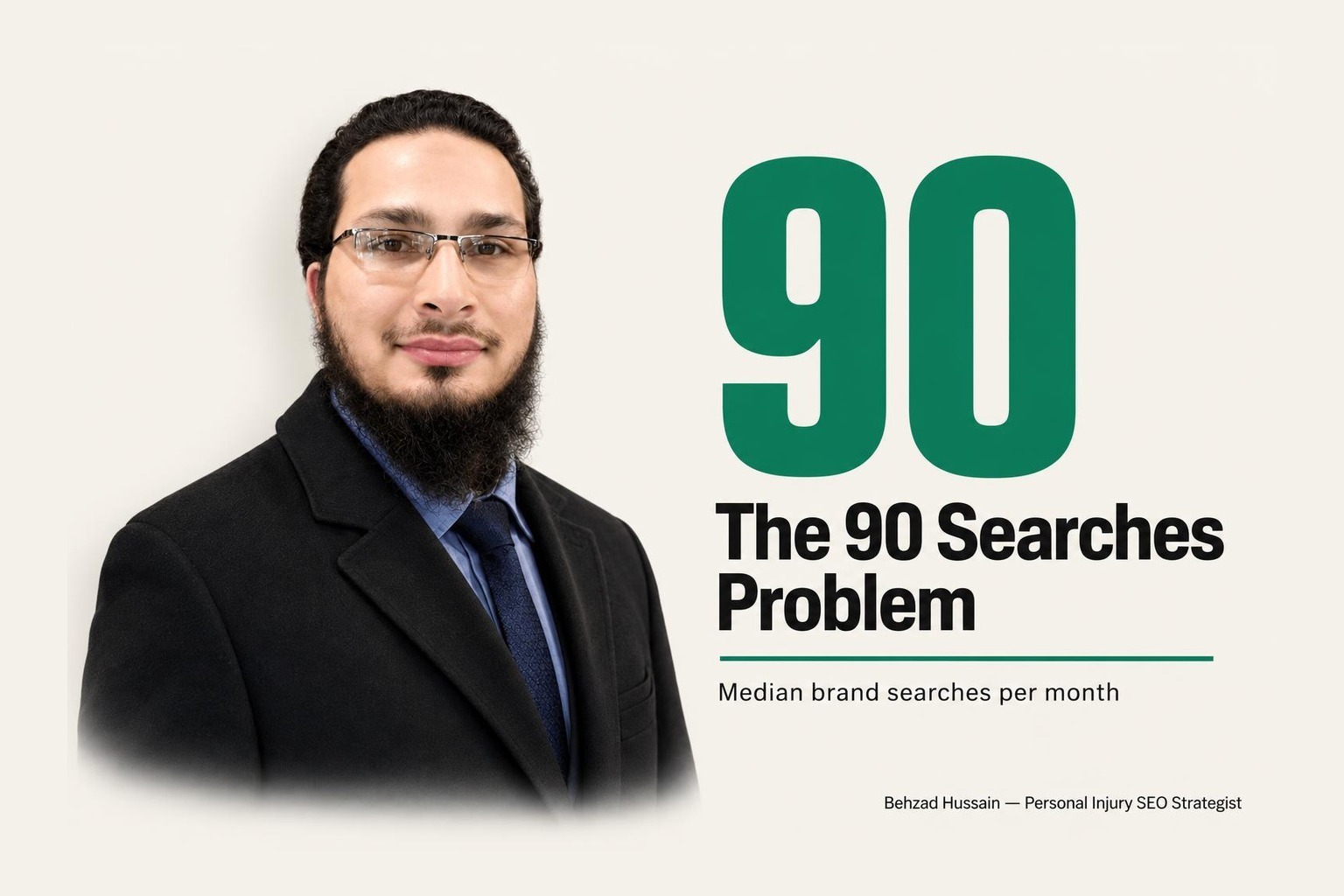
The 90 Searches Problem: What Brand Demand Data From 1,000 PI Firms Says About Being Findable but Unknown
The median personal injury firm on Google page one earns about 90 brand searches a month: ninety people typing the firm’s actual name. Half the winners of the most expensive vertical in search are, by that measure, names almost nobody looks for on purpose. That finding, from my study of 1,000 US PI firms, reframes what most firms should mean by the word marketing, and this piece walks the data and the playbook it supports.
The distribution: visible is not the same as sought
The numbers first, because the distribution is the story.
Median firm brand demand: roughly 90 US searches a month. The 75th percentile: 320. The 90th percentile: 1,000. The mean, dragged skyward by giants: over 2,000, with the largest name in the dataset earning hundreds of thousands of monthly name searches. And the median individual attorney: 20 searches a month.
Sit with the shape of that. The top decile lives in a different reality from the median, and the median winner, a firm that already ranks on page one, starts every client relationship from zero prior awareness. The client found them the way you find a gas station: by proximity and availability, not by reputation. Every case signed that way begins with the trust meter at empty, which is the most expensive place to begin in a profession sold on trust.
What brand demand is actually worth
The study’s correlation matrix puts brand demand in context rather than on a pedestal, and the context is the useful part.
Site authority tracks organic traffic at 0.82, the strongest relationship in the matrix. Backlinks track at 0.63. Firm brand demand tracks at 0.41. In the full regression, each added authority point associated with about 15.7 percent more organic traffic, while doubling brand demand associated with roughly 4.5 percent more, everything else held equal.
Two honest readings follow, and I publish both because the caveats are where the credibility lives. First: authority remains the dominant lever, which is why the structural work stays first in every sequence I run. Second: brand demand is not a rank hack, and my data gives no license to claim it improves your page-one position. What it is, is the flywheel term: demand for your name produces traffic that arrives regardless of that week’s rankings, feeds the entity record machines corroborate, and compounds independent of the auction.
The asymmetry nobody expected: people amplify, listings do not
The study’s strangest finding is the one with the clearest strategic consequence.
When brand demand interacts with a person knowledge panel, an attorney resolved by Google as a recognized individual, the relationship with traffic amplifies measurably: a positive interaction of 0.179, statistically significant. The same brand demand interacting with a business-only panel shows no amplification at all, trending mildly negative. And segmenting the cohort, the firms whose presence is person-led converted brand attention into traffic along the steepest slope in the dataset, 0.68.
Plainly: the machines pay out attention on people more readily than on listings. A firm whose founding attorney exists as a resolved, corroborated person gets more from every unit of name recognition than a firm that built the same recognition around a logo. The market, meanwhile, spends overwhelmingly on the logo; in my companion audit, only 20.6 percent of 1,005 page-one firms even declared an attorney as a person in machine-readable form.
Building the 90 into 900, honestly
Brand demand is buildable, but the build looks nothing like a campaign, and I will not pretend otherwise. From the data and from years inside this vertical, the inputs that move name search are unglamorous and compounding.
Publish under names, not just a brand. Research, guides, and answers signed by real attorneys give people and machines a person to remember and corroborate. The asymmetry finding says the same effort routed through a person pays a steeper slope.
Be the source for something specific. Nobody searches for a generalist. Name recognition accrues to the firm known for the case type, the courtroom result, the data, the stand. This is topical authority wearing its public face.
Show up where your market already looks, consistently, in your own voice. The mechanism this whole essay serves is recognition converting into deliberate search. Recognition is manufactured by repeated, useful, attributable presence, and by nothing else that lasts.
And measure it. The number is one free report away in any search console, yet almost no firm tracks its own name demand month over month. What gets measured gets built; the 90-search median exists partly because nobody is looking at the gauge.
How do you actually measure your own name demand? Three gauges, all free. Your search console shows the queries containing your firm and attorney names, month over month; that trend line is the flywheel’s speedometer. Keyword tools report the search volume on your exact name the same way they report any phrase. And autocomplete is the qualitative check: type the firm name slowly and note what Google suggests alongside it, because those suggestions are what the market associates with you. Track firm and attorney names separately, since my data says they behave differently and the attorney line is the one with the amplification attached. Ten minutes a month, one spreadsheet row, and the invisible asset becomes a managed number. The firms that watch the gauge are also, not coincidentally, the ones that notice when a reputation event or a published study moves it, which is how the build plan learns what actually works.
What this does not say
Three guardrails, because data earns trust by admitting its edges. This is cross-sectional research: it maps association, not guaranteed causation. It does not say brand demand ranks you higher; the study found total brand demand essentially flat across page-one positions. And it does not make Google Business Profiles optional; profiles serve the local pack and the corroboration record even where they do not amplify click volume.
What it does say is enough: the median winner is unknown, authority remains king, and the person-led firms convert attention into traffic at the steepest rate measured. Those three facts, held together, are a strategy.
The gauge worth watching
If your firm tracks one new number this quarter, make it your own name’s monthly search demand, alongside the attorney names on the door. Put it on the same dashboard as caseload and revenue, reviewed at the same meeting, because a number that never enters the room never gets built. The firms in my dataset with real name demand did not get it by accident; somewhere, someone treated recognition as a line item. Then ask the only question the distribution leaves open: what would have to be true, published, and repeated for that number to double, and who at the firm owns making it true?
The full study, distributions, matrix, and regression tables included, is free on my research page: behzadhussain.me. The person-entity companion study is there too: behzadhussain.me
Ninety searches a month is what the middle of this market settles for. The firms that treat their own name as an asset with a gauge, a build plan, and an owner will not stay at the median long, and the machines are already built to pay them for the climb.
About the Author
Behzad Hussain — Personal Injury SEO Strategist
Behzad Hussain is a Personal Injury SEO Strategist, independent researcher, founder and CEO of Rank Brilliance, and creator of the Personal Injury Organic Authority Engine. He helps competitive personal injury law firms build organic case acquisition systems through technical SEO, Semantic SEO, structured data, topical authority, and entity reinforcement.