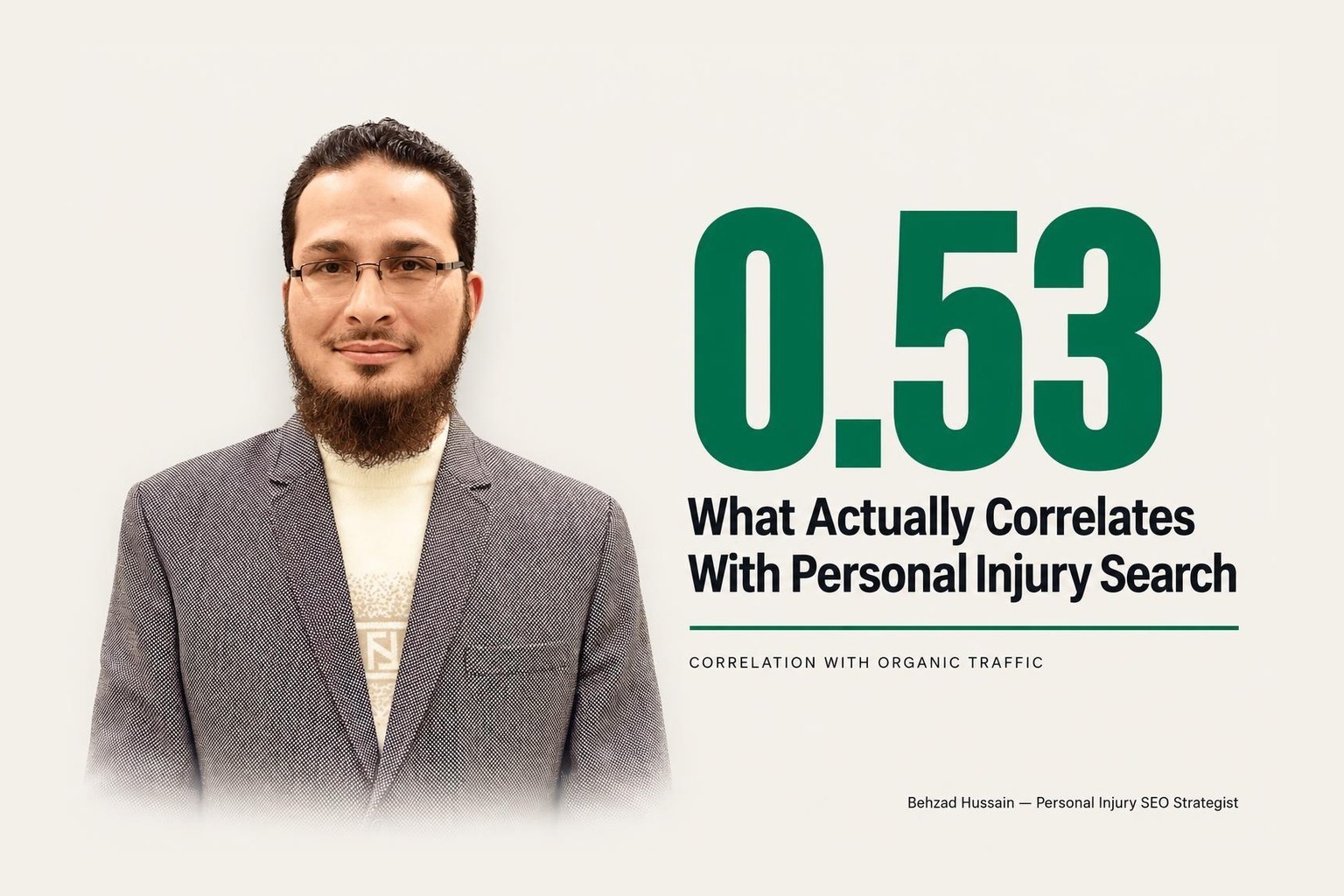
What Actually Correlates With Personal Injury Search Visibility: The Order of Operations, Measured Across 1,005 Firms
Across 1,005 page-one personal injury websites, the structural pillar that correlates most strongly with organic traffic is the least glamorous one: technical foundations, at 0.53. Intent coverage follows at 0.40, authority signals at 0.20, and the conversion layer at 0.14, with the total structural score tracking traffic at 0.55. Four numbers, one descending staircase, and a spending map that inverts how this market actually buys. This piece walks the measurements, the honest limits of what correlation proves, and the order of operations the data keeps insisting on.
The measurement, briefly
My 2026 report scored 1,005 page-one PI firm websites against eleven structural questions grouped into four pillars: whether machines can crawl, render, and trust the site; whether pages capture the queries claimants actually type; whether the firm and its attorneys exist as verifiable authorities; and whether visibility has a route to a signed case. Each firm’s pillar scores and total were then set against its organic visibility.
The correlations above are the paper’s canonical figures, computed on roughly 997 firms after exclusions, and they are published with the method so anyone can re-run the arithmetic rather than take my word for it. Alongside them sit two companions worth holding: the total structural score tracks domain authority at 0.55, and AI visibility at 0.19.
Reading the staircase honestly
First, the caveats, stated plainly because data that hides its limits is marketing. These are cross-sectional correlations: they establish association across a population at a moment, not guaranteed causation for any single firm. Correlation at 0.53 is strong for messy field data of this kind and would be unremarkable in a laboratory. And pillar scores are not fully independent; firms that finish foundations tend to be firms that finish other things.
Now the reading that survives all three caveats: the ordering. Foundations at 0.53 predict visibility more than twice as strongly as authority signals at 0.20, and nearly four times the conversion layer at 0.14. Every arrow points the same direction: the deeper the layer, the stronger its relationship with outcomes. Whatever the causal machinery underneath, a spending strategy that ignores a consistent ordering across a thousand firms is not skepticism. It is a bet against the only map anyone has bothered to draw.
The market spends in exactly the reverse order
Hold the staircase against how PI firms actually buy, and the inversion is almost comic.
The typical engagement sequence I audit runs: redesign first, because partners can see it. Content retainer second, because it produces artifacts. Link campaign third, because authority sounds like the point. And the crawl layer, the rendering path, the structural identity, the unglamorous 0.53, last or never, because no one in the conference room has ever watched a bot fail to read a page.
The data says build bottom-up; the market builds top-down, because the penthouse demos well and the foundation does not demo at all. This is also why the same market shows a mean structural score of 3.13 out of 11 with nobody above 7: top-down building produces decorated buildings on unpoured concrete, at scale, forever.
The dependency logic explains the correlations better than any mystery: a link campaign pointed at a site machines cannot reliably read is authority delivered to a closed door. Intent coverage on pages that render in five seconds is an answer the reader never sees. Later layers cannot outperform the layers they stand on, and the correlations fall in exactly the order the dependencies run.
Can a firm skip to the conversion layer, since that is where cases actually close? It is the tempting shortcut, and the dependency logic answers it: the 0.14 layer converts visitors the earlier layers deliver, so polishing it on a structurally invisible site is optimizing the checkout of an empty store. The order runs foundation first because every later investment is multiplied or nullified by what sits beneath it. That said, the conversion layer’s small coefficient does not make it optional; three in ten page-one firms present no clear ask at all, and for a firm whose foundations already stand, that is the cheapest fix on the board. Sequence is not a value ranking. It is plumbing.
The two companion numbers
The 0.55 with domain authority says the structural score is not measuring some private definition of quality; it moves with the metric the whole industry already respects, while being something a firm can actually act on question by question.
The 0.19 with AI visibility deserves the careful sentence: real, positive, and modest, exactly what an early, noisy answer layer should produce, especially one whose citations my same report found to be mostly off-topic. The strategic read is not that structure barely matters to AI. It is that the AI relationship is young, the seats are cheap, and by the time that coefficient matures to look like the Google one, the firms already structured will have been collecting the difference for years. Early-era correlations are where first movers get paid; mature ones are trivia.
One score, three surfaces, three strengths. There is no separate Google project, authority project, and AI project. There is one foundation with three payoff channels attached, at different stages of ripeness.
The order of operations, operationalized
Translated into a sequence a firm can actually run, the staircase reads:
First, foundations, the 0.53 layer: crawlability, rendering, speed on the devices claimants hold, and a machine-readable declaration of what the firm is. Days to weeks of engineering, not a redesign.
Second, intent coverage, the 0.40 layer: one case type at a time, every real question answered, one owner per query, until the topic is finished before the next begins.
Third, authority, the 0.20 layer: the attorneys as corroborated public records, earned mentions from sources with standing, consistency across every surface that speaks about the firm.
Fourth, conversion, the 0.14 layer: the clear ask, the form for those who cannot call, the intake that answers in minutes. Smallest coefficient, and still the layer where three in ten page-one firms fail outright, which is why it stays in the framework at all.
Then hold the sequence against decay, quarterly, owned by a named person, because structures drift and the staircase only pays firms still standing on it. The maintenance hour is cheap; rebuilding a slid foundation two years late never is, and the market is full of firms paying that second price without knowing which purchase caused it.
This dependency order is not a preference of mine; it is the shape of the data, and it is baked into both instruments I offer. The free PI Authority Scorecard scores all four pillars in 90 seconds and names your weakest: behzadhussain.me. The PI SEO Diagnostic delivers the full sequenced roadmap, $4,500 fixed, refundable until it is clear: behzadhussain.me. And the complete report, methods and all, is free to check my work: behzadhussain.me
One last measurement habit makes all of this operational: re-measure after every fix, against the same eleven questions, so the sequence stays honest. Firms that fix without re-measuring drift back into buying by instinct within two quarters, and instinct in this market reliably points at the penthouse.
A thousand and five firms, eleven questions, one descending staircase. The market will keep buying it upside down, which is precisely the opportunity for the firms that read the numbers right side up.
About the Author
Behzad Hussain — Personal Injury SEO Strategist
Behzad Hussain is a Personal Injury SEO Strategist, independent researcher, founder and CEO of Rank Brilliance, and creator of the Personal Injury Organic Authority Engine. He helps competitive personal injury law firms build organic case acquisition systems through technical SEO, Semantic SEO, structured data, topical authority, and entity reinforcement.