Why My Prices Are Public: The Pricing Philosophy Behind Fixed Fees, No Discounts, and a Refund Term I Advertise
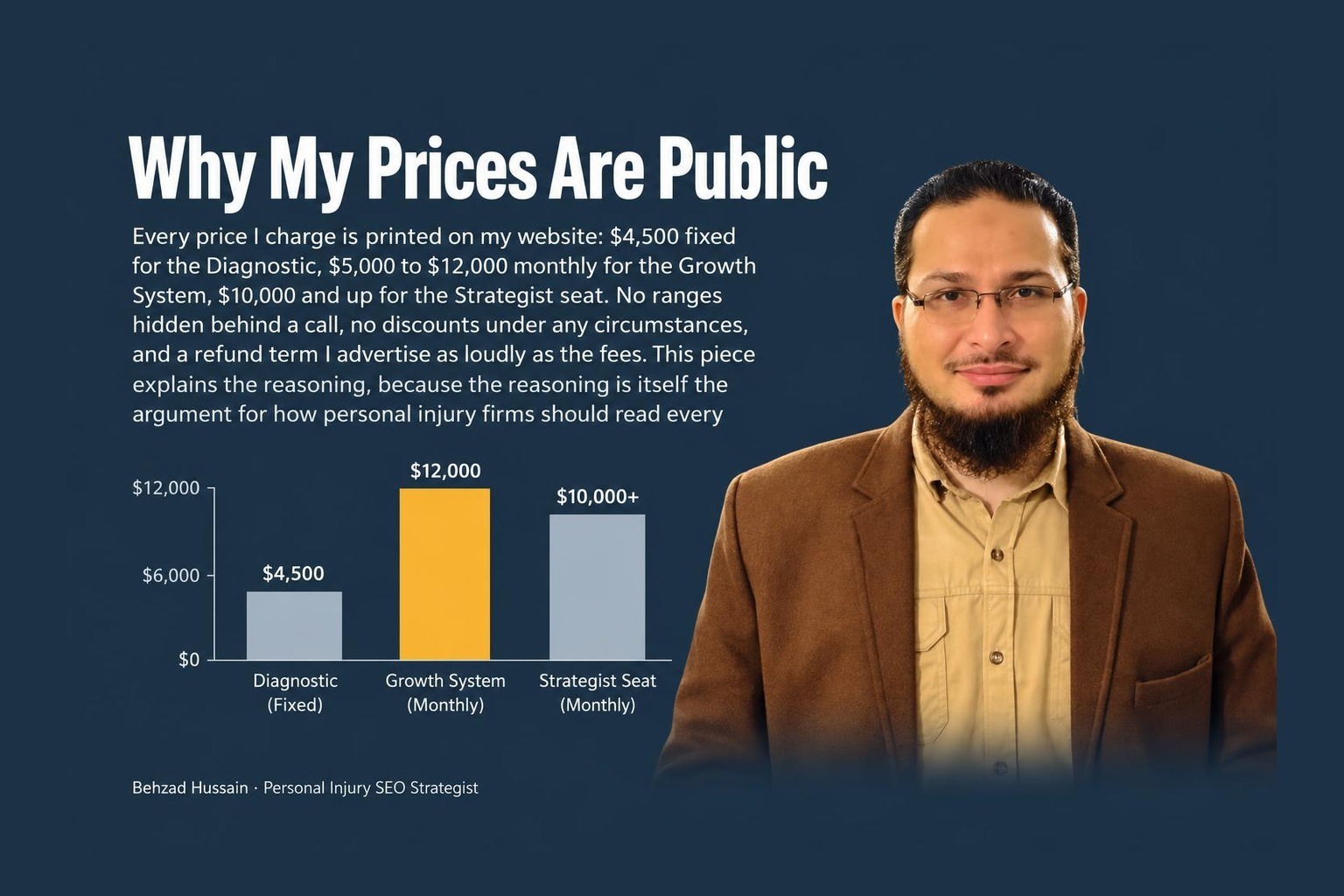
Every price I charge is printed on my website: $4,500 fixed for the Diagnostic, $5,000 to $12,000 monthly for the Growth System, $10,000 and up for the Strategist seat. No ranges hidden behind a call, no discounts under any circumstances, and a refund term I advertise as loudly as the fees. This piece explains the reasoning, because the reasoning is itself the argument for how personal injury firms should read every vendor who prices differently.
The problem pricing has to solve in this market
Search marketing is what economists call a credence good: the buyer cannot fully evaluate it before purchase, and often not even after. A PI firm owner cannot inspect an SEO engagement the way they would inspect a building. They decide almost entirely on proxies, and they decide as professional skeptics, because most of them have been burned by an agency at least once.
In that environment, price is not just what you pay. Price is information. It is one of the few signals the buyer can actually verify, compare, and reason about before committing. Which means how a vendor prices tells you how they plan to behave, before a single deliverable exists.
Hidden pricing says: the number depends on you, and we will discover together how much you can bear. Movable pricing says: the first number was an opening position. Percentage-of-spend pricing says: our income grows when your costs do. Every one of those structures is a forecast of the relationship.
Public and fixed: what it buys the buyer
Printing the numbers does quiet work in every direction, and none of it is generosity.
It ends the negotiation before it starts. Firms that hide prices are planning to negotiate; I am not negotiating, I am diagnosing, and a diagnosis costs what it costs regardless of how the patient feels about the estimate. The meeting can then be about the firm’s actual situation instead of a dance about numbers.
It arms the skeptical third party. Every real engagement decision at a law firm survives a hostile review: the partner who was not on the call, the spouse, the lawyer friend who knew someone who got burned. Public prices mean that reviewer finds no daylight between what was pitched and what is printed. Materials that survive cross-examination are the only materials worth producing for buyers who are professional cross-examiners.
It filters honestly. A firm shopping for the cheapest option discovers immediately that I am not it, before either of us spends an hour proving it. The fee floors are the positioning: they state, without adjectives, which end of the market the work serves.
No discounts, ever: a discount is a confession
The no-discount rule reads as stubbornness until you translate it. A discount tells the buyer the first price was fiction, and invites the obvious follow-up: what else was? A vendor who folds ten percent under mild pressure has disclosed their conviction, their margins, and how every future disagreement will be resolved.
Lawyers know this from their own fee conversations. The attorney who cuts their fee the moment a client hesitates has taught the client to hesitate. The professionals people actually trust decided their number before the meeting and let the work defend it.
There is also a fairness term the industry rarely says out loud: every discount granted to a hard negotiator is financed by the clients who paid the real number. A no-discount policy is a promise to every existing client that nobody is getting the same work cheaper for shouting.
The refund term: putting the risk where the information is
The Diagnostic is refundable until the roadmap is clear. I advertise that term next to the price because, for a credence good, an outcome commitment reassures the buyer in a way no report ever will.
Nobody controls Google, and any vendor implying otherwise is lying early. So the honest structure moves the risk to the party with the most information: me. If the diagnosis does not produce a roadmap the firm finds clear, the fee comes back. I can offer that plainly, and keep offering it, because the roadmap is always clear; structural problems have nameable causes and sequenced fixes. The term costs me nothing except the obligation to be as good as claimed, which is precisely the obligation a buyer should want priced in.
The same logic runs through the rest of the terms: the retainer is month to month after onboarding, the deliverables are owned outright by the firm, capacity is capped and published. Each surrendered term is one less thing a skeptic has to take on faith.
The cost of free, and the arithmetic of expensive
Two objections meet this philosophy, and both dissolve under this vertical’s own numbers.
The first: why pay for a diagnosis when free audits exist? Because a free audit is a sales document wearing a lab coat; it finds whatever the seller sells. The audit that costs money is the one with a single client in the room. The most expensive audit a firm ever runs is the free one that spent eighteen months pointing at the wrong problem.
The second: $4,500, or five figures monthly, sounds like real money until it meets the market it serves. This is an industry whose advertising arms race burns $2.5 billion a year, where firms pay $100 to $300 for single clicks, and where one signed case carries a fee that can exceed a year of any engagement I offer. Against the buyer’s own arithmetic, the pricing is not the bold part of the offer. The refund is.
Does publishing prices invite competitors to undercut? It is the objection I hear most from other consultants, and it misunderstands what the floors do. A competitor can undercut a number; they cannot undercut a position. The fee floors state which problems the work is built for, and the firms those floors filter out were never the market. Meanwhile the firms the floors attract have already accepted the premise before the first call, which is why the calls are short and the engagements clean. Underpricing me is trivially easy and changes nothing about the only contest that matters: who the skeptical buyer believes. In a credence market, the cheaper unverifiable promise loses to the dearer verifiable one, and publishing the number is part of what makes it verifiable.
How to read every vendor after this
Strip out my offers entirely and the piece still leaves a firm owner with a screen that works on anyone:
Where are the prices, and why would hiding them serve you? What happens when you push on the number, and what does the answer predict about every future dispute? Where does the risk sit, in a promise or in a structure? And what exactly do you keep if you stop paying?
Vendors are not obligated to price the way I do. But they are disclosing something either way, and buyers in a credence market survive on reading disclosures.
The engagements themselves, all prices printed, live here: behzadhussain.me and the Diagnostic, refund term included, here: behzadhussain.me
Price is information. Publish it, fix it, and back it, and the right buyers do the rest of the work themselves. That is not a sales technique. It is what having nothing to hide looks like as a business model.
About the Author
Behzad Hussain — Personal Injury SEO Strategist
Behzad Hussain is a Personal Injury SEO Strategist, independent researcher, founder and CEO of Rank Brilliance, and creator of the Personal Injury Organic Authority Engine. He helps competitive personal injury law firms build organic case acquisition systems through technical SEO, Semantic SEO, structured data, topical authority, and entity reinforcement.